General Horta Inta-A declares himself the leader of the transitional government in Guinea-Bissau after a military coup, but former President Goodluck Jonathan who was in the country to monitor the election insists that the military takeover was stage-managed by President Umaro Sissoco to truncate democracy
By Patrick Ogboru
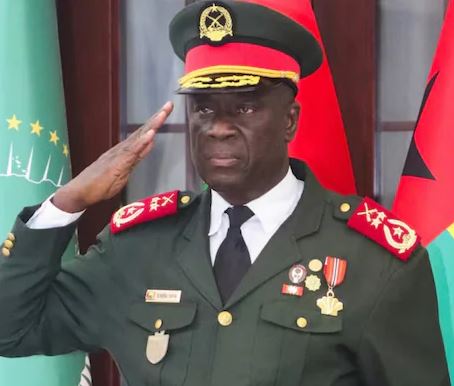
Guinea-Bissau General Horta Inta-A salutes an officer during the swearing-in ceremony as the transitional leader and Chief of the High Command in Bissau on Thursday, November 27, 2025. General Inta-A was sworn in as the transitional President of Guinea-Bissau, one day after army officers announced they had deposed the country’s President, Umaro Sissoco Embalo, staging the West African nation’s latest military coup.
“I have just been sworn in to lead the high command,” Inta-A declared, after taking the oath of office in a ceremony at the military’s headquarters on Thursday, November 27, 2025.
Having served until now as the Chief of Staff of the country’s army, Inta-A is considered to have been close in recent years with President Embalo, who was deposed on Wednesday, November 26.
He said evidence had been “sufficient to justify the operation”, adding that “necessary measures are urgent and important and require everyone’s participation”.
The African Union (AU) Commission chairperson on Thursday condemned the military coup and called for the immediate and unconditional release of Embalo and all detained officials, the AU said in a statement.
Military officers, referring to themselves as “the High Military Command for the Restoration of Order”, said in a televised statement on Wednesday that they had ousted Embalo, in the latest episode of turmoil in the coup-prone country.
It came one day before provisional results had been expected to be announced in the race between Embalo and Fernando Dias, a 47-year-old political newcomer who had emerged as Embalo’s top challenger to run the West African state, which is a hub for cocaine trafficking.
On Thursday, November 27, the capital, Bissau, was mostly quiet, with soldiers on the streets and many residents staying indoors even after the overnight curfew lifted.
On Wednesday, November 26, a day after two leading candidates in a tightly contested presidential election each declared victory, a group of military officers claimed “total control” of the country.
The takeover announcement on Wednesday came shortly after sustained gunfire was heard near the election commission’s headquarters, the presidential palace and the Ministry of the Interior in the capital.
Reacting to his deposition, Embalo said, “I have been deposed,” he later told French broadcaster France24 in a phone call on Wednesday, adding that he was “currently at the general staff headquarters”.
Former President Goodluck Jonathan has described the recent military takeover in Guinea Bissau as more painful to him than his loss to former President Muhammadu Buhari in the 2015 presidential election.
Jonathan, who spoke in a video interview, said the development was particularly troubling because of his long-standing involvement in restoring democracy to the West African country.
Jonathan had travelled to Guinea Bissau as part of the West African Elders Forum to monitor the presidential and parliamentary elections in that country.
But while observer missions from the African Union (AU), Economic Community of West African States (ECOWAS), and other bodies were still carrying out their duties, the military struck and seized power.
The military takeover left Jonathan and his team stranded and raised concerns over his safety.
He was later evacuated from Guinea Bissau and brought to Nigeria on Thursday, November 27. He said the incident unsettled him.
In his words, “What happened in Guinea Bissau is quite disturbing to me, a person who believes in democracy. In fact, I feel more pain than the day I called Buhari to congratulate him when I lost the election as a sitting president.
“I have been quite particular about Guinea Bissau. As a sitting president then, Guinea Bissau was in crisis. It started around 2012. In 2011, we had to go physically and work with them and made sure that the 2013 elections were conducted.”
He described the situation in Guinea Bissau as bizarre, arguing that it did not fit the usual pattern of a military coup.
Jonathan said President Embaló’s early announcement of his own “arrest,” while still using his phone to speak to international media, raised questions about the credibility of the claim.
Jonathan insisted that the latest election in Guinea Bissau was peaceful as he cited reports from ECOWAS, AU and other observer missions.
He expressed concern that while results were being collated, Embaló announced that a coup had taken place and that he had been detained, even though evidence suggested he was never arrested.
“It is painful for me that President Embaló was the one announcing a military takeover of government. It is totally unacceptable.
“What happened in Guinea Bissau, I would not call it a coup; it was not a coup. For lack of a better word, I will say it was a ceremonial coup because it was President Embaló who announced the coup before the military later came up to address the world that they were in charge of government.
“Embaló had already announced that there was a coup, which is strange. Not only announcing the coup, but Embaló, while the coup took place, was using his phone and addressing media organisations across the world that he had been arrested. I’m a Nigerian close to 70 and I know how they keep Heads of State when a coup takes place.
“They cannot be playing pranks; nobody should call others fools. There is no way there will be a military coup at a time they were about to announce election results and the president was the person who announced the coup. It doesn’t happen anywhere,” Jonathan said.
The former president advised against engaging the military in a battle to take back power and called on ECOWAS and the AU to release the full election results.