For those in favour of climate justice for Africa and the Global South, the just concluded COP30 in Belem, Brazil, to which the United States of America failed to send representatives, participants again sing discordant tunes, fuelling another round of doubts that the yearly COPs remain a stark reminder that the answers to the climate crisis do not lie in the climate talks, which U.S. President, Donald Trump and some analysts have described as ‘a scam’
By Edu Abade
A few hours before the conclusion of this year’s United Nations Climate Change Conference (COP30), which held between November 10 and November 21, 2025 in Belem, Brazil, participants, especially those in favour of a resolution of the global climate crisis were jubilant that the end of fossil fuel era inches closer as COP30 deal agreed after a bitter standoff.
But that was not to be, as poorer countries of the Global South insisted that wealthy countries of the Global North should triple funds for countries to tackle climate impacts, but deforestation and critical minerals blocked from final deal
The international media reported that the world edged a small step closer to the end of the fossil fuel era on Saturday, November 22, 2025, but not by nearly enough to stave off the ravages of climate breakdown. Countries that met in Brazil for nearly two weeks could manage only a voluntary agreement to begin discussions on a roadmap to an eventual phase-out of fossil fuels, and they achieved this incremental progress only in the teeth of implacable opposition from oil-producing countries.
The talks were hauled back from the brink of collapse in an all-night session into Saturday morning, after a bitter standoff between a coalition of more than 80 developed and developing countries, and a group led by Saudi Arabia and its allies, including Russia.
There was disappointment from campaigners, but relief that the talks had produced at least some progress. Developing countries achieved part of their goal at the global talks, which was a tripling of the financial support available from rich countries to help them adapt to the impacts of the climate crisis. They should receive $120 billion (£92 billion) a year for adaptation, from the $300 billion developed countries pledged to them last year, but not until 2035, instead of the 2030 deadline they were demanding. Many had also hoped the increase would be on top of the $300 billion.
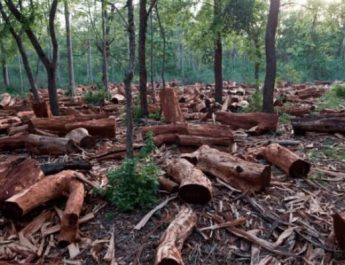
A roadmap to the halting of deforestation was dropped from the final deal, a bitter disappointment for nature advocates at this “rainforest Cop” held in Belém, near the mouth of the Amazon River.
The agreement among 194 countries-excluding the US, which did not send a delegation-was reached in the early morning after 12 hours of nonstop extra-time talks among ministers in deserted conference halls, and completed at a closing meeting at 1.35pm, after negotiations were hauled back from the brink of collapse on the evening of Friday, November 21, 2025.
In the plenary, most country delegations, including Colombia, complained vociferously that they were not allowed to speak before the deal was given through, despite Brazil having said this would be “Cop of truth.” The session was briefly paused but the Cop president, André Corrêa do Lago, then confirmed that the decisions that were given through earlier had been adopted.
Cop veteran and former German climate envoy, Jennifer Morgan, said: “While far from what’s needed, the outcome in Belém is meaningful progress. The Paris agreement is working, the transition away from fossil fuels agreed in Dubai (at the Cop28 talks in 2023) is accelerating. Despite the efforts of major oil-producing states to slow down the green transition, multilateralism continues to support the interests of the whole world in tackling the climate crisis.”
Director of the Power Shift Africa think tank, Mohamed Adow, said: “With an increasingly fractured geopolitical backdrop, Cop30 gave us some baby steps in the right direction, but considering the scale of the climate crisis, it has failed to rise to the occasion. Despite calling themselves climate leaders, developed countries have betrayed vulnerable nations by failing to deliver science-aligned national emission reduction plans.”
Pakistan’s head of delegation, Aisha Humaira, accused developed countries of hypocrisy: “Countries that have used all sources of energy in the last 200 years and have achieved the pinnacle of industrial growth and yet not stopped using all those sources of energy are telling us ‘stop growing,’” she said, adding, “The right to growth and security is fundamental for every country.”
Efforts to limit global heating to 1.5C above pre-industrial levels, in line with the goals of the Paris agreement, were also addressed in the final text, but less robustly than vulnerable countries had hoped. Before the conference, countries were supposed to present new national plans on cutting emissions, but they fell short of the commitments needed to maintain the 1.5C limit, which has already been breached but which analysts say could be returned to.
Instead of censuring this failure, the conference agreed to set up an “accelerator” programme to address the shortfall in the Nationally Determined Contributions (NDCs), which will report back at next year’s Cop, to be held in Turkey but presided over by Australia. The text exhorted countries to “full implementation of NDCs while striving to do better”.
The final deal also recognized the “just transition” that social justice campaigners have been calling for, which means helping workers affected by the move away from fossil fuels and towards clean energy. But key provisions on the exploitation of “critical minerals”-which has been accompanied by soaring human rights abuses in some countries-were blocked by China and Russia.
Insiders said the talks came close to foundering on Friday, after a hectic few weeks in Brazil that began with a summit of world leaders held by Brazil’s president, Luiz Inácio Lula da Silva, and attended by about 50 heads or deputy heads of state.
But after the leaders left and Cop30 formally began on Monday, 10 November 10, 2025, discussions among ministers and high-ranking officials degenerated into a bitter standoff. A fire near the delegation offices on Thursday afternoon, in which no one was seriously hurt, forced evacuation of the conference centre and disrupted negotiations at a crucial stage.
When they resumed late on Thursday evening, the rift was clear: over 80 countries had declared in favour of including a commitment to “transition away from fossil fuels” in the final outcome, but scores of countries-led by the Arab group, which includes Saudi Arabia-lined up against it.
That opposition forced the relegation of the “transition away from fossil fuels” – that scientists say is essential to staving off the worst effects of climate breakdown-to a voluntary commitment rather than the legally binding decision many had hoped for.
Global Lead, climate justice at ActionAid International, Teresa Anderson, said: “A lack of climate finance is throwing a spanner in the works of climate progress. Global south countries (which) are already carrying the costs of the climate crisis they have not caused, desperately need support from rich countries if they are to take on any more commitments. Nowhere was this more evident than on the issue of fossil fuels, where specific text once again ended up unfunded and on the cutting-room floor.”
Nikki Reisch of the Centre for International Environmental Law, said: “This is an empty deal. COP30 provides a stark reminder that the answers to the climate crisis do not lie inside the climate talks-they lie with the people and movements leading the way toward a just, equitable, fossil-free future.”
Make Big Polluters Pay Rejects $125bn TFFF
Meanwhile, in their quest for climate justice, the Africa Make Big Polluters Pay (MBPP) Coalition has rejected the newly launched Tropical Forest Forever Facility (TFFF), describing it as a dangerous and misleading attempt to financialize nature under the guise of protecting it.
The TFFF, spearheaded by Brazil, is being touted as a $125 billion blended-finance fund that promises annual payments to countries for protecting and maintaining their forests.
But in a statement, the Africa MBPP said the facility-broadly marketed as an innovative climate finance instrument-offers no real support to climate-vulnerable nations.
The Africa MBPP, comprising over 32 member organisations including Corporate Accountability and Public Participation Africa (CAPPA), Gender CC Southern Africa, Global Forest Coalition (GFC), and others from across the continent, is committed to holding polluting corporations accountable for their significant contributions to the climate crisis.
The coalition warned that TFFF reduces tropical forests to “tradable assets” controlled by powerful financial institutions, who will in turn, perpetuate the same extractive systems that drive deforestation, exploitation and inequality.
“The excitement that has trailed the launch of the TFFF is misplaced,” the coalition said, adding, “Rather than safeguarding forests, it commodifies living ecosystems, undermines Indigenous and community-led stewardship, and erodes the principles of climate justice it claims to uphold.”
According to the group, the TFFF poses grave risks to Africa, home to some of the world’s most bio-diverse forests and climate-vulnerable communities.
“Instead of empowering African nations, the Facility risks tightening financial dependence and eroding local sovereignty over forest resources,” the Africa MBPP said.
Countries including Nigeria, Angola, Benin, Cameroon, Côte d’Ivoire, Equatorial Guinea, Ghana, Liberia, Mozambique, Rwanda, Sierra Leone, Togo, and Uganda are being drawn into a system, the group says, that places investor returns above community needs.
“What it offers is not real climate finance, but new layers of external bureaucracy and financial engineering, the group warned.
According to the coalition, the TFFF’s model which centres a large investment fund, whose returns are prioritised for investors before any payments reach countries, risks deepening corporate influence and excluding frontline communities, whose knowledge and custodian keeper have long protected biodiversity.
The Fund proposes to pay countries about US$4 per hectare of standing forest annually, an amount the coalition describes as tokenistic compared to the ecological, cultural and economic value of tropical forests and the real costs of community-led protection.
Far from advancing the Paris Agreement or Africa’s restoration goals, the coalition added, the TFFF “threatens to divert attention and resources away from genuine, community-led climate actions towards opaque financial schemes whilst replacing public accountability with private financial interests at the same time.”
The group criticised the Facility’s financing structure, noting that it functions less like a climate-response mechanism and more like a financial vehicle designed to generate market-based returns. The coalition expressed concerns that forest payments are tied to the performance of the facility’s investment portfolio, meaning countries receive only what is left after investor obligations are met.
It argued that this approach represents “a blatant privatisation of forest finance, rooted in speculation rather than sustainability.”
“By contrast, if even one percent of the $2.7 trillion spent annually on global military budgets were redirected, it would free up $27 billion a year-over six times what the TFFF’s risky, market-based model promises.”
According to the coalition, this comparison “exposes the TFFF for what it truly is: a profit-making instrument disguised as climate action.”
The MBPP Coalition also condemned the decision to appoint the World Bank as trustee of the TFFF, describing it as a regressive and exclusionary arrangement that undermines local ownership and accountability.
Executive Director of CAPPA, Akinbode Oluwafemi, said, “Experience has shown that the World Bank-led climate finance centralises power, delays funding, and silences frontline communities, making the TFFF another bureaucratic obstacle rather than a climate solution.
“Accountability in climate finance starts with rejecting corporate capture. The World Bank must not be allowed to turn forest protection into another business model.”
Mokoena Ndivile of the Gender CC Southern Africa, noted, “Forest preservation is not a privilege; it is a right tied to the survival, dignity, and livelihoods of communities, especially women who depend on the forest for sustenance and resilience. Handing control of the Tropical Forests Forever Facility (TFFF) to the World Bank risks turning this right into another instrument of financial control, and we will not accept that.”
Similarly, Kwami Kpondzo of the Global Forest Coalition (GFC) expressed concern that “World Bank involvement in TFFF would marginalise knowledge of indigenous peoples and local communities, prioritise corporate profit over community needs, thereby weakening local ownership and stewardship of forest resources.’’
The coalition insisted that the TFFF‘s governance structure fails to represent or prioritise the Global South. “Its systems for access and oversight, it said, are built to serve financiers, rather than forest peoples.
The TFFF offers no path to justice, only an illusion of progress,” the coalition concluded. “True climate action will not come from financial schemes or distant institutions, but from the communities that have always protected the forests with their lives.”
The MBPP, therefore, urged world leaders to reject the Facility and instead support a transparent, community-led climate finance system that strengthens, not undermines local control and environmental justice, especially in Africa.