
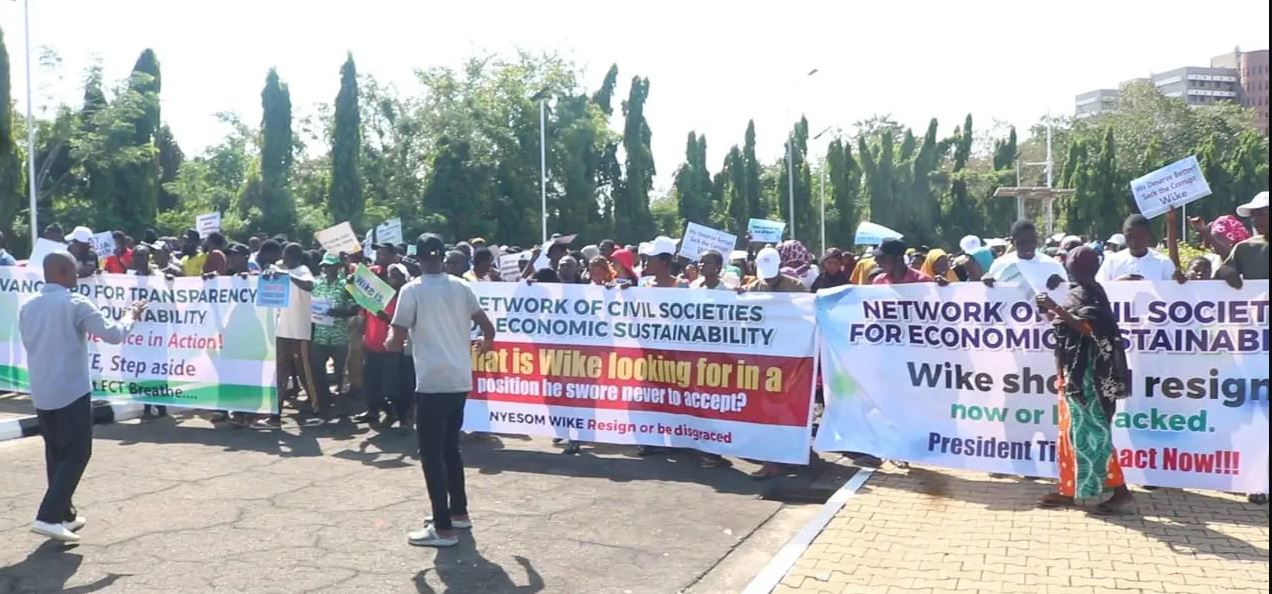
Demolition of coastal and some residential areas in Makoko, Oworonshoki, Owode-Onirin and other parts of Lagos State sparks protests by human rights activists, some of whom were tear-gassed, shot, harassed, intimidated, arrested and arraigned in court, reinforcing government’s insensitivity to the plight of ordinary citizens as the police and demonstrators trade blame over the recent demolitions
By Edu Abade
The Lagos State Government headed by Governor Babajide Sanwo-Olu, the Lagos State House of Assembly and the Ministry of Environment and Water Front Development have been accused of flouting community concerns and litigations instituted by some of community folks, the state government continued a demolition spree in entire communities for private concerns.
Following the demolitions in Makoko, a predominantly fishing community and later Oworonshoki, Owode-Onirin and other parts of the state, which resulted in the death of several persons in over 12 families as of the last count, angry residents protested to the governor’s office and the State House of Assembly in Alausa demanding an immediate halt to ongoing demolitions, resettlement and compensation for families displaced in the affected communities.
The protests later escalated to a tipping point with men and officers of the Nigeria Police Force tear-gassing and shooting some peaceful demonstrators at the Lagos State House of Assembly, while some were arrested and arraigned over alleged treason and plans to breach the peace.
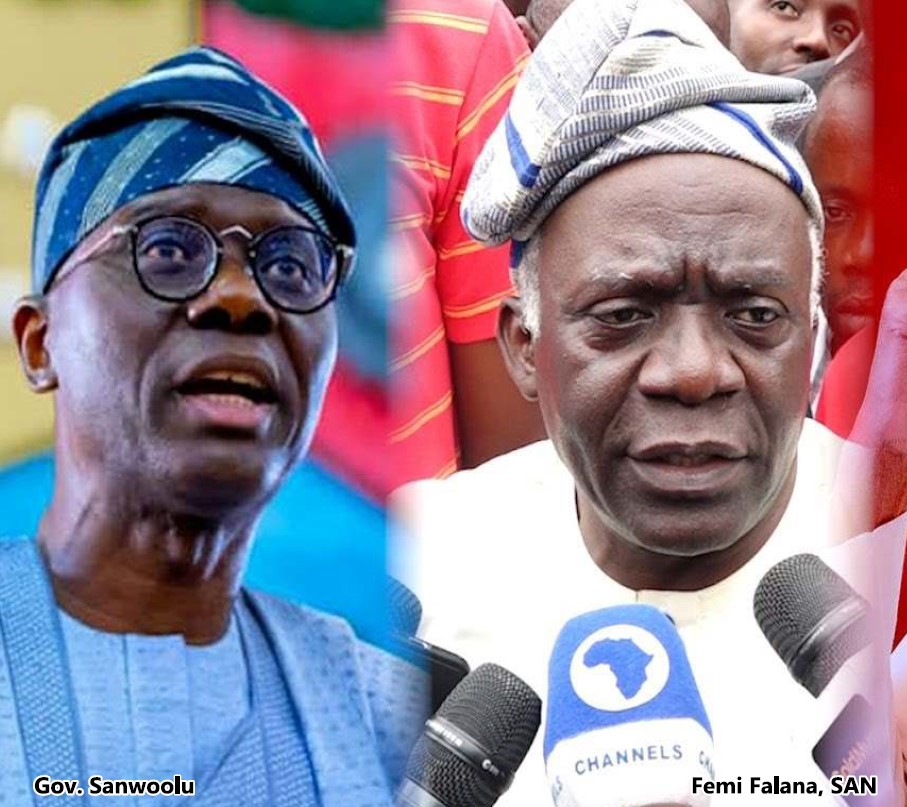
It took the intervention of human rights Lawyer, Femi Falana (SAN) to secure the release of Comrade Hassan Taiwo Soweto and other protesters, while some women and young men who were shot during the protests are being treated in hospital.
As it is typical of the Nigeria Police, Commissioner of Police (CP) in Lagos State, Olohundare Jimoh, was accused of personally supervising Soweto’s torture before he was released on bail after Falana’s intervention in court.

However, as the tensions rise, the police have defended its action as an effort to act in the public interest by arresting violence and possible breach of the peace, but civil society groups and members of the public disagree, insisting that tear-gassing and shooting peaceful protesters, including women, girls and youth flew in the face of responsible policing.
An Assistant Executive Director at the Corporate Accountability and Public Participation Africa (CAPPA), Zikora Ibeh, lamented that since January 5, 2026 security operatives and demolition teams had violently displaced residents, including women and children.
“The Lagos State Government has entered Makoko Community and violently displaced people from their ancestral homes,” Ibeh said. “Women, children, fathers and families have been tear-gassed from their homes and rendered homeless without shelter, water or other alternatives.”
She described the demolitions as a deliberate attempt to remove poor residents from prime waterfront locations for elite interests, insisting that the government had failed to provide basic reliefs, while further alleging that several deaths had occurred during the exercise, including babies and women and called for an immediate investigation of the development.
Recalling that such demolitions had taken place over the years in Oko-Baba, Ayetoro (parts of Makoko), Otumara, Baba-Ijora, Oworonshoki, Precious Seeds, Badia East, Otodo-Gbame, Maroko, Monkey Village, Ilaje-Bariga and Ifelodun, she said, “We are here to ask the governor why these demolitions have continued despite the deaths recorded in the community. We want the demolitions halted immediately, compensation paid to affected families, and investigations opened into the use of force.”
Ibeh added that residents had initially agreed to demolitions within 30 metres of power lines, later adjusted to 50 metres and then 100 metres, but alleged that demolitions had extended beyond those limits.
“As we speak, demolitions are still ongoing in the communities. The government has violated its own agreements, local laws and international standards.”
A community leader and member of Slum Dwellers International, Ojo Jide, described the demolitions as chaotic and lacking documentation, saying, “There is no profiling, no data capturing, no house numbering,” he said. “How do you compensate people or resettle them when there is no record of what you have destroyed?”
Another resident, Phineas Kojah lamented that the demolitions contradicted Governor Sanwo-Olu’s assurances that “the demolitions would be limited to 100 metres from the power lines and that we would not be evicted from Makoko.”
During the protests, a representative of the Lagos State House of Assembly, who received a letter from the protesters on behalf of the governor, assured that their demands would be communicated for necessary action.
Civil society groups further accused the government of contempt of court, citing a 2017 Lagos High Court ruling that forced evictions without consultations violate the constitutional right to dignity. They also cited an August 2025 judgment by Justice F.N. Ogazi of the Federal High Court in Ikoyi, which restrained the state and its agencies from demolitions in Makoko and other waterfront communities.
It would be recalled that the judgment reportedly awarded ₦3.5 billion in damages against the Lagos State Government and the Nigeria Police Force for previous demolitions and the unlawful killing of community leaders, insisting that the damages remain unpaid till date.
Specifically, CAPPA condemned the violent, unlawful and deeply reprehensible actions of the Lagos State Government and the Nigerian Police Force against hundreds of peaceful victims of illegal demolitions, assault and killings of some persons who gathered at the Lagos State House of Assembly on Wednesday, January 28, 2026.
In a statement made available to newsmen by Media and Communications Officer, CAPPA, Robert Egbe, CAPPA said security operatives led by the Lagos State Commissioner of Police attacked hundreds of displaced residents who had gathered at the Assembly complex to express their grievances over the ongoing demolitions and forced evictions across waterfronts and low-income communities in the state.
CAPPA demanded the immediate and unconditional release of Soweto, a member of the #EndBadGovernance Movement in Lagos State, alongside other demonstrators arrested during the protests.
The group said Soweto, alongside several peaceful protesters, including Comrade Jacob Akiri and Evangelist Isaac Doosuga, a septuagenarian from Makoko, were forcibly seized by police officers after the Commissioner of Police ordered police officers to tear-gas the protesters.
It also described the incident as a flagrant violation of constitutional rights and a continuation of what it called the Sanwo-Olu-led administration’s pattern of repression, lawlessness and cruelty against poor and displaced communities.
It said the actions of the state authorities showed a flagrant disregard for human dignity, the rule of law, and democratic norms.
Speaking further on the events that unfolded at the State House of Assembly, CAPPA noted that the protest was entirely peaceful. It said that displaced residents, including elderly men and women whose homes and livelihoods had been destroyed, had marched for hours peacefully from Ikeja Under-Bridge to the State House of Assembly to formally present their grievances to lawmakers.
“Unfortunately, lawmakers who briefly came out to address the protesters, including Hon. Ogundipe Stephen Olukayode, Chairman of the House Committee on Information, Strategy and Security, refused to allow the protesters access to the Assembly premises or the amphitheatre, a public civic space meant for citizens engagement. Exhausted protesters, including elderly persons, were denied seats and even the most basic courtesies,” the statement added.
In his reaction, Executive Director of CAPPA, Akinbode Oluwafemi, said the rights to freedom of expression, association and peaceful protest were guaranteed under the Nigerian Constitution adding that it was supposed to protect the citizens under international human rights law.
Oluwafemi was quoted as saying that there was no legal, moral or political justification for the use of tear gas or force against unarmed citizens and journalists exercising their rights, adding that the incident reflected a growing pattern of responding to civic dissent with repression rather than dialogue, particularly when protests exposed government’s failures around demolitions and forced evictions carried out without adequate notice, compensation or humane resettlement.