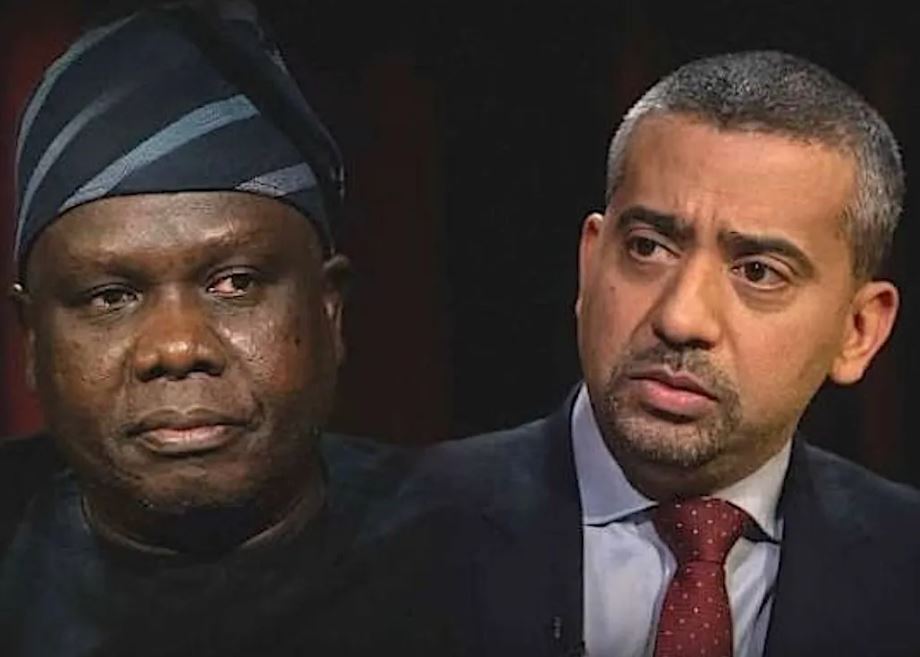

The recent interview granted a foreign media, Al Jazeera, by one of the presidential spokespersons, Daniel Bwala, where he was unable to articulate a solid defence against the unpopularity of the Tinubu government, begins to haunt him
By Udoka Ekeleme
The Presidential Spokesperson on Policy Communication for President Bola Ahmed Tinubu, Daniel Bwala has accused a foreign media, Al Jazeera, of selectively editing his recent interview, claiming the cuts created a misleading narrative that sparked online criticism.
The interview, part of the “Head-to-Head with Daniel Bwala” series conducted by journalist Mehdi Hasan, was widely shared on social media, drawing backlash from some Nigerians who described Bwala’s responses as embarrassing.
Speaking in an interview with On-Air Personality Daddy Freeze, Bwala said, “There is a fact that was incorrectly portrayed and has formed the basis of many opinions online, which was unfortunately pushed by Al Jazeera. I asked them to put the record straight.”
He explained that the interview took place on February 11, 2026, and was originally intended to run for one hour and 20 minutes. “The interview was conducted properly. Questions were asked, and I answered them. I didn’t deny anything,” he said.
However, Bwala claimed that when the network uploaded the interview online on March 5, only 49 minutes of the conversation were included, omitting nearly 20 minutes of content. He added that an 8-minute version later circulated, which “joined and cut parts of the interview in a way that emphasized certain points while leaving out crucial context.”
According to Bwala, Al Jazeera had initially assured him that the full interview would be aired on television before being uploaded online. “Their excuse was that trending matters around Israel, Iran, and the US affected the airing. But even so, they went ahead and uploaded the edited version on YouTube,” he said.
The President Tinubu spokesman also said that the full interview should be released to ensure proper context. “It’s very important that they publish the full video,” he said, warning that selective editing risks creating misunderstandings about his statements.
In reaction to the uncoordinated interview, a politician, Kingsley Moghalu, expressed deep concern over the interview. In a post on X, Moghalu described the interview as a monumental embarrassment for Nigeria, President Bola Tinubu’s administration, and Bwala personally—though he noted Bwala’s record makes this the least significant of the three.
Moghalu argued that the global audience witnessed Nigeria’s leadership being sharply criticized, reflecting poorly on the country’s political culture. He highlighted a perceived lack of coherent ideology or policy in Nigerian politics, replaced instead by opportunism and the pursuit of power, with “turncoatism” often celebrated over principle.
He also criticized the administration’s choice of spokespersons, suggesting that loyalty is prioritized over competence. Appointing former opposition figures who had previously made personal attacks on the government, Moghalu noted, undermines credibility. In Bwala’s case, this led to difficulties defending the government’s record without resorting to misleading statements.
Moghalu emphasized that more capable and principled individuals could represent Nigeria effectively on the international stage, allowing discussions to focus on government performance rather than a spokesperson’s past positions.
He added that he had received numerous calls from friends around the world, all expressing shock and sympathy for Nigeria.
“It was a sad day for our country. I’ve received several calls from friends from various countries around the world. All were in shock and felt sorry for our country to be put in such a spot,” Moghalu said.
He called for a more competent, principled, and credible approach to governance and representation, stressing that Nigeria’s potential on the world stage remains immense, even if current leadership often falls short.
On his part, a human rights activist, Prof. Chidi Odinkalu, said it was equally embarrassing that Bwala had not prepared himself properly before the interview. Recall that Bwala had claimed that he was not notified in advance that questions regarding his personal background would be included in the interview, leading to various reactions on social media.
In his clarification, Bwala mentioned that the interview request from Head-to-Head indicated that the conversation would center around national issues such as security, the economy, and corruption. He stated:
“Head-to-Head reached out to me asking for an interview, saying they wanted to question our government on security, the economy, and corruption. At no point during our nearly six months of talks did they say they would address my past.”
Bwala’s statements indicated that he felt caught off guard by the inquiries relating to his personal history, suggesting that the interview diverged from the agreed-upon subjects.
However, Prof. Odinkalu took to his official X account on Saturday, March 7, 2026, to stress the significance of being prepared for public appearances. Odinkalu’s message seemed to emphasize that Bwala should have expected such inquiries to arise during a high-profile interview. In his post, Odinkalu stated, “My brother, remember those times in primary school when they emphasized the importance of completing homework? Very crucial.”
A former presidential candidate, Omoyele Sowore, also came hard on Bwala, insisting that attempts by government officials to defend the administration of President Tinubu, are unlikely to succeed given the current perception of the government both locally and internationally.
Sowore made the remark during an interview with SYMFONI Television on Tuesday, March 10, 2026, while reacting to the recent appearance of presidential spokesperson Bwala on a foreign news platform where his credibility and integrity were questioned during a discussion on Nigeria’s political and security situation.
The activist argued that defending the Tinubu administration on international media platforms has become increasingly difficult because of the country’s prevailing socio-economic and security challenges.
“My first comment on Bwala’s appearance is that it’s not possible to defend Tinubu anywhere,” Sowore said during the interview.
He suggested that the controversy surrounding Bwala’s foreign media appearance should not come as a surprise, noting that spokespersons for any government are often placed in the position of defending official policies and narratives regardless of public sentiment.
Sowore’s remarks come amid growing debate over how the administration communicates its policies and responds to criticism, particularly during international media engagements where Nigerian officials are sometimes confronted with tough questions about governance, security, and the country’s global image.
A chieftain of the All Progressives Congress (APC) and former Presidential Campaign Council member, Dr. Ibrahim Osinowo claimed that Bwala disgraced only himself and his family — not the Tinubu administration — with his recent appearance on Al Jazeera.
Speaking on News Central TV, Osinowo criticized Bwala’s conduct in that interview. “Daniel Bwala is a younger brother. He has disgraced himself and his family and not Asiwaju’s government. I believe he will have to answer to his conscience. The interview was simple — a man of honour, dignity, and respect would have handled it differently. I met him many years ago when he was an aspiring senator, and I could tell then that he was not going to go far in a certain sense. I realised that he was someone who bends the truth, and we decided to keep our distance,” he said.
Osinowo insisted that his comments came from a place of personal investment in the government rather than any official capacity. He stated that public figures like Bwala would be judged not only by their actions today but by the legacy of their past actions.
Sharing his views on Bwala’s interview in a video shared on his YouTube channel, a human rights lawyer and activist, Dele Farotimi urged the public not to ridicule or personally attack Bwala over the interview. Instead, he said the episode should be viewed as a cautionary lesson about the risks involved when individuals are asked to defend claims that are widely doubted or contested by the public.
Farotimi emphasized that intelligence alone is insufficient to protect someone placed in a position where they must defend a narrative that many people find unconvincing. According to him, even highly capable and knowledgeable individuals can appear foolish when compelled to justify statements that lack credibility in the eyes of the public.
He further drew comparisons to previous national controversies in which officials struggled to defend positions that many Nigerians found difficult to accept, suggesting that Bwala’s experience is not unique but reflects a recurring challenge for those in public office.
Rather than focusing on Bwala as an individual, Farotimi encouraged Nigerians to consider the broader implications. He argued that the situation illustrates how holding a public office can sometimes pressure officials into making statements that may ultimately harm their reputation or credibility.
Farotimi said, “Pity Daniel, the son of Bwala. Don’t deride him; pity him and then learn a lesson from it. It’s a teachable moment.”