There are strong indications that a public health epidemic looms in Bata and Malabo and other parts of Equatorial Guinea unless urgent and concrete steps are taken to avert the situation
By Our Reporter
Throughout history, humanity has faced numerous diseases such as cholera, malaria, typhoid and diarrhea. These pathologies are mostly related to insufficient management of the environment and, in particular, to the absence of adequate environmental sanitation systems.
Sanitation is a fundamental pillar to guarantee a healthy, dignified and comfortable life. However, millions of people live daily with contaminated environments where critical stages of the sanitation chain – such as access to toilets, treatment, disposal and safe reuse of waste-are non-existent or unreachable.
Recognizing this problem, in 2010, the United Nations General Assembly and Human Rights Council declared the right to safe drinking water and sanitation as an essential human right for the full enjoyment of life (United Nations, 2010). This breakthrough provides a crucial tool to influence government decision-making and combat the global water crisis (UNICEF and WHO 2020).
The rapid economic development of the past two decades In Equatorial Guinea, has led to the transformation of many communities including the now densely populated cities of Bata and Malabo. However, the growth in these regions have outstripped the capacity of existing infrastructure, creating a critical gap in the sanitation sector. Urbanization in the two cities do not align with SDG 6 which aims to ensure availability and sustainable management of water and sanitation for all by 2030.
Sanitation is not only a civil work, but the basis for guaranteeing public health, protecting the environment and improving the quality of life of citizens.
Current Situation
In the Semu neighborhood of Malabo, behind the Semu Market, is located the town of Eboho Ndang, an area that connects the Semu and Ñumbili neighborhoods. Previously, this area was swampy and inhospitable, but the arrival of the oil bonanza since 1995 accelerated urban growth, with populations moving to areas with greater economic activity, such as Malabo.
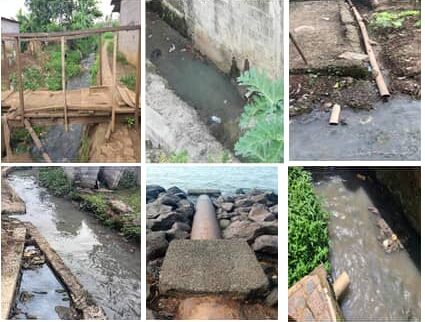
Eboho Ndang, inhabited mainly by low-income families, is at the lowest level of the market, becoming the recipient of waste and waste in the area. Residents suffer from the effects of sewage on a daily basis, especially during rainy seasons when the area is flooded with waste-laden water. This leads to persistent bad odors and frequent skin diseases. Despite multiple complaints and evaluations by authorities, no definitive solution has been found, and many residents have resigned themselves to living with these conditions.
An independent study of Bata conducted in May 2026 indicates that 95 percent of residents have wastewater near their homes, and 50 percent have suffered from related diseases, mainly diarrhea and skin conditions. The worst-affected neighbourhoods – Nkolonbong, Bikuy and Mbangang – have limited or no drainage infrastructure.
Despite improvements in the supply of drinking water and plans to channel rivers, poor wastewater management and heavy rainfall cause a deficient system to overflow, contributing to pockets of pollution and disease. The lack of maintenance further aggravates the situation, with frequent flooding during the rainy season.
Testimonies From The Locals
Edjang, one of the locals said, “I have lived here since 2002. Before, people used to bathe in this river, although they never drank its water. Today the situation is very different: the river is polluted by the garbage that is thrown from the upper part, and in the rainy season all that dirt comes down to here.
My parents taught us to respect rivers: not to throw garbage, urinate, or defecate in them. That’s why, when I built my house, I decided not to connect the cesspool directly to the river, but to do it somewhere else. It hurts me to see how some neighbors dump their wastes into the water. In addition, from tradition, we were always told that spirits live in rivers, and that is why they deserve respect.
Today the Cámara River is dead: you can no longer wash clothes, bathe or fish. The only thing I can say is that cleanliness is essential. My children and I try to clean up the edges of our land, but these efforts become futile as long as trash continues to arrive from above.
Boyé, another resident also revealed “I have lived in this neighborhood since 1960 and I remember that, at that time, the river was completely clean; there was no garbage and there was even a specific place where you could drink water directly from it. The channel was straight and you could fish with peace of mind, managing to fill up to four or five baskets of fish without any problem. However, the environment changed drastically due to construction, which diverted the natural course of the river.
Currently, between the works and the accumulation of garbage, water runs anywhere, causing serious flooding in low lying areas. When it rains heavily, water enters the houses and, when the storm ends, the rooms are full of waste and dirt.
Despite the pollution, there are still fish in the river that children catch using fan grilles. To recover the river, the fundamental solution is to stop throwing garbage, especially that which comes from the highest areas, which is the one that affects us the most down here”
Lucía Ejapa, who has lived in the neighborhood for more than 24 years has this to say: “.. I arrived with my father in 2000, when the Semu market did not yet exist. I remember that, when building it, they dragged the garbage to our yard, and many times we had to call on the driver to open roads.
Here a stream is born that connects to the Consul River, and digging just a few meters you will find water. However, most of the houses have the bathrooms connected directly to the river. The situation is dangerous and very risky: we live in a low-lying and swampy area, where 70 percent of the houses are flooded. In the rainy season, the water reaches up to the chest, dragging garbage and waste from the cesspools, which causes bad odors and diseases.
A channeling project began some time ago, but the works were left unfinished. In the meantime, we continue to suffer from flooding and trying to open accesses so that water can flow”, said a person of authority from the San Valentín Neighborhood.
“I have lived in Malabo since I was five years old and I have seen how the growth of the city has deteriorated our rivers. Before, when there were few people, we could wash clothes and bathe in them, but today they have become garbage dumps due to the constructions on their banks and the lack of maintenance.
Botupa Boneke, shares the same perspective. According to him, “the situation is dire because people throw garbage and connect waste pipes directly to the river, leading to disease and attracting mosquitoes. In order for rivers to regain their purity, it is necessary to strictly prohibit these discharges and raise awareness among the population; the problem is not the river itself, but the carelessness of people.”
Hard Facts
A recent study reveals that, although 56percent of homes have a toilet, 34 percent still use pit latrines, and 8.9 percent lack any type of bathroom. Of particular concern is that 52 percent of households located near rivers or seas discharge their wastewater directly into these bodies of water, which represents a serious health and environmental risk.
Only 10 percent of households near rivers are connected to sewerage networks, while 38 percent have poorly maintained septic tanks or private cesspools: 90 percent of these tanks have never been emptied, increasing soil contamination and public health problems. Only 9.5 percent empty periodically.
These data show the urgency of implementing improvements, including the extension of sewerage networks, adequate maintenance of septic tanks and educational campaigns that raise awareness about the importance of sanitation. The community is willing to participate in joint solutions, but technical and financial support from the government and local authorities will be indispensable.
The Challenge At Hand
Normalization of risk: The population has largely adapted to unhealthy conditions, which makes it difficult to perceive real risk. Communication campaigns must be forceful to reverse this acceptance.
Climate vulnerability: High rainfall calls for resilient solutions that consider flash floods as the norm.
Urban disorder: Disorderly growth has generated settlements in unsuitable areas, so it is important to prohibit new construction in natural drainage areas.
Institutional transparency: Community trust is critical to the success of any blended funding model; if they don’t see improvements, participation will decrease.
Strategic Solutions and Recommendations
To reverse the situation, a multisectoral plan is proposed that includes:
Infrastructure and maintenance: Prioritize the construction of collectors in critical areas and establish a municipal service for the safe and periodic emptying of septic tanks.
Mixed financing: Implement a quota system based on the willingness to pay manifested by 42% of families, guaranteeing financial sustainability.
Education and participation: Develop hygiene campaigns and form neighborhood committees that act as liaisons between the community and authorities to oversee the systems.
Improving wastewater management in Bata and Malabo is essential not only to protect public health, but also to preserve the environment and ensure a better quality of life for its inhabitants. The challenge requires a joint commitment between authorities, the community and technical organizations to build a sustainable future.