Stakeholders in the Nigerian maritime space unequivocally support innovation to effectively realize the numerous untapped potential in the Marine and Blue Economy, boost revenues, create jobs and accelerate prosperity for industry players the country and its citizens in a sector estimated at over $5 Trillion with a call on journalists to report deeper issues in the industry and elevate their reportage beyond the mundane
By Edu Abade
Maritime industry experts, including those drawn from the Nigerian Ports Authority, NPA, the Nigerian Maritime Administration and Safety Agency, NIMASA, Nigeria Customs Service, NCS, Dangote Refinery and the NLNG Shipping and Marine Services Limited have unanimously resolved to support innovation as the next frontier to explore in realizing the untapped potential in Nigeria’s Marine and Blue Economy
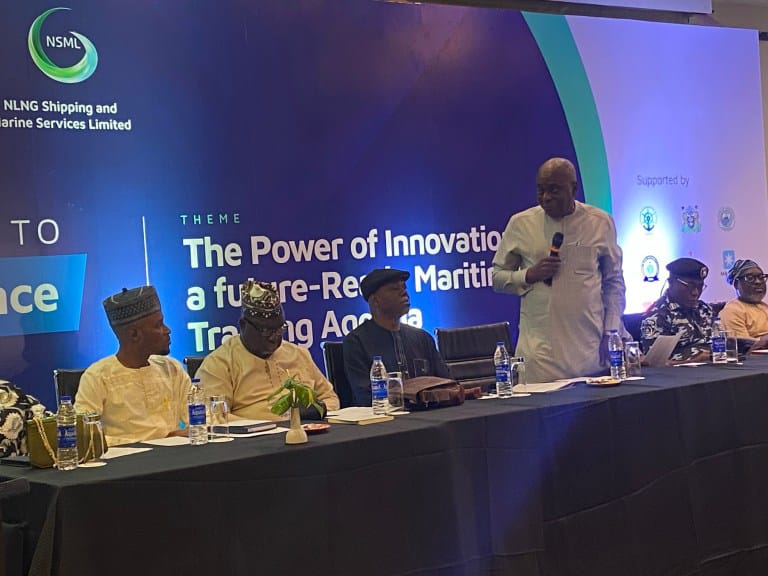
Speaking at the 2026 edition of the Association of Maritime Journalists of Nigeria, AMJON conference with the theme, The Power of Innovation In a Future-Ready Maritime Training Agenda, the participants at the well-attended summit minced no words that the theme of the conference came at an auspicious time most nations of the world seem to have advanced beyond the manual ways of transacting business, especially in a sensitive sector as maritime.
In her welcome address, President of AMJON, Vera Osokpo, said the theme for this year’s conference was not chosen in error; but to illuminate and set a clear tone for the new phase of the maritime sector, adding that if Nigeria must lead in Africa its maritime sector must take the lead.
“We are proud to collaborate with NLNG Shipping and Marine Services Limited, NSML for proving that the private sector can build the future of our maritime industry. We are also grateful to our partners from “NPA, NIMASA, NSML, Nigeria Customs Service and the Ministry of Marine and Blue Economy.
“This summit is not just a training. It is a mission. As maritime journalists, we are the bridge between policy and the people. Between the port and the public. If we do not understand innovation, we cannot report it. If we do not understand the future, we cannot shape the narrative.
“That is why we are here to learn, to be equipped, and to lead the conversation for a modern Nigerian maritime industry! Therefore, let this summit rekindle our purpose. Let us learn, let us innovate, and let us tell the stories that will position Nigeria as the maritime hub of Africa,” she said.
In his opening remarks, President of the National Association of Managing Directors of Licensed Customs Agents, NAMDLCA, and Chairman of the Occasion, Mr. Lucky Ehis Amiwero, who stressed the need for training and capacity building, insisted that Nigerians must stop politicizing issues and commit to training and retraining of manpower so as to foster a brighter future for the younger generation.
He also enjoined journalists in the maritime industry to continue to probe the deeper issues in the sector with a view to steering more robust conversations and greater matters of the national development
In his intervention, the keynote speaker, Dr. Charles Okorefe, said International maritime conventions should no longer be viewed solely as regulatory obligations, but as potential sources of new businesses and investment opportunities for Nigerian entrepreneurs.
He said Nigeria could leverage its obligations under major international maritime agreements to develop new services, industries and businesses within the country’s emerging Blue Economy.
He identified the United Nations Convention on the Law of the Sea (UNCLOS), the International Convention for the Prevention of Pollution from Ships (MARPOL), the Convention on Biological Diversity (CBD) and the African Continental Free Trade Area (AfCFTA) as frameworks that could create opportunities for Nigerian businesses.
Okorefe noted that the country’s vast maritime domain and growing Blue Economy ambitions provide an opportunity for entrepreneurs to develop solutions around the requirements created by these international frameworks adding that MARPOL, for instance, could stimulate businesses in ship waste management, eco-friendly fuel supply, recycling, port reception facilities, consultancy and maritime compliance training.
“Since the creation of the Ministry of Marine and Blue Economy in 2023, expectations had risen about the maritime sector’s capacity to contribute more substantially to national development. The key challenge however, has been to develop innovative approaches capable of transforming Nigeria’s maritime resources, international obligations and regional market access into tangible economic opportunities,” he stated.
He also stressed the importance of technology, identifying Artificial Intelligence, blockchain, Internet of Things, robotics and big data as some of the disruptive technologies that would shape the future of maritime operations.
Okorefe, who canvassed greater investment in infrastructure, research and human capital to ensure Nigeria remains relevant as the global maritime industry undergoes rapid technological transformation, maintained that Nigeria must move beyond merely responding to changes in the global maritime environment and begin proactively creating solutions and businesses around emerging trends.
“Maritime journalists have a duty to report the deeper issues of the industry with courage and greater determination as we explore opportunities in the nation’s Marine and Blue Economy and the time to act is now,” he said.
On its part, the Nigerian Ports Authority (NPA) cautioned that Nigeria’s drive towards smart and digitally driven ports will not deliver the desired transformation without a maritime workforce equipped with the skills to operate emerging technologies.
Managing Director of the NPA, Dr. Abubakar Dantsoho, who was represented by the Port Manager, Lagos Port Complex, Apapa, Adebowale Lawal stated this in his goodwill message maintaining that the maritime industry was undergoing profound transformation driven by digitization, artificial intelligence, automation, robotics and data-driven logistics systems, making continuous investment in human capital imperative.
He said innovation is no longer merely a concept for the NPA but has become central to the Authority’s efforts to improve efficiency, transparency, safety and service delivery.
He cited the Electronic Call-Up System (ETO), Electronic Access Control, digital revenue systems, vessel management platforms and the ongoing development of the Port Community System as some of the initiatives through which the NPA is moving towards a more integrated and digitally driven port environment.
He added that the Authority was also aligning its processes with the National Single Window to facilitate greater integration and electronic exchange of information among maritime stakeholders.
However, Dantsoho stressed that the effectiveness of these technologies would depend largely on the people operating them.
Stressing that technology without the right people will not deliver the desired transformation,” he said this made capacity development central to Nigeria’s maritime innovation agenda, noting that the NPA had invested in human-capital development through its training infrastructure, including the Port Training Institute and simulation facilities.
Dantsoho urged stakeholders to rethink the country’s maritime training framework to produce professionals who are not only technically competent but also innovative, adaptable and digitally literate.
He said future training programmes must prepare maritime professionals for emerging areas such as smart ports, autonomous and increasingly connected ships, cybersecurity, green shipping and data-driven decision-making.
Dantsoho said investment in the right skills today would produce a maritime workforce capable of driving safer, smarter, greener and more efficient port and maritime operations, adding, “The future is already here. Our responsibility is to ensure that Nigeria is ready-and that our people are leading the way.”
Also speaking, representative of the NLNG Shipping and Marine Services Limited, Dr. Effiong Ekanem Attah said Nigeria’s push to produce globally competitive seafarers received a major boost as over 272 cadets have completed sea-time training through its structured development programme, while 54 others are progressing towards professional certification.
Attah, who is the Manager of Maritime Centre of Excellence disclosed that the intervention is aimed at addressing one of the biggest challenges facing Africa’s maritime workforce-limited access to practical sea-time experience required for professional certification.
“Despite its strategic maritime position and extensive coastline, Africa continues to face a shortage of internationally certified seafarers and maritime professionals. Aspiring seafarers across the continent are often confronted with limited access to quality training, modern simulators, international accreditation and practical opportunities onboard vessels. These challenges have contributed to a continued reliance on expatriate personnel for specialized technical and operational roles in the maritime industry,” he stated.
He explained that the Maritime Centre of Excellence on Bonny Island was designed to disrupt the traditional training model by combining classroom learning with simulator-based training, professional certification, research, consultancy, industry collaboration and structured pathways to sea-time experience.
“The centre’s Seafarers Continuous Development Programme was specifically developed to bridge the gap between maritime education and deployment onboard vessels. Through partnerships with the Nigerian Maritime Administration and Safety Agency (NIMASA) and the Maritime Academy of Nigeria, Oron, the programme supports cadets in their journey towards obtaining Certificates of Competency.
“Beyond training, NSML has continued to pursue a Nigerianization agenda aimed at developing indigenous maritime professionals capable of operating to international standards. As of August 2026, we employed over 700 seafarers, making it one of the largest employers of qualified Nigerian seafarers.
The summit ended with the presentation of awards to various individuals and institutions that have contributed to the advancement and development of different segments of the nation’s maritime industry.