
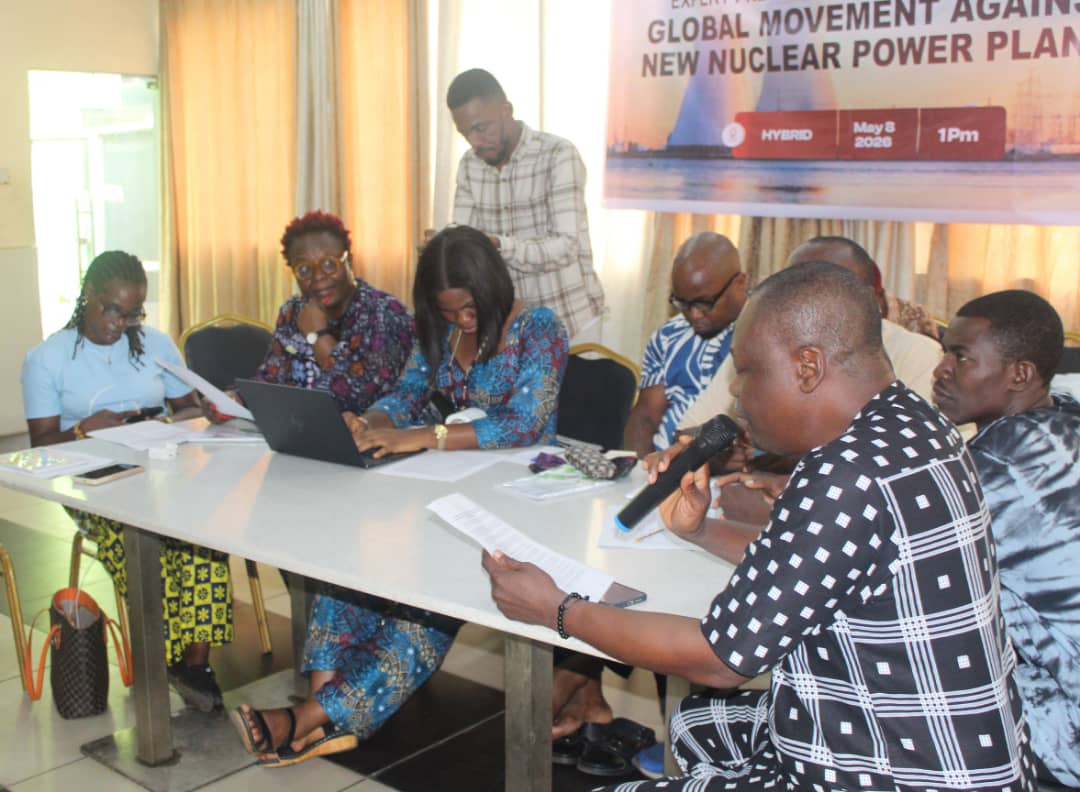
Community leaders and frontline defenders have called out governments of Africa and other world leaders to as a matter of urgency stop all nuclear energy expansion projects as the global climate crisis moves towards a tipping point
By Edu Abade
To avert a looming catastrophe of inestimable dimension, African government and world leaders must act quickly to arrest the escalating climate crisis and the planet from imminent implosion.
This was the verdict of experts and participants who gathered in Lagos at a hybrid Workshop on New Nuclear Power Plants being promoted globally by public and private interests and organized by the Renevlyn Development Initiative (RDI) in collaboration with Tipping Point North South, United Kingdom (UK).
Speaking virtually, Co-founder, Tipping Point North South UK, Deborah Burton, said that Africa must resist the pressure to adopt nuclear power because it remains a distraction for a continent that has an abundance of renewables that can power it and reduce the energy poverty of its people.
Deborah listed countries on the continent that have already announced plans to roll out nuclear power plants to include Angola, Burkina Faso, Egypt, Ethiopia, Ghana, Kenya, Morocco, Namibia and Tunisia. Others are Senegal, Rwanda, Tanzania, Uganda, Nigeria and South Africa that has the only operational nuclear plant built in 1984 during the apartheid era.
She cited a 2025 report titled: The Alarming Rise of False Climate Solutions in Africa: The Nuclear Energy Misadventure by 12 civil society groups in a host of countries on the continent, Europe and Russia which detailed the extent of plans and announcements to roll out nuclear power plants in Africa as the definitive position of Africans.
The organisations whose researches culminated in the report called for an end to plans to spend billions on building new nuclear power plants and advocated instead, for funding of clean, safe renewable energy sources, of which the continent has an abundance.
Also, in his welcome address titled: From Oil Mishaps to Nuclear Misadventure, Executive Director of RDI, Philip Jakpor commended the experts who addressed the issues around nuclear energy, which he said was gaining traction because more African governments are being lured into another form of colonialism.
“Special thanks to Deborah Burton who has worked strenuously with us at the Renevlyn Development Initiative on a shoe string budget but with the determination that this training must hold. We must also thank our media friends who have been consistent in exposing threats to our people and environment.
“We cannot claim to be experts in the field of nuclear energy. We can only refer to dictionary definitions, one of which is that nuclear energy is energy released during nuclear fission or fusion, especially when used to generate electricity.
“But we have heard of nuclear incidents and those that readily come to mind are the Chernobyl incident in Ukraine in 1986 and the Fukushima incident in 2011. Even with the radioactive fallouts and growing questions on how radioactive waste can be managed, the promoters of nuclear power plants want us to believe that nuclear energy is clean energy,” he stated.
Speaking further, Jakpor said Nigeria currently depends largely on fossil fuels for energy generation, adding that a lesser amount of energy comes from the hydro plants in Shiroro, Kainji and Jebba dams.
While we hear that the installed capacity of power from the existing hydro and thermal stations in Nigeria hover around 12,000 megawatts, for more than 20 years the megawatts that finally get to Nigerian users continues to hover around 3,500-4000 megawatts.
“To address this challenge, successive administrations have expressed interest in solutions outside fossil fuels. Unfortunately, the government has chosen to experiment with what most Nigerans would have nothing to do with.
“In 2007 the Nigeria Atomic Energy Commission (NAEC) which has the mandate to develop the framework and technical pathway to explore, exploit and harness atomic energy for peaceful application in all its ramifications signed a Memorandum of Understanding (MoU) with Rosatom, a supposed Russian company on May 31, 2016 for construction of four nuclear power plants in Nigeria.
The plants would cost about $80 billion and will have a total capacity of 4,800 megawatts by 2035, with each facility costing $20 billion. It is to be built by Russian firm-Rosatom
Rosatom will hold a majority stake in Nigeria’s nuclear facilities while the rest will be owned by the state, with roles to be defined in contractual agreements
Unfortunately, after civil society raised the alarm about the secretive nature of the discussions, the government and Rosatom have gone quiet. We do not know the status of the plans.
These are the issues being exposed by antinuclear advocates from Kenya, Zambia, South Africa, Germany and the United States surrounding nuclear power plants that we are not privy to.
A community leader and frontline defender in Uyombo, Kenya, who said the proposed nuclear power plant in Uyombo would create environmental, health and livelihoods impact, tasked affected communities on the need for organized, informed and collective response.
He said a major step was in reaching out to neighbouring villages and communities to form alliances and strengthen advocacy as well as promote a united regional voice, while urging the media for increased coverage for more visibility of the issues, highlighting NuPEA activities and community responses and help bring national attention to Uyombo concerns.
He said key outcomes of the efforts include increased community awareness and mobilization, stronger collaboration among villages, enhanced advocacy capacity, greater public media attention and relocation of the site.
The Uyombo Community leader, therefore, sought continued community engagement and sensitization, strengthened partnership and networking, sustained media advocacy, support for ongoing training and capacity building and continuous community vigilance.
Also in his intervention, Dr. Stephan Singer of CAN International, who gave a preview of Germany’s phase out of nuclear energy by 2023, maintained that the key problems of nuclear energy today is that it remains a highly radioactive waste.
He said about 30,000cm of high radioactive waste (90 percent of activity, 5 percent of volume) and constitute between 5 and 8 percent of all high radioactive waste globally (c. 600,000 tons).
“The initial target in 2013 was to have a final safe depositor for nuclear waste by 2031, which changed to 2046 by 2022 and again changed to probably between 2055 and 2070 early this year.
Since 2017, about 90 geological sites have been reviewed and researched with 80 percent excluded as insecure for long term such as for 100,000 to 1 million years. Costs have exploded beyond the Decommissioning Fund, while annual budget of environmental ministry for nuclear decommissioning now and in the future has reached 1.5 billion Pounds, which is half of the entire budget,” he revealed.
In his presentation on Rosatom Expansion and War in Ukraine, Vladimir Slivyak of Ecodefense revealed that in Russia, there were over 350 companies and well over 38-39 nuclear reactors in operation and they consume over 20 percent of available electricity.
He explained that there were at least four icebreakers with SMRs constantly researching and fueling and enriching nuclear weapon maintenance and development, while the supply of non-nuclear weapon related components are being channeled to Russian defense companies.
On the construction of new nuclear reactors, Vladimir said, “Rosatom in various documents claims it signed contracts for the construction of over 30 new reactors in various countries. Independent verification shows Russian official numbers can’t be trusted. Although Rosatom is a global leader in international nuclear expansion, its “foreign portfolio” is 30 percent smaller than declared.
“Rosatom controls over 40 percent of world uranium enrichment capacity and about 17 percent of nuclear fuel market. That makes them able to make various countries dependent on Russian supplies. This dependence results among other things in strong political influence from Russia,” he said.
He pointed out that European dependence and cooperation ensure fuel supply to VVER440 and VVER1000 reactors in Hungary, Bulgaria, Finland, Czech and Slovak republics and maintenance of old reactors, as well as uranium supply to Lingen and the construction of new nuclear plant (Paks 2) in Hungary with two VVER1200 units.
According to him, Rosatom takes part in war for active role in taking over Ukraine’s Zaporizhzhia Nuclear Power Plant and violently forces personnel to sign up new contracts with the company, while advising Russian army during the occupation of the Chernobyl Zone, among others.