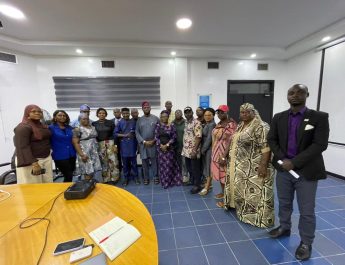
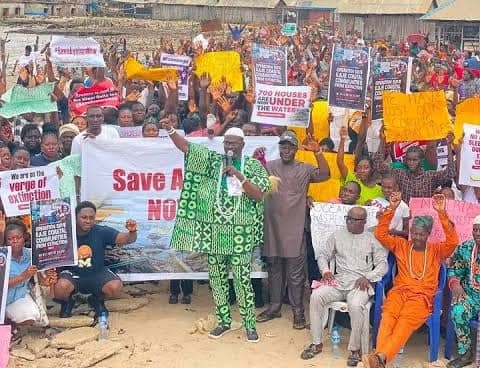
Some groups of environmental activists have condemned the Shell Petroleum Development Company (SPDC), other multinational and local oil producing firms for the environmental disasters their activities are causing in their host communities just as Ilaje communities in Ondo State protest against environmental and humanitarian crisis in their area
By Edu Abade
A Federal High Court sitting in Yenagoa, Bayelsa State presided over Justice Ayo Emmanuel on July 17 2026, dismissed the suit filed by King Bubaraye Dakolo of Ekpetiama Kingdom against Shell Petroleum Development Company of Nigeria (SPDC) and six other defendants, including the Attorney General of the Federation and the Nigeria Upstream Petroleum Regulatory Commission (NUPRC).
The suit marked FHC/YNG/CS/8/2025, sought to hold Shell accountable for four decades of oil spills, sustained gas flaring and the systematic destruction of rivers, forests, and farmlands across the Gbarain oil fields before the company’s controversial divestment of its onshore assets to Renaissance African Energy Limited.
The court dismissed the suit on four grounds including failure to comply with statutory conditions precedent under the Petroleum Industry Act 2021 and the Upstream Petroleum Remediation Funds Regulations 2022; the statute of limitations under the Public Officers Protection Act and the Limitation Law of Bayelsa State; The characterization of the fundamental rights framing as secondary to tortious claims; and the consequent sustaining of the defendants’ preliminary objections.
But responding to the judgement, the Health of Mother Earth Foundation (HOMEF) rejected the dismissal insisting that King Dakolo, the Ekpetiama people and their legal team should pursue an appeal to the highest court in the land.
HOMEF expressed concern about these reasons arguing that where aged oil infrastructure remain in use, noxious gas continues to flare and where contamination has not been remediated, the injury is not only historical, but also ongoing and framing decades of unaddressed harm as a series of expired causes of action is a judicial gift to extractive corporations and a betrayal of the communities bearing their costs.
Executive Director of HOMEF, Nnimmo Bassey noted with grave concern, that “Every one of these grounds is procedural; not a single finding goes to the merits of the environmental harm Ekpetiama people have suffered for over six decades.
“The Federal Government, through the Minister of Petroleum Resources, the NUPRC and the Attorney General, was a co-defendant in that suit for a reason, because their approval of a divestment that circumvented the Petroleum Industry Act’s environmental obligations makes them complicit in what the Ekpetiama people have endured.”
Also speaking, HOMEF legal officer Onome Etisioro stated that Shell’s obligations to the Ekpetiama people do not lapse with a court ruling, adding, “Nigerian jurisprudence has long needed a definitive ruling on what constitutes a continuing environmental wrong and the resulting ecocides that occur, and on whether limitation statutes designed for ordinary civil disputes can be applied without modification to the slow and cumulative violence of oil extraction.
“The Ekpetiama case was built to force those questions, but it was dispatched before the judiciary could answer them; the communities of the Niger Delta are the poorer for it. Every dismissal on a technicality is a deferral of the environmental jurisprudence this country urgently needs.”

The group of environmental watchdogs pointed out that the ruling is the latest instance of a troubling pattern in Nigerian environmental litigation: cases of profound public consequence, carrying the weight of decades of documented harm, are dismissed on procedural and technical grounds before a court ever reaches the substance.
“Nigerian jurisprudence has long needed a definitive ruling on what constitutes a continuing environmental wrong and the resulting ecocide, and on whether limitation statutes designed for ordinary civil disputes can be applied without modification to the slow, cumulative violence of oil extraction.
“We commend legal counsel Chuks Uguru and the Ekpetiama legal team for their commitment to pursue this matter through every available avenue. The appellate courts must have the opportunity to examine whether the procedural bars applied here serve justice or obstruct it. We call on legal advocates, environmental groups, and human rights organizations across the Niger Delta and beyond to support the appeal process that may arise with expertise, solidarity, and visibility.
In a related development, no fewer than 20 Ilaje coastal communities protest against environmental and humanitarian crisis on Thursday, August 6, 2026. The Coalition of Ilaje Ravaged Communities (CIRC) held a peaceful protest to draw attention to the worsening environmental and humanitarian crisis threatening coastal communities in Igbokoda, Headquarters of Ilaje Local Government Area of Ondo State.
The protest, tagged: Operation Save Ilaje: Protect Our Coastal Communities from Extinction, brought together affected residents and members of Ayetoro, Awoye, Mese, Gbagira, Jiringho, Ilowo, Ilepete, Idiogba, Oroto, Alagbon, Erunona, Olotu, Yaye, Womitenren, Ogboti, Lepe, Ehinmore, Abetobo and Abereke to demand urgent and concrete action from the Federal and Ondo State Governments to address the devastating impacts of ocean surges, coastal erosion, oil spills and environmental degradation in the region.
For decades, communities along the Ilaje coastline have watched their homes, farmlands, fishing grounds and other sources of livelihood disappear under the combined pressures of rising seas, coastal erosion and pollution. The situation has become particularly critical in communities including Ayetoro and Abereke, where residents are increasingly confronted with displacement and the loss of their ancestral homes.
The communities are demanding, among other measures: Urgent and effective intervention to halt further coastal erosion and sea incursions; construction of scientifically designed and fit-for-purpose coastal protection infrastructure and comprehensive environmental assessments and clean-up of oil-polluted areas
They are also demanding accountability and remediation by companies responsible for environmental damage; adequate compensation and livelihood restoration for affected residents; immediate action to protect fishing grounds, aquatic ecosystems and other community livelihoods and greater transparency and community participation in all government interventions affecting the Ilaje coastline.