
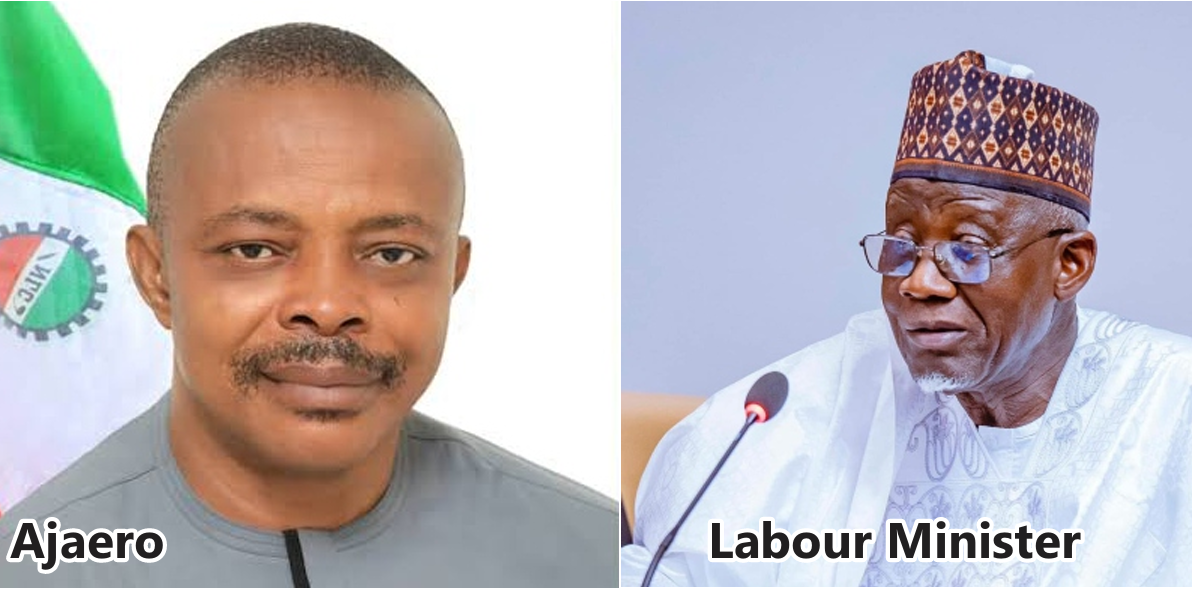
Ajaero’s Docile NLC Barks Again
With wages losing purchasing power and petrol prices squeezing household incomes, the Nigeria Labour Congress (NLC) faces a defining test: can another ultimatum force the government to act, or will workers remain trapped in a cycle of threats, negotiations and disappointment?
By David Oladimeji
The Nigeria Labour Congress (NLC), under the leadership of Comrade Joe Ajaero, is once again brandishing its sabres against the Federal Government, threatening fresh action over the rising cost of living, soaring petrol prices and the declining purchasing power of Nigerian workers. Yet, beyond the familiar language of ultimatums and impending confrontation, a fundamental question persists: Will the latest threats translate into tangible relief for millions of workers struggling to survive?
The latest confrontation began with a two-week ultimatum issued by the NLC to the Federal Government on October 8, 2026. The labour centre demanded an immediate reduction in petrol prices, the commencement of negotiations for a new national minimum wage and the implementation of outstanding agreements with organised labour. The deadline of the warning strike, which began on Friday October 9, has placed the government under renewed pressure to address workers’ grievances. Failure to meet the demands, the congress warned, could trigger further action.
But the question is whether another ultimatum will produce a different outcome from previous confrontations between organised labour and the government. Nigeria’s labour movement has a proud history of challenging policies considered inimical to workers’ welfare. From demonstrations against fuel price increases to nationwide strikes over wages and electricity tariffs, the NLC has repeatedly demonstrated its capacity to mobilise. The controversy surrounding its present leadership, however, centres on whether that historic influence is being translated into sufficient and sustained victories for ordinary workers.
For critics who describe Ajaero’s NLC as docile, the accusation is not necessarily that the congress has remained completely silent. Rather, it reflects dissatisfaction with what they consider the widening gap between labour’s forceful rhetoric and the practical outcomes of its confrontations with the government. The charge deserves scrutiny, particularly in a country where millions of workers believe their salaries no longer guarantee access to food, decent accommodation, healthcare and education.
Nevertheless, it would be misleading to suggest that the NLC has done nothing. The congress has issued warnings, mobilised workers, challenged government policies and demanded fresh wage negotiations. Its recent ultimatum is evidence that the leadership is still prepared to confront the administration publicly. The more important question is whether these interventions are sufficiently coordinated, sustained and effective to compel the government to respond to the realities of workers’ lives.
At the centre of the prevailing dispute is the N70,000 national minimum wage signed into law by President Bola Tinubu on July 29, 2024. Although the agreement represented an increase from the previous minimum wage, rising prices have continued to erode its purchasing power. Ajaero has argued that the amount no longer reflects the cost of living and has called for negotiations to begin on a replacement before the end of October 2026.
The contradiction is difficult to ignore. A statutory minimum wage may appear substantial on paper, but its value diminishes when the cost of transportation, food, rent, electricity and school fees rises faster than workers’ earnings. For employees who must spend a significant portion of their salaries simply getting to work, the distance between nominal wage increases and actual economic relief can be enormous.
The NLC’s demand for a reduction in petrol prices is therefore tied directly to its wage campaign. Petrol costs influence transportation expenses and the distribution of goods, while businesses often pass higher operating costs to consumers. When transport fares rise, the consequences spread across markets, affecting food prices and the cost of everyday services. Workers who do not own vehicles are particularly exposed to the cumulative impact of these increases.
The Congress wants petrol prices reduced to the level prevailing when the current minimum wage was signed into law in 2024. It has also demanded immediate wage awards, tax relief and the implementation of outstanding agreements affecting public-sector and health-sector workers. These demands reflect a broader argument that workers should not be expected to absorb the full consequences of economic adjustments without corresponding protection for their incomes.
Yet, the effectiveness of labour’s demands will depend on more than the strength of its communiqués. It will depend on the government’s response, the unity of the labour movement, the willingness of affiliates to participate in collective action and the ability of union leaders to sustain pressure beyond initial announcements. An ultimatum that is not followed by a clearly communicated strategy risks becoming another entry in the country’s long catalogue of labour-government disputes.
The recent experience of public-sector workers illustrates the difficulty of converting industrial action into lasting concessions. Workers under the Joint National Public Service Negotiating Council embarked on a three-day warning strike in early October over welfare concerns, fuel prices and wage-related demands. The Council subsequently warned that failure by the government to address the issues could lead to a more extensive industrial action. Reports also indicated varying levels of compliance across states.
The warning strike raised another uncomfortable question for organised labour: How long can workers afford to withdraw their services when their incomes are already under pressure? Strikes impose costs on governments and employers, but they also impose costs on the workers who lose wages, face disciplinary risks or struggle to sustain their families during prolonged industrial disputes. This makes preparation, coordination and clearly defined objectives essential to any credible labour strategy.
For Ajaero, the challenge is to demonstrate that the NLC can move beyond periodic declarations of resistance to a structured campaign with measurable objectives. Workers need to know what concessions the congress is seeking, how progress will be assessed, what happens if negotiations fail and what safeguards will protect vulnerable employees during industrial action. Clarity on these questions could strengthen workers’ confidence and make it harder for the government to dismiss the demands as routine agitation.
The government, for its part, cannot escape responsibility by portraying labour’s demands as mere political noise. A government that expects citizens to endure economic reforms must also explain how the benefits of those reforms will reach ordinary households. It must account for the measures introduced to cushion hardship, demonstrate progress on outstanding agreements and engage organised labour in good faith. Where government policies impose substantial costs on workers, transparency and meaningful consultation are indispensable.
Ajaero has accused the Tinubu administration of failing to engage adequately with the NLC, alleging that letters sent between May and December 2025 went unanswered. According to his account, the failure to secure meaningful engagement contributed to the Congress’s decision to plan a nationwide protest in December 2025. The allegation, reported by TheCable in October 2026, underscored the breakdown of trust that has complicated relations between the two sides.
If the allegation is accurate, the government’s approach raises serious concerns about industrial relations. Negotiation is not a favour that an administration grants to organised labour; it is a necessary mechanism for preventing disagreements from escalating into disruptive confrontations. Ignoring correspondence or postponing difficult conversations may delay a dispute, but it does not resolve the underlying grievances.
However, the NLC must also examine its own methods. A labour movement that invokes its historic mandate must demonstrate that its actions are driven by workers’ interests rather than the pursuit of public attention. Its credibility rests on the ability to communicate honestly with members, distinguish achievable short-term relief from long-term structural reforms and ensure that negotiations do not end without transparent explanations of what was secured or conceded.
Ajaero has pointed to state governments that pay above the N70,000 minimum wage, citing figures ranging from N75,000 to N104,000, to challenge arguments about the affordability of higher wages. His position raised a legitimate question about why the Federal Government should maintain a lower wage level when some states have adopted higher rates. However, a durable national wage settlement must also consider fiscal capacity, the cost of living, productivity and the need to ensure that agreed wages are actually paid.
The larger debate is whether Nigeria’s minimum wage framework can keep pace with persistent price increases. Periodic adjustments may provide relief, but they cannot, by themselves, resolve the structural pressures that make basic goods and services increasingly expensive. Transport infrastructure, domestic energy supply, food production, housing, healthcare and taxation all affect the real value of wages. Stakeholders, therefore, have advised the NLC to combine its immediate demands with a credible programme of economic advocacy.
They said that this is where the accusation of docility becomes more complicated. According to watchers of labour events, a union’s effectiveness should not be measured solely by the number of strikes it organised or the frequency with which its leaders threaten confrontation. It should, rather, be measured by whether it secures enforceable agreements, protect workers against arbitrary treatment, monitor implementation and communicate the results to its members. Equally, a leadership that repeatedly threatens action but fails to explain the consequences of its decisions risks weakening the credibility of future warnings.
The description of Ajaero’s NLC as docile may be politically forceful, but it remains an assessment that must be tested against the Congress’s record, the concessions it has secured and the outcomes of its actions. The recent ultimatum shows that the organisation is still willing to challenge the government. Whether that challenge will produce meaningful change remains an open question. However, what worries many is that Ajaero’s NLC does not act when it is necessary. They said the current NLC has lost its biting capacity reminiscent of the NLC of the era of former president Olusegun Obasanjo when every fuel price increase at the time attracted prompt and commensurate action from organized labour, and forced government to rethink its action.
Those were the days of now Senator Adams Oshiomhole-led NLC when labour strikes were common and forceful to the extent that the government must appease the workers to avoid crisis in the polity. Now, critics of the NLC in this dispensation insisted that the Congress watched helplessly when President Tinubu declared removal of subsidy on fuel, floated the naira to the admiration of the World Bank and International Monetary Fund (IMF), policies that heralded the untold hardship in the country. Critics said an active labour union would have gone on indefinite strikes to challenge these unpopular policies.
The Ajaero-led NLC has watched without commensurate action the back-and-forth movement of government over the nation’s ailing refineries without registering its protest. Under this government, billions of dollars have been spent on the refineries for turnaround maintenance which never yielded any effective outcome. Thus, many have wondered whether the NLC under Ajaero is dead or alive as Nigerian workers continue to bemoan their ordeal under the current government.
The NLC has rejected the Federal Government’s response to its demands for urgent economic relief and the commencement of negotiations for a new national minimum wage, raising concerns over a possible escalation of industrial tension as its 14-day ultimatum runs its course.
The Congress, in a letter to the Minister of Labour and Employment, Dr Muhammad Maigari Dingyadi, faulted the government’s position that negotiations for a fresh minimum wage review would be premature before June 2027, insisting that preparations for a new wage agreement should begin immediately.
The NLC in the letter signed by its President, Ajaero, also insisted on a reduction in petrol prices, the implementation of tax relief measures agreed upon in 2023, immediate wage awards to cushion the rising cost of living, and the implementation of agreements with the Joint Health Sector Unions (JOHESU) and JPSNC.
Although the NLC in the letter did not expressly declare an imminent strike, its rejection of the government’s response to NLC’s ultimatum and insistence on urgent action by government is an indication of a looming industrial confrontation if the dispute remained unresolved before the ultimatum expires.
In the Federal Government response to the NLC’s communiqué, the minister of Labour and Productivity maintained that the current national minimum wage of N70,000, signed into law on July 29, 2024, would become due for review on June 1, 2027.
According to the minister, the law provides for a review of the national minimum wage every three years, making an earlier review premature.
He said, “Commencing a fresh review exercise barely two years into the implementation of the current wage, which represented an increase of over 133 per cent from the previous minimum wage of N30,000, would be premature, inconsistent with the law, and disruptive to the orderly industrial relations system envisaged by the Act”.


