
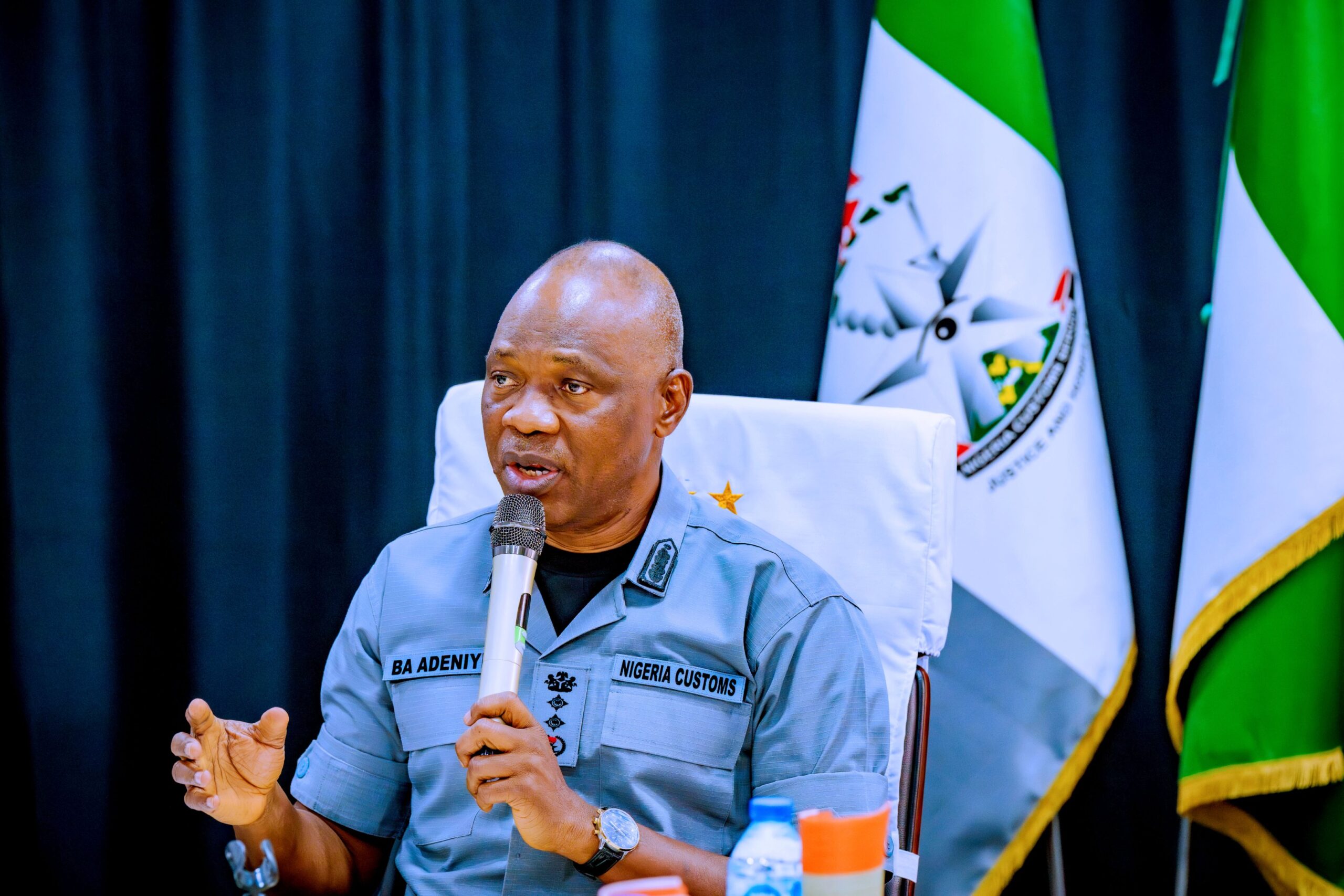
Customs Showcase Stewardship Under Tinubu Government
*As Mgt Bridges 16 Yrs Generational Gap
From closing a 16-year generational gap, influencing global Customs policies, to record-breaking revenue, strategic appointments and international recognition, stakeholders said Dr. Adewale Adeniyi’s leadership has given the Nigeria Customs Service (NCS) a new identity
By David Oladimeji
The Nigeria Customs Service (NCS) is experiencing a defining chapter in its history, said Dr. Boniface Aniebonam, founder of the National Association of Government Approved Freight Forwarders (NAGAFF). Accordingly, other notable stakeholders also said that at the centre of the Service’s transformation under the government of Bola Ahmed Tinubu, is its Comptroller-General (CGC) Bashir Adewale Adeniyi, MFR. Since assuming leadership in June 2023, Adeniyi has embarked on an institutional renewal which analysts agreed that it is changing the Service’s operational culture, strengthening revenue generation, and also expanding Nigeria’s influence in international Customs administration.

For an organisation traditionally saddled with responsibilities to seize illicitly imported items, pursue border enforcement and revenue generation, the challenge is enormous. However, many argued that the Adeniyi vision for the NCS appears broader, including building a Customs Service that combines discipline with efficiency, enforcement with trade facilitation, and institutional experience that incorporates youthful energy. Currently at the centre of the success story of the NCS in recent years is a youthful workforce which is referred to as the “new-generation” officers.
The first evidence of this transformation is reflected in the revenue figures since the coming of Adeniyi as the CGC. Customs revenue collections under Adeniyi’s supervision increased from approximately ₦3.21 trillion in 2023 to ₦6.105 trillion in 2024 and an impressive ₦7.281 trillion in 2025, reinforcing the Service’s growing contribution to national revenue mobilisation.
Behind the unprecedented revenue figures were efforts made to strengthen compliance from the business community, block revenue leakages, improve monitoring and embrace technology. The introduction of the B’Odogwu platform and other modernisation initiatives to enhance an efficient service delivery is a reflection of the administration’s determination to make Customs operations less manual and more efficient, transparent and technology-driven.
Stakeholders further agreed that Adeniyi has also placed considerable emphasis on discipline, professionalism and operational efficiency. They stressed that in an institution with Commands spread across seaports, airports, land borders and inland formations, accountability and effective personnel management must remain essential to delivering sustainable results.
Another important aspect of the NCS administration under the Tinubu government is the pursuit of balanced promotions and career progression. This agenda recognizes competency, rewards experience and creates opportunities for deserving officers. It is critical to maintaining morale and ensuring institutional stability.
Perhaps, one of the Adeniyi-led management’s most consequential administrative interventions is the sustained effort to bridge the lingering 16-year generational gap within the Service. Recall that between 1994 and 2008, no new intakes were recruited into the NCS for inexplicable reasons. The failure had created a huge gap in leadership succession. Rather than allow the gap to become a succession problem, the Adeniyi administration has sought to create a smoother transition between experienced officers and younger professionals.
This generational renewal has become visible in the strategic deployment of the new-generation officers to sensitive Commands. It is a deliberate demonstration that leadership should not be determined by years alone, but also by competence, preparedness and the ability to deliver.
For example, many grade A Commands across the country are witnessing pragmatic leadership that is suppressing smuggling and generating surplus revenue for the government. At the Federal Operations Unit (FOU), Zone A, Lagos Command, Deputy Comptroller OO Afeni, the acting Area Controller (CAC), represents the emerging generation entrusted with challenging enforcement responsibilities. The Unit’s anti-smuggling operations demand intelligence, vigilance and determination, making it a demanding environment for any officer. Afeni had dealt bitter blows on smuggling syndicates which operated along the Idiroko Border post in Ogun State, before his recent redeployment to the FOU Zone A. Afeni’s successful management of the two Enforcement Commands speaks volume of his administrative competency and Adeniyi’s ability to identify future leaders.
Also, at the Ports and Terminal Multipurpose Limited (PTML) Command, Apapa, Lagos, DC Nura Miko, the CAC of the Command occupies another strategic position in Customs leadership and administration. PTML is an important revenue generating centre, requiring effective supervision, compliance monitoring and a firm understanding of modern port operations.
Deputy Comptroller Bolaji Adigun’s movement from Kirikiri Lighter Terminal (KLT), Lagos to the Onne River Port Command in Rivers State as CAC of the two Commands respectively, illustrates the importance of leadership mobility and experience across different operational environments. Similarly, DC Mahmood Mundi who currently superintends over the Murtala Mohammed International Airport Cargo Command, otherwise referred to as NAHCO Airport Command, operates in a sensitive environment requiring intelligence, alertness and operational efficiency. Mundi has served successfully in different Commands and different capacities, notably among them being the DC Enforcement at the Murtala Mohammed International Airport Command before his recent elevation to the status of an acting CAC. The NAHCO Command is already experiencing drastic revolution that would result in huge revenues for the government. Mundi has also vowed to smash all smuggling syndicates that would want to use the Command to perpetrate offensive activities.
Other notable deployments include DC Olufemi Kukoyi who holds sway at the Lagos Free Trade Zone (FTZ) as the CAC. His leadership is being applauded by numerous stakeholders, DC Abdlmumini Ibrahim, the CAC of Ogun 2 Command at Idiroko and Umar Madugu at Scanning Headquarters, Abuja. The Apapa Area Command also remains central to the Service’s revenue and operational responsibilities. It is currently being managed by the erudite Comptroller Murtala Muazu, one of the new-generation officers with great leadership capabilities. Adeniyi-led management’s capacity to identify these rare young leaders is receiving praises from stakeholders.
They said that these appointments reflected a leadership philosophy that recognises youthful energy and the importance of succession planning. The real test, however, remains the officers’ ability to deliver measurable results in revenue generation, enforcement, professionalism and trade facilitation, which many said they are achieving effortlessly.
Beyond personnel management, Adeniyi is confronting one of Customs’ oldest challenges: public perception. For years, interactions between officers and sections of the trading community had sometimes been characterised by suspicion, confrontation and mutual distrust.
His administration has increasingly emphasised stakeholder engagement, encouraging constructive relationships with importers, exporters, freight forwarders, licensed customs agents and manufacturers, and even the international Customs community. The message is that Customs should be a partner in economic development rather than an unnecessary obstacle to legitimate business.
Experts stressed that a modern Customs institution must enforce the law without compromising professionalism. It must protect national revenue while facilitating legitimate trade, earning public respect through transparency, discipline and service delivery.
BEYOND NIGERIA: ADENIYI’S GLOBAL DIPLOMACY
Analysts have argued that one of the most remarkable dimensions of Adeniyi’s leadership is his emergence as an international voice in Customs administration. His election on June 28, 2025, as the Chairman of the World Customs Organization (WCO) Council made him the first Nigerian to occupy the position, placing the country at the centre of global Customs policy discussions.
His unanimous re-election in 2026 for a second term, further strengthened Nigeria’s international standing in global Customs administration. The WCO Council represents 186 member administrations and serves as its highest decision-making body. For Nigeria, this position offered an opportunity to influence discussions on trade facilitation, revenue optimisation, border and national security, and digital transformation.
But Adeniyi’s international achievements go beyond the WCO Chairmanship. By mid-2026, the NCS had expanded its structured international engagements to more than 20 Customs administrations, creating opportunities for knowledge sharing, capacity building, intelligence and operational collaboration.
One particularly important breakthrough was the revival of Nigeria’s long-dormant Customs Mutual Assistance Agreement with the United States. Following engagements with US Customs and Border Protection, the renewed cooperation provides a framework for intelligence sharing, data-driven targeting and stronger responses to drug trafficking, arms smuggling and money laundering. Plans for a Centre for Advanced Cargo and Passenger Data Analysis further underline the potential benefits.
China, Nigeria’s biggest trading partner, is another important pillar of this diplomatic strategy. The Customs cooperation memorandum signed in Shenzhen on May 8, 2024, and subsequent mutual administrative assistance arrangements with the General Administration of Customs of China, provided a framework for improving supply-chain security, trade statistics, e-commerce and cargo clearance. Cooperation also covers the acceleration of China’s zero-tariff arrangements for eligible Nigerian exports.
Saudi Arabia and Belarus have also entered Nigeria’s expanding Customs cooperation network. Agreements signed with their respective Customs authorities in Brussels in June 2025 provided frameworks for mutual assistance, information exchange, joint investigations and stronger enforcement against smuggling and prohibited trade.
Closer to home, Adeniyi’s administration has strengthened engagement with the Republic of Benin on joint border management and trade facilitation goals. The proposed joint border post at Segbana-Tsamia and efforts to operationalise the Nigeria-Benin Economic Cooperation Memorandum, are important steps towards reducing smuggling and improving legitimate cross-border commerce.
His African Customs diplomacy also received a boost when Nigeria hosted the inaugural Customs Partnership for African Cooperation in Trade(C-PACT) Conference in Abuja in November 2025. The meeting produced the Abuja Declaration, providing a platform for stronger cooperation among African Customs administrations and advancing the objectives of the African Continental Free Trade Area (AfCFTA).
Another international milestone came in December 2025 when Adeniyi chaired the 93rd Session of the WCO Policy Commission in Antigua, Guatemala. The gathering brought together Customs leaders from the organisation’s six regions and provided an opportunity to showcase Nigerian initiatives, including the Authorised Economic Operator (AEO) Programme, Time Release Study and B’Odogwu platform.
The significance of these engagements is that Nigeria is no longer merely participating in international Customs discussions; it is increasingly occupying leadership positions and contributing to the conversations shaping global trade administration. The practical benefits will depend on implementation, but the diplomatic foundations are significant.
THE HUMAN FACE OF CUSTOMS
Away from revenue houses, border posts and international meetings, the Service’s Corporate Social Responsibility (CSR) initiatives provided another dimension to Adeniyi’s administration. Through the Customs Cares programme, the Service has expanded its social engagement into education, healthcare, environmental sustainability, food security and community development. These interventions demonstrate that Customs’ responsibility to Nigeria extends beyond collecting duties and intercepting prohibited goods.
Such initiatives have helped to give the institution a human face, strengthening its relationship with communities and demonstrating that public institutions must also contribute to social welfare.
THE BIGGER PICTURE
Nevertheless, watchers of Customs events insisted that sustaining these achievements will require continuous investment in technology, improved cargo clearance, consistent discipline, transparent promotions and stronger stakeholder confidence. International agreements, they said, must also translate into practical benefits for Nigerian businesses, security agencies and the national economy.
Ultimately, Adeniyi’s leadership is becoming a story of more than revenue figures and international honours. It has extended to preparing an institution for the future, creating opportunities for younger officers, and positioning Nigeria as an influential voice in global Customs administration.
For the Comptroller General, analysts said perhaps the greatest legacy will not simply be the trillions of naira collected or the international recognition earned. According to them, it will be the strength of the institution he leaves behind and its ability to sustain reforms beyond his tenure.
From Apapa to Abuja, from Lagos to Brussels, Washington, Beijing and beyond, Adeniyi is making a statement: Nigeria Customs must not only collect more revenue; it must facilitate trade, command respect, influence global policies and prepare its next generation of leaders for the challenges ahead. That is the real meaning of the Customs revolution.
CGC Approves 4-Day Computer Based Promotion Examination For 5,550 Officers
In the meantime, a four-day promotion examination time table has been approved by Adeniyi for the new generation officers. The examination will be computer based, written and oral, and will run from November 16 and ends on Thursday November 19, 2026.
The promotion examination will affect officers from Deputy Comptrollers rank seeking promotion to substantive Comptrollers, Assistant Comptrollers to Deputy Comptrollers and Chief Superintendents of Customs to Assistant Comptrollers.
Superintendents, Deputy superintendents, Assistant superintendents 1 down to Customs Assistant 11 will also participate in the promotion test. The promotion exercise is expected to produce Comptrollers that will take full charge of customs administration beginning from next year when the leadership transition is expected to be consummated.


