Environmental activists, community representatives, climate justice crusaders and journalists who reviewed the state of Nigeria’s ecology pass a damning verdict on the nation’s environment, insisting that the unsustainable practices of fossil fuel corporations in collaboration with their local partners have ensured a systematic and continuous devastation of the country’s land, water and air with a call on the Federal Government to strengthen regulatory agencies to enable them to carry out their statutory functions effectively
By Edu Abade
To return Nigeria to the path of a sustainable and healthier environment, the Federal Government and all relevant authorities must strengthen the National Oil Spill Detection and Response Agency (NOSDRA) and the National Environment s Standards and Regulations Enforcement (NESREA) and other government agencies to carry out their duties effectively and hold polluters accountable.
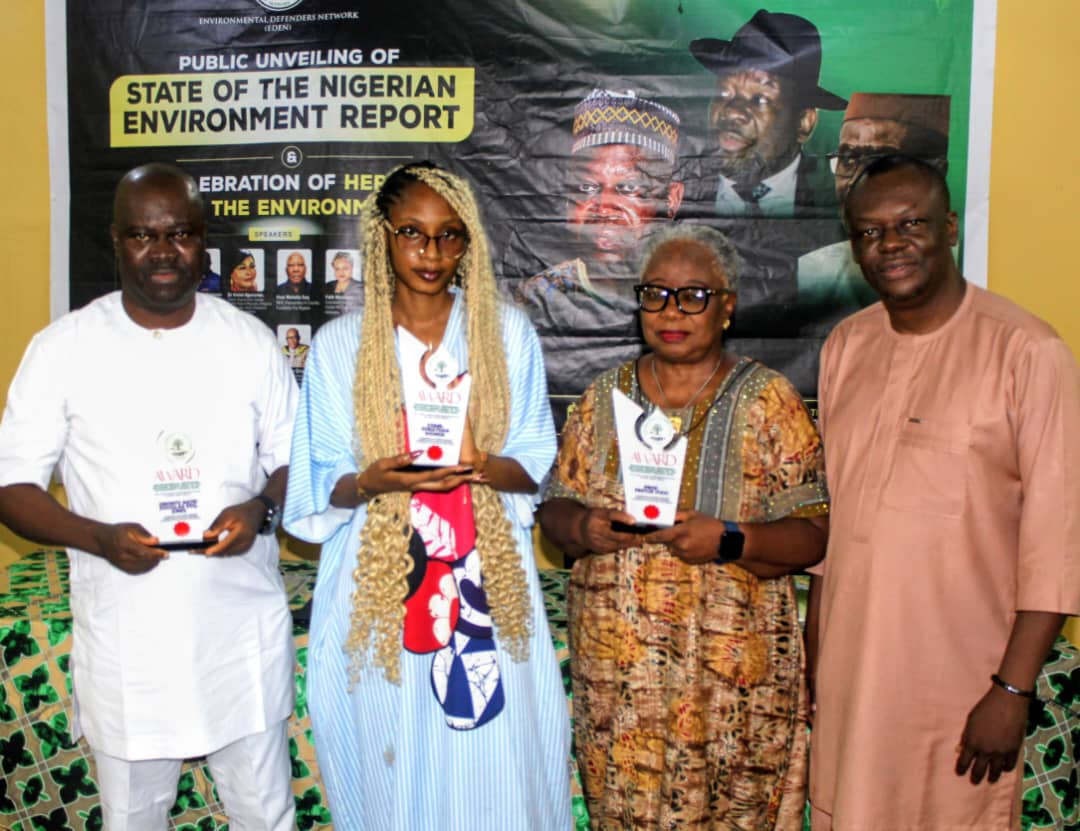
This was the verdict of experts who spoke at the Environmental Defenders Network’s (EDEN) public unveiling of the State of the Nigerian Environment Report and Celebration of Heroes of the Environment on Monday, August 28, 2026.
They also argued the Ogoni and Niger Delta clean up exercise should not be cosmetic, but must follow globally accepted standards similar to the response to the BP oil leak in the Gulf of Mexico which involved prompt clean up and compensation of affected communities.
Executive Director of EDEN, Barrister Chima Williams, who spoke in company of former Vice Chancellor of the Lagos State University, LASU, Prof. Olarenwaju Fagbohun, former Deputy Clerk of the Nigerian Senate and Founder Vivien Nonyelum Njemanze Foundation, Dr. Vivien Njemamze, among others, said, meaningful dialogue must be initiated with host communities with a view to hearing directly from them and addressing their grievances against extractive companies.
“Divesting International Oil Companies, IOCs, must be forced to fulfil all their outstanding MOUs and Global MOU obligations to community people and their environment before handing over assets to Domestic Oil Companies.
“We seek a halt to the ongoing divestment processes until environmental justice is secured for communities impacted by IOC operations, while the issue of local community exclusion in the ownership structure of assets through divestment must be addressed.
“We also demand the involvement of host community representatives, civil society representatives, relevant Government Ministries, Departments and Agencies, MDA’s representatives including representatives of both divesting and investing entities in a multi-stakeholders review team on best practices in the divestment process,” they stated.
The experts equally made a strong case for encouraging renewable energy dis-centralization and promoting indigenous energy companies to provide renewable energy in Nigeria coupled with will to. deal with the political nature of allocation of oil blocks, which has been a key grievance in local communities.
“On solid minerals, there should be adequate funding for the Nigerian Geological Survey Agency (NGSA), and other government agencies charged with the responsibility of generating geo-scientific data so that they can execute their statutory obligations.
“The requirement that reclamation of mining land should be carried out concurrently with mining operations in the Minerals and Mining Act of 2007 should be enforced religiously by the government.
Address the issue of creating an enabling environment for companies that are ready to observe the highest environmental standards in mining operations to check the proliferation of Artisanal and illegal miners in the solid mineral sector.
“To draw the line, we must say that it is difficult for us to come to any other conclusion than what we have proposed above in addressing the myriad of environmental crises bedevilling the country,” the report added.
EDEN and its local and international partners maintained that the present state of the environment in Nigeria presents a case of systematic and continual devastation of the land, waters and air by the unsustainable practices of the fossil fuels corporations owned by foreign entities and their collaborating Nigerian partners.
“We have also seen in recent times that the brazen and reckless mining of solid minerals has a negative toll on the environment in Nigeria. The impacts of these activities are further exacerbated by climate change which has resulted in unprecedented levels of sea level rise and high temperature which continue to adversely affect agricultural productivity and the health of citizens.
“Seventy years of oil exploration and extraction have done grave harm to the environment and by extension the health and survival of the people of Nigeria. To the majority of the people living in oil impacted communities in Nigeria, when asked the question whether oil has been a blessing or a curse to them, their answer is always to the later.
“Asked if they can substantiate their position, they will quickly draw attention to the degraded environment. To them apart from not having access to the benefits of oil extraction, their livelihood sources (farmlands, rivers etc) have been destroyed thereby making survival difficult for them and their children.
“Seventy years of oil exploration and extraction means different stories for different issues. The benefits and its distribution have also meant different strokes for different folks. For the environment, the story is a tale of woes. In August 2011, the widely referenced United Nations Environment Programme (UNEP) Assessment of Ogoniland was released.
“The findings of UNEP were as catastrophic as the peculiar circumstance of the people living in the geographical space called Ogoniland in Rivers State. The UN body found out that years of pollution has rendered the environment more degraded than many may have anticipated. The report asserted that for the Ogoni environment to be restored to full productive health, it will require what could easily pass for the world’s most wide- ranging and long-term clean-up exercise to be undertaken – 30 years.
“Ogoniland represents a fraction of the Niger Delta region where oil operations are carried out. The situation of environmental pollution in Ogoniland represents the situation in other parts of the Niger Delta. There is however the argument that there are worse scenarios elsewhere in the Niger Delta than what was found in Ogoniland. The Niger Delta region following the negative impacts of decades of oil pollution has been aptly described by Watts and Zalik as “the most polluted place on the planet,” the report further stated.
Speaking on the lessons from decades of oil exploration and exploitation in Nigeria, the experts posited that just like crude oil in the Niger Delta region, solid minerals extraction in the North could unleash prosperity in Nigeria and improve the lot of host communities.
“In the 1960s the revenues from solid minerals financed many government programs until the emergence of the petroleum industry and cheap Petro dollars which led to negligence of other hitherto thriving sectors. The resurgence of the mining industry with the Nigerian government diversification efforts and the growing call for a just energy transition has inadvertently paved the way for informal miners and companies to become very active and they get away with environmental crimes due to lack of clearly defined policies in the sector.
“In the oil and gas sector just as solid minerals, while public outcry against environmental despoliation has been more concentrated on the physical distortion of the environment, little attention is paid to issues such as stranded assets. As the oil corporations abandon their oil wells and moribund mines litter the country, the concentration of toxic residues from their operations will continue to affect the
environment and the health of local communities.
“Those issues aside, extraction without responsibility continues to deny local communities the opportunity for development. In most host communities either in the Niger Delta or in the north, the locals contend with lack of government amenities such as good roads, health centers and electricity.
Despite the blame heaped on extractive companies for their reckless activities, the Nigerian state cannot be exonerated from these crimes. Public officials are either complicit in form of collusion or they turn the other eye out of helplessness in handling the situation.
“Agencies set up by the government to address the environmental fallouts of extraction are in most cases platforms for theatrics to keep the locals busy without addressing their concerns. This has been the observed pattern in many cases where spills are reported to agencies like NOSDRA and they complain of lack of manpower or equipment to reach the affected sites and have to depend on the despoilers of the environment to reach such places.
“In view of these endless challenges besetting the environment there is an urgent need for actions to address them. Degraded environments must be restored and secured for sustenance of life now and for generations unborn. Such a decisive move will stem the restiveness and tide of violence associated with natural resource governance.
“In addressing these issues, priority should be accorded to the youths who feel a sense of disillusionment and hopelessness that their resources are expropriated without any form of benefits accruing to their communities hence the recourse to arms and violent resistance which many see as the only way out,” the report revealed.
In its executive summary, EDEN noted that Nigeria is one of the most endowed nations of the world in terms of its natural and human resources. Nigeria is blessed with vast arable land for agriculture, mineral deposits, diverse wildlife and plant species and a network of productive rivers and water resources.
It states that Nigeria has enjoyed a relatively stable environment and there is hardly any record of a monumental natural disaster that has happened within its geographical space. But the threat to the sustainability of the environment in Nigeria emanates from human activities and inactions.
The human activities that undermine the environment come from compromised lifestyles and attitudes birthed by massive industrial and commercial activities. While the consumption and waste disposal patterns of ordinary Nigerians have contributed to a large extent to plastic pollution in the nation’s waters, traditional and change ‒ resistant agricultural practices occasioning continual deforestation have resulted in large scale biodiversity loss. Unsustainable harvesting of forest resources through unrestrained poaching, lumbering, and subsistence harvest of firewood has negatively affected both rainforest and mangrove forests in Nigeria.
“The State of the Nigerian Environment Report is not intended to merely present data and update on the perilous state of the Nigerian environment. Its prime purpose is to increase public awareness on the extent to which the destruction of the environment affects everyone, and to amplify the call to action that all stakeholders must take steps to halt any further degradation of the environment and join forces to protect it for all of us.
“Published research and media reports indicate that the ruination of the environment in Nigeria is predominantly man ‒ made which also implies that human actions can halt, restore, and sustain it for the sake of posterity. The findings in this report reflect the comprehensive work and research conducted by dedicated members of the EDEN team and our allies in the environmental justice community who are also on the frontlines of the quest to save our natural patrimony. Our observations point to the fact that the health of the Nigerian environment is no longer at ease. The stark reality of the situation portends grave danger to all concerned.
“From the North to the South and from the East to the West the environment in Nigeria can best be described as one that is sick and needs urgent attention. From the unregulated petroleum extraction related pollution ravaging the Niger Delta region to the varied artisanal solid minerals mining induced destruction in the other parts of the country, the Nigerian environment is laid bare to huge biodiversity losses, colossal waste lands, life threatening gully erosion, ocean surge and coastal erosion, draught and desertification among others contributing to the increased climate change impacts and conflicts, one cannot but imagine how people could allow unregulated economic activities take away the soul of the environment on which their ultimate survival depends?”