
Communities Demand Unpaid Entitlements
Host communities of the Eastern Gas Pipeline give the Nigerian National Petroleum Corporation Limited and the Pipeline Infrastructure Nigeria Limited a two-week ultimatum over their unpaid surveillance entitlements
By Jude Nzennaya, Port Harcourt
Host communities along the Eastern Gas Pipeline Network (EGN) have issued a two-week ultimatum to the Nigerian National Petroleum Company Limited (NNPCL) and Pipeline Infrastructure Nigeria Limited (PINL) to settle outstanding payments owed pipeline surveillance contractors and guards.
The communities have also demanded their inclusion in the Corporate Social Responsibility (CSR) programmes of both organizations, insisting that those who contribute to safeguarding critical national infrastructure should also benefit from the development initiatives associated with its operations.
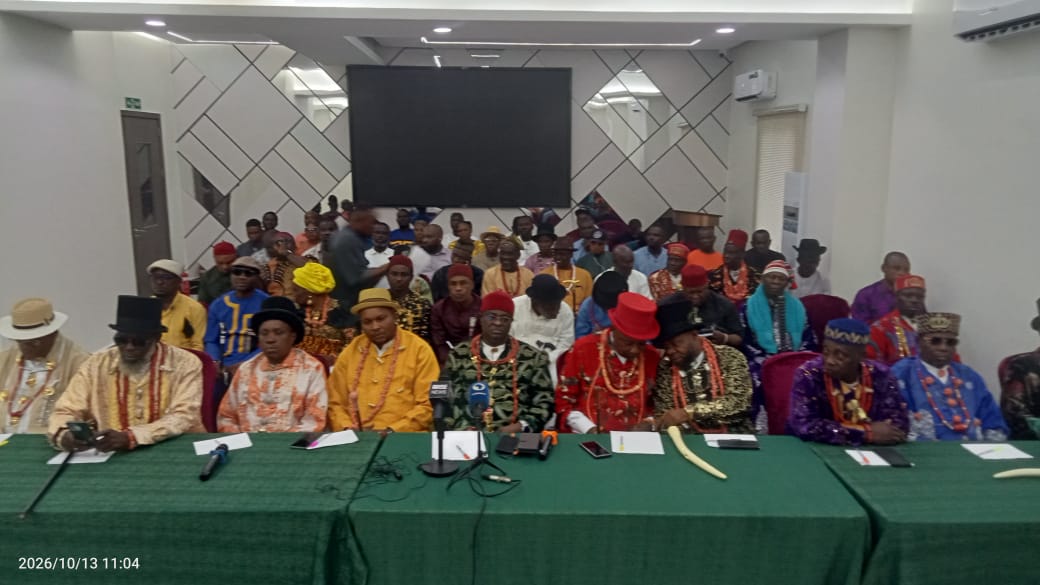
The demands were presented at a press conference on Tuesday 13th October 2026 in Port Harcourt, Rivers State, where the communities expressed concern over the prolonged delay in the payment of entitlements to surveillance contractors and guards responsible for protecting the gas pipeline infrastructure.
Speaking on behalf of the host communities and stakeholders, the paramount ruler of Elele-Alimini Community in Rivers State, Nye Nwe Ali, His Royal Highness Eze Peter Wagbara CP (Rtd) said the outstanding payments had placed considerable pressure on families who depend on the earnings for their daily survival.
According to him, the delay has generated anxiety, dissatisfaction and uncertainty among community members, many of whom have continued to support the pipeline surveillance programme in the interest of public safety and national energy security.
“The surveillance guards have families and responsibilities. They depend on the timely payment of their earnings to meet basic needs, while community stakeholders have continued to support the programme and mobilise their people in the interest of pipeline security,” Wagbara said.
He warned that the continued failure to address the payment concerns could weaken the trust and goodwill painstakingly built among the host communities, PINL and NNPCL.
“The prolonged delay has understandably created anxiety, dissatisfaction, and uncertainty among our people. We are concerned that if this situation persists, it could undermine the goodwill and confidence that have been painstakingly built between the host communities, PINL and NNPCL,” he added.
The communities stressed that the ultimatum should not be interpreted as a withdrawal of their support for pipeline protection. Rather, they described it as an appeal for both companies to fulfil their obligations and sustain the cooperation that has helped maintain security along the Eastern Gas Pipeline Network.
They called on PINL and its client, NNPCL, to take immediate steps to reconcile outstanding obligations and pay the full backlog owed to surveillance contractors, guards and eligible community stakeholders.
They also urged the companies to ensure that regular payments resume promptly and continue in accordance with agreed contractual and administrative arrangements.
In a further demand, the communities asked both organizations to engage recognized traditional rulers and community representatives to communicate a clear payment schedule, address outstanding grievances and establish a sustainable mechanism for resolving future disputes.
The communities gave the companies a two-week grace period from the date of their public statement to resolve the outstanding payment issues and demonstrate concrete progress towards incorporating their communities into relevant CSR initiatives.
“We hereby give PINL and NNPCL a two-week grace period from the date of this public statement to resolve the outstanding payment issues and demonstrate concrete action towards the inclusion of our communities in relevant CSR programmes,” the statement read.
“We expect this period to result in meaningful progress, including the settlement of the backlog, the resumption of regular payments, and the formal inclusion of our communities in the relevant development initiatives.”
Beyond the payment dispute, the host communities want a more structured relationship with the two companies, particularly in the area of community development.
Wagbara said the communities should be formally integrated into scholarship schemes, youth and women empowerment initiatives, and other development programmes operated by PINL and NNPCL.
He emphasized that participation in these programmes should be guided by transparent eligibility criteria to ensure that deserving members of the host communities have fair access to the opportunities.
For the communities, the demand for CSR inclusion reflects their expectation that their contributions to pipeline security should be accompanied by meaningful opportunities for social and economic advancement.
They also want regular engagement between the companies, traditional institutions and community stakeholders to improve communication, strengthen accountability and prevent future disagreements over payments and development commitments.
Despite their concerns, the communities acknowledged that PINL’s operations had contributed to improved peace and security in their areas and along the gas pipeline corridors.
They were careful to stress that their ultimatum was neither intended to disrupt the operations of PINL and NNPCL nor to discourage investment in the Niger Delta region.
Instead, they described their demands as a call for fairness, accountability and the fulfilment of obligations to communities that have embraced the responsibility of protecting critical national infrastructure.
“Our communities have keyed into the vision of community-based pipeline surveillance. Our people understand the strategic importance of the Eastern Gas Pipeline Network to national energy security and economic development, and they have continued to contribute to its protection,” the statement said.
The communities maintained that their continued participation in pipeline surveillance was rooted in an understanding of the network’s importance to the country’s energy supply and economic development.
However, they insisted that the sustainability of the arrangement depends not only on community cooperation but also on the timely fulfilment of agreed obligations by the companies involved.
As the two-week deadline approaches, the attention of the host communities is expected to remain focused on the response of PINL and NNPCL to their demands.
The immediate priority is the reconciliation and settlement of outstanding surveillance entitlements, alongside the restoration of regular payments. Equally important to the communities is a clear commitment to their inclusion in scholarship, empowerment and other CSR programmes.
For the traditional rulers and stakeholders, resolving the dispute would provide an opportunity to reinforce the cooperation that has supported pipeline security while addressing the economic concerns of the people who participate in the programme.
They reiterated their willingness to pursue peaceful engagement and constructive dialogue but warned that their patience should not be mistaken for an absence of legitimate concerns.
Ultimately, the dispute highlights the importance of timely payments, transparent communication and inclusive community development in sustaining relationships between infrastructure operators and their host communities.
For the Eastern Gas Pipeline Network, the challenge is to ensure that the shared responsibility of protecting critical national infrastructure is matched by the fulfillment of obligations and a development framework that recognizes the interests of the communities along its route.