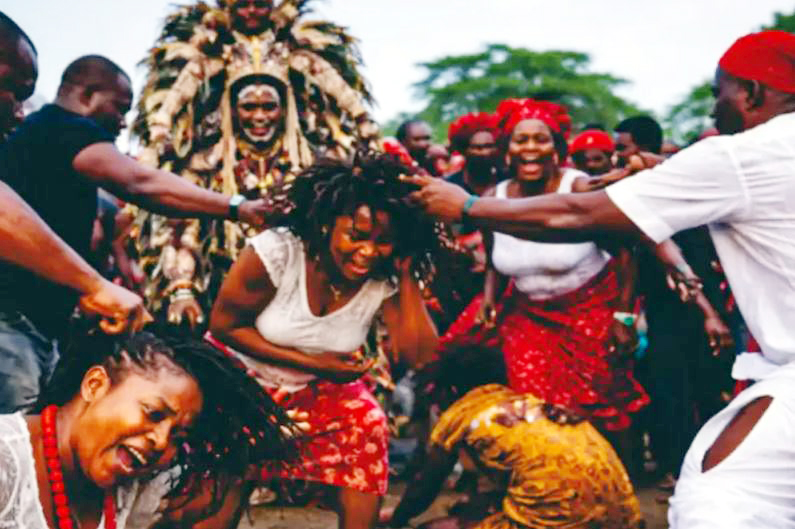
A fertility festival for women seeking children turns violent in Oruamudhu Quarters of Ozoro, headquarters of Isoko North Local Government Area of Delta State, as some randy youths used the opportunity to sexually molest ladies, leading to national outrage and calls for total abolishment of the tradition that tramples on women’s dignity
By Edu Abade
It all started from a video on social media which depicted some sort of sexual harassment of a number of ladies in Ozoro, Isoko North Local Government Area of Delta State. It immediately went viral with some uninformed persons about the culture and tradition of the community calling it a Day of Rape or Festival of Rape, which the owners of the land said it is not, and can never be.
Swiftly responding to the incident, prominent Nigerians including a former presidential candidate of the Labour Party, Peter Obi, condemned what he described as “the sexual assault and harassment of women during the ‘Alue-Do’ festival in Ozoro, calling the attacks a reflection of misplaced national priorities.
In a statement on Saturday, March 21, 2026, titled, Channeling Our Women to Critical Areas of Development, Obi described the festival incident as a “triviality” that diverts attention from more pressing development needs, particularly the empowerment of women, who constitute over 50 percent of Nigeria’s population.
“While the rest of the nations of the world are investing in critical areas of development such as human capital, we lag behind. Instead of ensuring that our women-the vital segment of our population-are educated and meaningfully integrated into leadership and management structures, where they have consistently proven to contribute significantly to development, we fall short.
“This is evident in countries like the Scandinavian nations and even in developing economies. In Indonesia, for instance, women own over 50 per cent of SMEs, which provide about 98 percent of jobs.
“Similarly, in Bangladesh, women make up about 60 percent of the workforce in the garment industry, the country’s largest export sector, generating about $50 billion-far more than what Nigeria earns annually from crude oil exports,” Obi said.
He further criticized the national focus on events such as the Ozoro festival, where videos circulating on social media showed young women being chased, stripped, and molested in broad daylight on Thursday, March 19. The videos sparked widespread outrage across the country.
“Rather than emulating these nations by investing in our women-and harnessing their productivity-our focus drifts toward trivialities such as the Ozoro festival, a development that reflects poorly on our national priorities.
“This is a profound misplacement of values. Greater effort should be directed toward meaningful development, including policies and initiatives that empower women and integrate them into the economic mainstream,” Obi added.
Also commenting on the incident, a former Minister of Education and founder of the School of Politics, Policy and Governance, Dr. Obiageli Ezekwesili, urged the police to punish all identified offenders of sexual assault on women in Ozoro in Delta State.
In a statement, she noted that Nigerians must collectively act firmly or risk enabling a dangerous precedence in other matters where Nigeria has normalized impunity.
She said the moment demanded more than mere reactive arrests, but a public accountability process led by the Delta State government, clear deterrent signals through swift judicial action, nationwide reinforcement of zero tolerance for gender-based violence and strengthening of community-level intelligence and policing systems.
“The scale and coordination of the sexual attacks in repulsive videos and images suggest that those criminal violations of women were not at all spontaneous. It raises urgent questions about intelligence, community policing and the visible presence or absence of law enforcement. The failure of governance is evident in the deeply disgusting, disgraceful and completely unacceptable acts that depraved men audaciously perpetrated in that community.
“There is no culture, no tradition and no circumstance that justifies the assault of women. What occurred in that Ozoro community was not cultural expression; it was criminal violation and violence against women,” she said.
The National Agency for the Prohibition of Trafficking in Persons (NAPTIP) also condemned the attack, describing it as “barbaric” and a violation of human rights, and pledged to support efforts to ensure justice for the victims and prevent future incidents.
Meanwhile in its intervention, the Isoko National Youth Congress (INYC) strongly condemned the reported harassment of women during the recent Ozoro Festival, describing the incident as disturbing and unacceptable.
In a statement, its President, Akpotheyowve Collins Ogaga, expressed serious concern over reports that some women were harassed and, in certain instances, sexually abused during the festival, he maintained that such actions did not reflect the values and traditions of the Isoko people.
Ogaga stated, “Cultural events are meant to promote peace, unity and pride not to create fear or endanger lives. We completely reject all forms of harassment and abuse against women. These actions are wrong and have no place in our society.”
He, however, commended the Commissioner of Police, Aina Adesola, for his swift response, noting that the directive given to officers led to the prompt arrest of those involved. Ogaga added, “We appreciate the quick intervention of the Commissioner of Police, whose directive ensured that officers moved in immediately and arrested the suspects. This shows a clear commitment to justice and the protection of citizens.”
But in a statement signed by the President General of Ozoro Kingdom, Berkley Asiafa and Secretary General, Prince Obaro Egware, they explained that the Alue-Do Festival is traditionally regarded as a festival of fertility. It is widely believed to be a cultural practice that brings blessings of children to individuals or couples experiencing difficulty in childbirth.
“As part of this long-standing tradition, certain symbolic practices are observed, including the act of playfully dragging and pouring sand on married individuals who are yet to have children, as a cultural expression believed to invoke fertility.
“However, some youths misinterpreted and misapplied this cultural practice in a negative and unacceptable manner, leading to the harassment of some young women. We wish to clearly state that reports circulating on social media alleging that rape and widespread atrocities occurred during the festival are false and misleading. No incidents of rape were recorded. The situation involved the harassment of two young women by individuals who took advantage of the occasion to act irresponsibly.
“We condemn any form of harassment or misconduct. Such behavior is not part of our culture and traditions and will not be tolerated. Appropriate steps are being taken to address the actions of those involved and to ensure that future celebrations are conducted in a peaceful, respectful, and orderly manner. We urge members of the public to disregard false reports and refrain from spreading misinformation that may tarnish the image of our cherished cultural heritage,” the statement reads.
Also, in his response titled, All Eyes on Ozoro: The Rape Story and Image Tarnishing of a Kingdom, Olubokun Anthony Otame, a prominent son of Ozoro based in the United Kingdom (UK) argued that the circulating video was unclear and the voiceover is nothing more than a chaotic performance by a Gen‑Z content seeker desperate for views, followers and monetization on TikTok, YouTube and Facebook. Unfortunately, this attempt at virality is now being used to tarnish the image of an entire kingdom.
“What troubles me most is how quickly people have joined the chorus of condemnation without understanding the facts behind the facts. I grew up in Oruamudhu. I witnessed the Aleudo festival many times. I knew one of the old chief priests-Baba Ako of blessed memory-and the priestess, the late Oni‑Olokun Titi Idu, whose compound was barely ten metres from ours. These ancestral custodians were people of deep piety and unquestionable integrity.
“The Aleudo festival, much like the ancient Greek Dionysian rites or the Roman festivals of Ceres and Bona Dea, was fundamentally a fertility ceremony. It was a communal appeal to the divine on behalf of the barren and those struggling with procreation. It had nothing-absolutely nothing-to do with rape or the violation of women.
“In fact, those who had the courage to come out during the procession from the shrine at Azon were surrounded by community women. These women poured sand on their bodies and invoked the spirits to remove the burden of barrenness. It was a ritual of hope, healing, and renewal, not violence.
“We must not allow the reckless behaviour of a few misguided youths-driven by reprobate impulses and the lure of social‑media fame-to redefine a sacred tradition. A thorough forensic investigation is necessary. Let the perpetrators be identified, let the law take its full course, and let the truth stand. Even the gods know how to respond when their name is dragged unjustly.
“As the eye and voice of the gods, those who by divine callings know and can see what many cannot. The Aleudo festival, like the ancient fertility rites of Greece and Rome, carries cultural, spiritual, and historical significance that should not be erased by sensationalism. Traditions evolve, but their essence must not be distorted,” he stated.
However, the Police Public Relations Officer (PPRO) Delta State Police Command, Bright Edafe, said: “Although about four ladies interviewed on the incident confirmed that they were not raped, the community head and chief organizer of the event and four other suspects have been arrested. The Commissioner of Police has ordered their transfer to the State Criminal Investigation Department.”
The police also later affirmed that six girls who are students of the Southern Delta University in Ozoro confirmed that they were sexually harassed but not raped.
A police serving officer in Ozoro who spoke with Tentacle on condition of anonymity, confirmed that as of Tuesday, March 24, 2026, no fewer than nine persons, including the youth Leader of Oruamudhu Community where the incident happened, Comrade Owuawho, had been arrested as the state police command continues investigations into the matter.
“The truth is that the matter is being overrated and overhyped because there was a festival of fertility quite alright, but to generalize the event and say that women were raped on that day is not correct. Some young men hijacked the celebration to harass a few girls away from the scene of the festival, but there was neither rape nor ‘penetration’ so to say,” he said.
Besides, a veteran Arts and Culture journalist and an indigene of Ozoro, Anote Ajeluorou, told Tentacle that some stupid GenZs who don’t have a sense of what tradition is took advantage of a fertility festival usually held in Oruamudhu Quarters, not the entire Ozọrọ and decided to unleash the monster eating up their warped minds to harass some young girls. The alleged rape didn’t happen because they were stopped.
“So there is nothing like Rape Day anywhere in Isoko. But as they say, when one finger brings oil, it soils all others! The culprits have been arrested and will be prosecuted. Ozọrọ as a kingdom has disowned them and Chairman of the Local Government Area has also released a statement, not only condemning the act, but pressing charges against the perpetrators. So it’s all false. There is no Rape Day or Festival of Rape anywhere in Isoko Land, not least in Ozọrọ.
Meanwhile, one of the victims, Miss Ezeugo Ijeoma Rosemary, a 300-level student of Library and Information Science, Southern Delta University, Ozoro who is still traumatized from the incident narrated her harrowing experience thus: “I am from Imo State but reside in Warri. On that day, at about 5pm I went to pick up my power bank unknown to me that they were holding their festival because it was not announced. Immediately I came down from the bike, a lot of boys from different directions started shouting that they should hold me. ‘Hold her, hold her, na girl she be’, they said, so I tried to escape but they swooped on me like bees. The crowd was much and they started harassing me, pulling my clothes. They eventually tore my clothes until they stripped me naked. They were manhandling me, pulling my breasts and touching my whole body. They also took my phone. One boy later came to my rescue as I was shouting for help. I was alone and the incident happened at a junction close to my school. The festival was not held at Gwake where I went to charge my power bank.
“I am getting better but feeling pains in my chest and breasts. On Sunday, I was told that the Commissioner of Police wanted to see me, so I went with my dad and our lawyer to Ozoro. At the King’s palace I was questioned and asked to go to A Division to write my statement. I was also asked to list the items that I lost during the incident which I did. The school management has not told me anything but I will be going back to school next month because I am still in trauma”.