As Nigeria heads towards the crucial 2027 presidential election, youthful voters who form the bulk of the electorate express concerns that the economic hardship and insecurity ravaging the country will worsen if incumbent President Bola Tinubu is reelected for the second term in 2027, however these are quick to add that due to the anger that cuts across the country caused by Tinubu’s inhuman policies, the incumbent President can only secure a comeback through rigging and another glitch from the handlers of INEC portal which they insist will be resisted
By Edu Abade
Even President Bola Ahmed Tinubu himself admitted in his Democracy Day address to the nation on Friday, June 12, 2026, that Nigerians are suffering severe economic hardship.
But beyond just economic hardship, exacerbated by rising inflation, high cost of fuel, escalating price of cooking gas which is forcing most households to revert to charcoal, sawdust and firewood for cooking their meals, insecurity has taken a dive for the worse ever in the three years of the President Tinubu administration.
In the last couple of weeks alone, hundreds of Nigerians have been abducted in Borno, Oyo and other parts of the country, while the abductions in Zamfara State took a new dimension as over 39 elders who went for a peace meeting with bandits ended up being kidnapped in a most brazen manner.
In his Democracy Day address, which has been adjudged uninspiring by citizens, Tinubu had stated in part, “We have moved from training with our allies, the United States, France and other European countries, to precision targeting. In Arege, Borno State, we degraded ISWAP’s command centre. Terror-related deaths are down by 81 percent since 2015. Over 13,000 terrorists have been neutralized in the past year. But we also keep the door of surrender open. Over 124,000 fighters and dependents have laid down their arms since 2023 through Operation Safe Corridor.
“To bandits, kidnappers and sponsors of terror, we urge them to surrender or face the full force of the Nigerian State. These windows of surrender will not remain open forever. No mercy will be shown to those who trade in the blood of Nigerians”.
Regarding the worsening insecurity in the country, the Northern Elders Forum (NEF) cautioned President Tinubu to immediately declare a national security emergency as escalating violence, kidnappings, banditry and armed attacks threaten Nigeria’s stability, economic growth, national cohesion and unity.
National spokesperson of the group, Abubakar Jiddere in a statement described the country’s security situation as alarming and unprecedented, stressing that millions of Nigerians are now living under constant fear due to the activities of criminal groups operating across several parts of the country.
The group further stated that the worsening insecurity has exposed Nigerians to daily threats, with attacks becoming more frequent and widespread in in Zamfara, Katsina, Kaduna, Niger, Plateau, Benue, Kogi, Kwara, Borno, Oyo, Edo, Enugu and Imo states.
The NEF also lamented the Federal Government’s failure to adequately safeguard lives and property despite repeated assurances from security agencies, authorities and even the United States government under President Dionald Trump, noting that several communities continue to suffer deadly assaults from bandits, kidnappers, terrorists and other armed groups that operate with increasing boldness.
A social critic, Theophilus Agbu who spoke to Tentacle in Lagos recently wondered why the Federal Government remained adamant in arresting and questioning people like Sheikh Gumi, who have openly supported the activities of the bandits, saying that his recent open declaration following the abduction of school children in Oyo State that he was proud of the boys and that the Islamization agenda of Northern Islamic extremists being extended to the South-West, South-South, South-East and other parts of the country was working out.
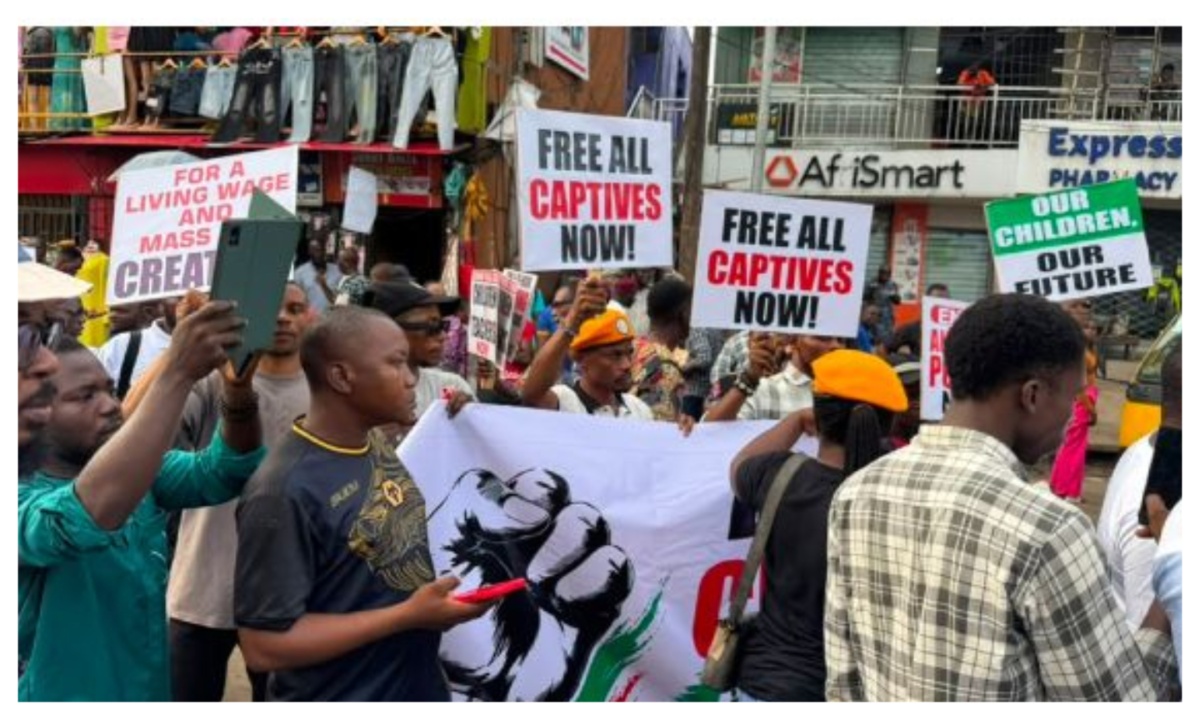
In an attempt to vent their anger on the escalating insecurity and hardship among Nigerians, human rights lawyer and Senior Advocate of Nigeria (SAN), Femi Falana in partnership with over 16 civil society groups embarked on mass protest on Friday, June 12, 2026.
The groups, comprising trade unions, youths, social movements and faith-based organizations, noted that the protest was timed to coincide with the country’s yearly Democracy Day for June 12 every year.
Organizers of the national protest decried what they described as widespread administrative failures which leave ordinary Nigerians with nothing to celebrate on the June 12 anniversary.
At the core of Nigerians agitations is the need for the Independent National Electoral Commission (INEC) to conduct credible, free and fair presidential election come 2027. They vowed to vote, defend their votes and ensure that their votes count in the forthcoming general elections.
Citizens who shared their thoughts with Tentacle believe that the Chairman of the Commission, Professor Joash Amupitan was already showing signs of a biased electoral umpire, who is ready and willing to accede to the whims and caprices of his employer, Tinubu, insisting that if the glitches that characterized the 2023 presidential elections happen again, the commission’s national offices would be burnt down by angry voters whose votes couldn’t count.
Already, Amupitan has shown signs of favouritism in the restoration of suppressed constituencies in Benue, Delta, Jigawa and Kogi for 2027 Polls, saying that the decision was in line with the powers conferred on INEC by the 1999 Constitution (as amended) and the Electoral Act, 2026.
But a critical review of the restored constituencies showed that Benue State got five including Nyamatsor, Ukum Afia, Konshisha III (Shangev-Tiev), Makurdi III (South East) and Gboko III
Delta State had six constituencies-Aniocha North II, Ika North East II, Sapele II, Ethiope West II, Warri South West II and Warri North II, while Jigawa State got one constituency namely, Aujara State Constituency.
In Kogi State, the INEC Chairman restored 10 constituencies being the highest number namely: Adavi East; Eika; Ajaokuta North; Bassa-Komu; Dekina Town & District; Ijumu II; Kabba-Bunu II; Koton Karfe II; Igalamgwa and Ogugu.
To allow political parties to nominate candidates in these restored areas, INEC has fixed June 16 to 25, 2026, for the conduct of party primaries exclusively in the affected constituencies.
A nationwide poll conducted ahead of the 2026 Democracy Day, released by premier polling agency NOIPolls showed that 72 percent of Nigerians are dissatisfied with the current state of democracy in the country. Within this group, 46 percent stated that they are “not satisfied at all,” while 26 percent identied as “not satisfied.”
Conversely, only 21 percent of respondents expressed any satisfaction with the nation’s democratic progression.
The data highlighted stark geographic disparities in how democratic governance is perceived across Nigeria’s geopolitical zones.
Dissatisfaction peaks sharply in the southern regions, while parts of the north reported relatively higher tolerance.
The 2026 Democracy Day opinion poll was conducted in the week commencing June 1, 2026, and involved computer-assisted telephone interviews (CATI) of a proportionate nationwide sample of 1,000 randomly selected Nigerians aged 18 years and above who own phones, representing the six geo-political regions and 36 states and the Federal Capital Territory (FCT).
The report reads in part: “The reasons behind this dissatisfaction are rooted in core governance failures. For instance, among dissatisfied respondents, increased insecurity (31%), poor dividends of democracy (20 percent), economic hardship (19 percent), and poor governance (17 percent) are the primary drivers.
“This perception is reflected in citizens’ evaluation of government performance across sectors. Data from the poll indicate that performance is rated poorly in areas most critical to daily life. For instance, security receives a 72 percent “Very Poor” rating, followed by electricity (57 percent), foreign policy (49 percent), and the economy (48 percent).
As Nigeria marked the 33rd anniversary of the June 12, 1993 and 27 years of uninterrupted civilian rule on Friday, June 12, 2026, a Civil Society Organization (CSO) with the name Corporate Accountability and Public Participation Africa (CAPPA), has urged the Federal Government to treat the country’s worsening insecurity as a direct threat to democracy, the rule of law, and the credibility of the 2027 general elections.
In a statement to mark the day, the group cautioned that no democracy can flourish when citizens live under the constant threat of kidnapping, terrorism, banditry, communal violence, and other forms of criminality.
Assistant Executive Director at CAPPA, Zikora Ibeh, said, “Democracy cannot thrive where people are afraid to travel on highways, send their children to school, cultivate their farms, operate businesses, or participate in elections.”
The organization lamented the continued spread of kidnapping-for-ransom across the country, noting that persistent mass abductions, including attacks on schools and educational institutions, pose a grave danger to national growth and development.
According to available data, no fewer than 4,722 persons were abducted in 997 kidnapping incidents between July 2024 and June 2025, while no fewer than 762 people lost their lives in kidnapping-related incidents during the same period. Nigerians also paid an estimated N2.57 billion in ransom to kidnappers in the course of the year.
As the 2027 presidential election draws closer, millions of voters have expressed angst against the reelection of President Tinubu to continue with his policies that are pauperizing citizens. The social media is awash with serious warnings by netizens that Tinubu must not come back in 2027. Netizens argued that a Tinubu comeback in 2027 will worsen economic and security woes of citizens because then he would not mind critics, and may allow the country to slide into a killing field and anarchy. These voters added that if Tinubu succeeds himself in 2027, Nigerians may buy fuel for as high as N2,500 per litre and a kilogram of cooking gas for as high as N5,000. At the moment a kilogram of gas is sold for almost N3,000. Many Nigerians who had converted their power generating sets to gas have begun to convert them back again to fuel because of the frightening cost of cooking gas.
Cost of electricity and its unavailability are telling on the nation’s investments and entrepreneurship. Many small and medium scale enterprises are finding it difficult to run their businesses because of epileptic power supply, and high cost of electricity whenever it is available. Recall that Tinubu had promised he would fix electricity supply in his first year as President, and also assured Nigerians that he would not solicit for their votes for second term if he failed in this promise. In fact, Tinubu clearly told Nigerians not to vote him the second term if he failed to fix electricity.
Unfortunately, three years down the line, electricity supply has worsened beyond what Tinubu met on ground. But his handlers are insisting that campaign promises are different from governance reality. They said it was when Tinubu entered Aso Rock that he found out that things were not as he had envisaged before making the promise. Critics, however, ask why Tinubu did not carry out feasibility study of the APC government at the center before making frivolous promises. His promises have turn out to hunting.
Voters advised Tinubu against desperate campaign moves which they argued that they suggest plot to manipulate the 2027 presidential election. These citizens cited example with the just concluded APC presidential primaries where Tinubu scored almost 11 million votes as a devious move to coronate himself a second time.
But they quickly referred to the campaign strategy of former governor of old Imo State in the 1980’s, Bar. Samuel Onunaka Mbakwe who was often referred to as the weeping governor. When Mbakwe was asked why he, as the gubernatorial candidate of the Nigerian People’s Party (NPP) in the 1983 elections, was not engaged in a serious campaign as other governorship candidates from NPN, GNPP and PRP.
Mbakwe had answered that he didn’t need to spend money on campaigns anymore after his first tenure. According to him; “The roads I constructed campaign for me. The industries I built campaign for me. Adapalm, our shoe industry, Imo poultry and Aluminium Extrusion campaign for me. Imo airport campaigns for me. The schools and their happy teachers will campaign for me. The workers will campaign for me. If they don’t, then I don’t need to be governor.”
Nigerians said they expect such answer from the Nigerian president and the governors in this campaign period. Let their achievements campaign for them. They should not impose themselves on the citizens through election result manipulation. They should not suppress any opposition. Let their achievements in infrastructural development, security, food, health, employment opportunities, economy, education, youth development and anti-corruption campaign for them.