

Patriotic citizens who conduct their businesses around the Idiroko Border post in Ogun State, continue to commend the acting Area Controller (CAC) of the Ogun 1 Customs Command, Deputy Comptroller Oladapo Afeni, for the adoption of a more aggressive, intelligence-backed enforcement strategy that is not only eliminating illegitimate business activities, but boosting trade facilitation and national security, to the admiration of the nation’s leadership
By Innocent Chukwu
For decades, the Idiroko border corridor has existed at the intersection of legitimate commerce and the informal economy, serving simultaneously as a gateway for legitimate trans-border trade and a lucrative passage for smugglers exploiting Nigeria’s long and porous western frontier.
But that business environment appears to be undergoing a gradual transformation.
At the centre of the emerging change is the Ogun 1 Area Command of the Nigeria Customs Service (NCS), where the Acting Customs Area Controller (CAC ), Deputy Comptroller Olukayode Afeni, has adopted a more aggressive, intelligence-led enforcement strategy aimed at altering the risk-reward equation that has historically sustained illicit commerce along the corridor.
Acting Comptroller Afeni’s philosophy since he became the head of the Customs Command late last year has remained relatively straightforward: legitimate trade should be facilitated, but smuggling, drug trafficking and other forms of economic sabotage must become increasingly difficult, expensive and dangerous.
Thus, the latest operational scorecard presented by the Command on Thursday, August 13, 2026, provided an insight into the scale of that campaign.
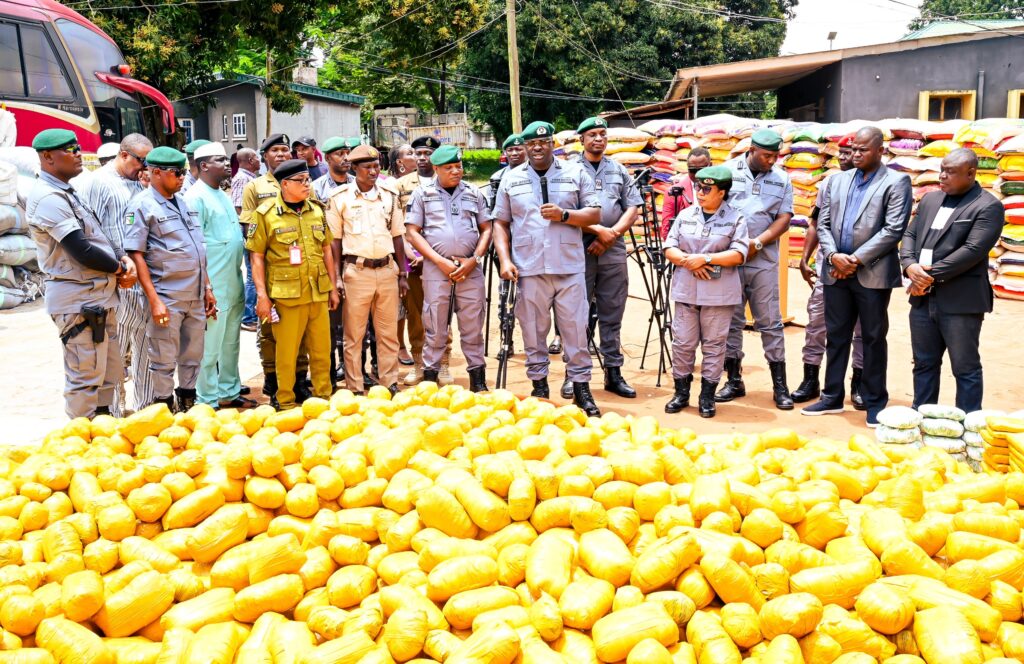
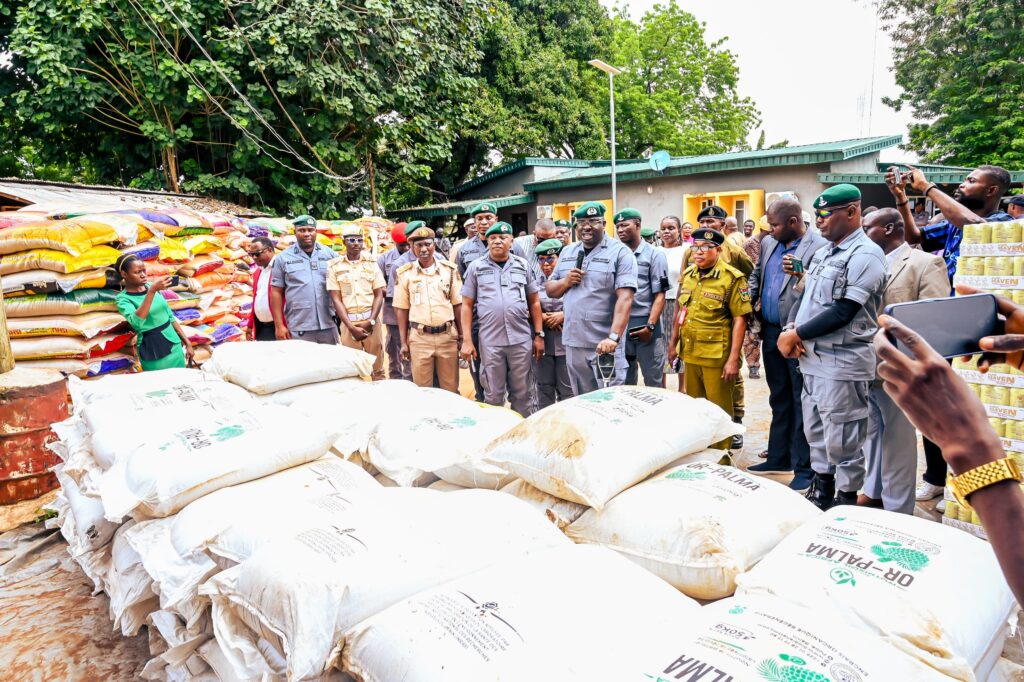
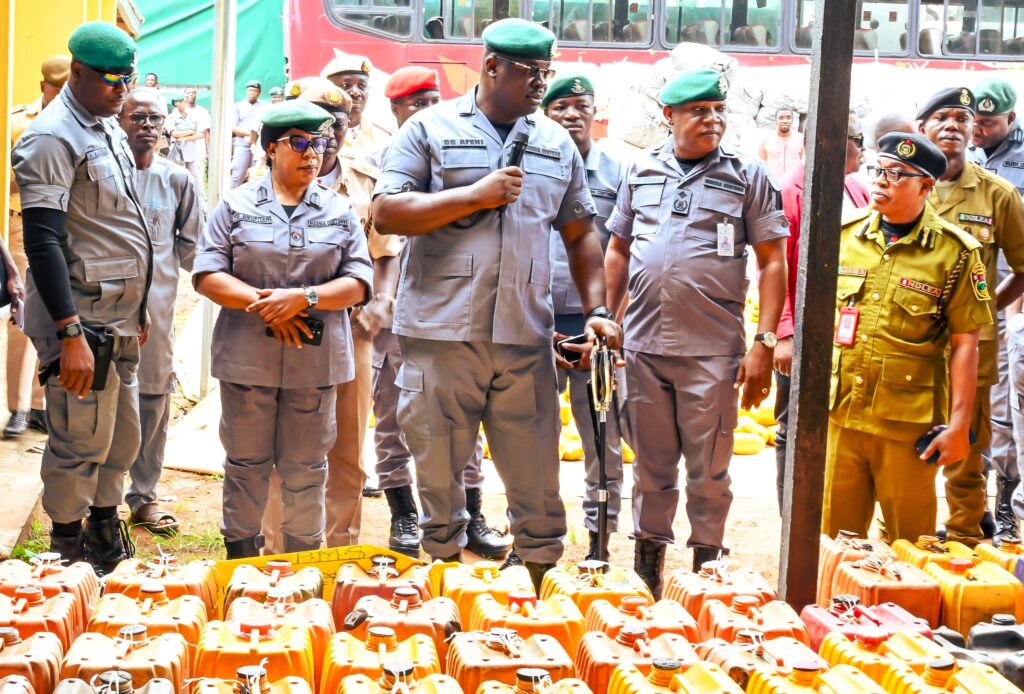
On the said date, the Afeni-led Command paraded seizures with a combined Duty Paid Value (DPV) of N3.574 billion, covering agricultural products, petroleum products, textiles, consumer goods and narcotics.
Among the intercepted items were 2,339 bags of foreign parboiled rice, 70 cartons of basmati rice, 6,035 parcels of Ghana Loud/Indica, 30 bags of foreign sugar, 11,450 litres of PMS in kegs, 1,750 litres of PMS in drums, 30 kegs of diesel, 100 bags of fertilizer and 67 bales of second-hand clothing.
The seizure list also included thousands of pieces of new clothing, drinks, cosmetics, hair accessories, fire extinguishers, purses and other consumer products.
But the significance of the figures does not lie merely in their monetary value. They provide an indication of the variety of commercial activities that the Command is now confronting along the border—and of the extent to which enforcement is beginning to influence the operating environment for both legitimate traders and illicit networks.
The Idiroko corridor has never been simply a Customs enforcement zone. It is a commercial ecosystem connecting communities and businesses on both sides of the Nigeria-Benin frontier.
For legitimate traders, the border provides access to markets, goods and opportunities for cross-border commerce.
For smugglers, however, the same geography presents opportunities to bypass formal import procedures and exploit differences in prices, taxes, restrictions and market demand between the two countries, this
is where Afeni’s intervention becomes significant.
Rather than viewing seizures as isolated enforcement events, the current strategy increasingly appears designed to disrupt the underlying business model of smuggling. Every
intercepted truck, vehicle, petroleum consignment, rice shipment or narcotics parcel represents not only a seizure but a potential interruption of a supply chain. The objective is to make illegal trade less predictable and less profitable.
Rice and the Economics of Local Production
Foreign parboiled rice remains one of the most visible commodities in the border enforcement equation. The interception of more than 2,300 bags of the staple food in the latest operation reinforced the persistent pressure on domestic rice production from illicit imports. Afeni’s
argument is that smuggling should be viewed through the prism of economic protection rather than merely customs prohibition.
When imported rice enters Nigeria outside the approved channels, it competes directly with Nigerian farmers, millers and distributors without necessarily bearing the same regulatory and fiscal obligations.
For a government attempting to strengthen domestic agricultural production, such competition can undermine investment and discourage farmers from expanding production.
The Ogun 1 Customs’ campaign, therefore, places border enforcement within the broader question of Nigeria’s food-security strategy.
In Afeni’s formulation, protecting the border is also protecting the farmer and enhancing national food security.



The Narcotics Economy
If rice represents the agricultural dimension of the border challenge, narcotics represent its darker security dimension.
The Ogun 1 Command’s interception of 6,035 parcels of Ghana Loud/Indica in the latest operation is significant, but the larger figure disclosed by Afeni is even more revealing.
From January to date, he said, Ogun 1 has handed over 32,412 parcels of hard drugs and 92 sacks of raw Cannabis Sativa to the National Drug Law Enforcement Agency (NDLEA), Idiroko Special Command.
That figure places narcotics enforcement firmly among the Command’s major operational priorities.
It also demonstrates why border security is increasingly requiring agencies to work beyond traditional institutional boundaries.
Customs officers may intercept the shipment, but the investigation, drug intelligence and prosecution process require the specialised capabilities of the NDLEA and other security agencies.
The formal handover of the seized narcotics during Thursday’s event, therefore symbolised the growing importance of inter-agency collaboration in securing the Idiroko Border corridor.
The Border as an Export Gateway
Perhaps, one of the less discussed aspects of the Ogun 1 story is the Command’s export performance.
While considerable attention is naturally attracted by seizures, the Command also recorded 10,110 metric tonnes of exports, with a Free On Board (FOB) value of N2.594 billion.
White talc, crushed thermal coal and CNG were identified as the principal drivers of the export volume.
That statistic is important because it challenges the perception of Idiroko principally as a route for imported goods.
The corridor is also capable of serving as a platform for Nigerian export drive.
This creates a potentially important policy distinction. The objective of effective border management should not be to suppress cross-border commerce; rather, it should be to differentiate legitimate commerce from illicit trade and create an environment where compliant businesses can operate with greater certainty. For
Customs, that means enforcement and trade facilitation must move together.
Revenue From the Corridor
The Command’s fiscal contribution also offers another measure of its economic relevance.
In July alone, Ogun 1 collected N90.066 million from baggage assessments, auctions of perishable items, PMS and other charges.
Although the figure can be considered modest when compared with the revenue generated by Nigeria’s major seaport commands, it illustrates the multiple revenue streams available within the border environment.
More importantly, it demonstrates that the border economy extends beyond the conventional importation of goods. It equally facilitates export trade, an achievement that presents Afeni as a versatile and knowledgeable Customs Chief.
A New Risk Calculation for Smugglers
The central question surrounding Afeni’s tenure as the CAC of Ogun 1 Command, may therefore, not be how many seizures the Command recorded in a particular month.
It may be whether the enforcement campaign is succeeding in changing the underlying calculation made by those who contemplate using the Idiroko corridor for illegal trade.
For years, smuggling has survived because its potential returns could outweigh the risks of interception.
That equation changes when intelligence improves, surveillance becomes more effective, inter-agency coordination becomes stronger and seized goods are followed by investigation and prosecution.
Afeni’s repeated warning that the Command intends to make Ogun I “hostile” to smugglers, is therefore, more than rhetoric. It represents
an attempt to change the commercial environment in which illicit operators make their decisions. But
legitimate trade must remain protected
There is, however, another side to the equation. Idiroko’s importance cannot be measured only by the volume of contraband intercepte.
Thousands of Nigerians depend on legitimate cross-border commercial activity, while manufacturers, exporters, transporters, farmers and traders require an efficient and predictable border environment.
This makes Afeni’s appeal to the media to distinguish legitimate trade from illicit activity particularly important.
An aggressive enforcement regime that succeeds in deterring smuggling, but inadvertently discourages legitimate commerce would produce an incomplete outcome.
The real measure of success would be a corridor where legitimate traders face greater certainty while smugglers face greater uncertainty.
That distinction will be critical to the long-term economic impact of the current enforcement drive.
From Border Enforcement to Economic Protection
Afeni’s presentation ultimately places the Ogun 1 Command at the intersection of three major national priorities: National Security, Economic Protection and Trade Facilitation.
The seizure of foreign rice speaks to agricultural protection.
The interception of narcotics speaks to public safety and national security.
The export figures point towards the untapped commercial potential of the corridor. The
revenue figures demonstrate its fiscal relevance. Taken
together, the figures suggest that what is happening at Ogun 1 Customs Command under the workaholic Afeni, according to many credible sources, is bigger than a succession of seizure announcements. It is
a contest over the character of the Idiroko Border economy itself.
A businessman who operates within the border, but pleaded not to be identified, said whether the emerging model can permanently shift the corridor from an environment where illicit commerce flourishes to one where legitimate trans-border trade becomes the dominant business model, would depend on the sustainability of the enforcement, the efficiency of Customs procedures, infrastructure, inter-agency cooperation and the willingness of border communities to support lawful commerce.
For now, however, Afeni appears determined to push the equation in one direction. Make
legitimate trade easier to identify and protect—and make smuggling increasingly difficult to sustain.
That could ultimately prove to be the most consequential change taking place along the Idiroko corridor, experts argued.