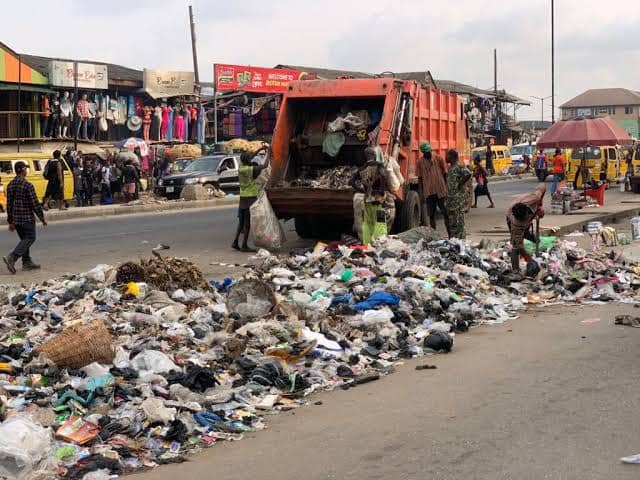
Lagos, the crowded, crawling and suffocating mega city of Nigeria and Africa is overwhelmed by increasing refuse dumps and bad roads in what residents describe as the worst experience in all parts of the state in the Governor Babajide Sanwo-Olu era, giving the impression that the state government has abandoned its core responsibility in the build-up to the upcoming 2027 general election
By Edu Abade
Lagos as it is known, has never been this burdened by the level of decay and abandonment giving the waste disposal challenges that have beset the metropolis. The Babajide Sanwo-Olu administration and the Commissioner for the Environment, Tokunbo Wahab and his counterparts in the ministries of works and health, as well as the Muyiwa Gbadegesin-led Lagos Waste Management Authority (LAWMA) look on helplessly.
This medium learnt that the incumbent governor has been having challenges with his mentors at the presidency, perhaps this is the worst experience in recent times in the waste management sector. There is reportedly a daily accumulation of over 15,000 tons of waste awaiting evacuation across the state, especially in Alimosho, Apapa, Ojo, Ikorodu, Amuwo-Odofin and Mushin local government areas of the state.
Visits to Iyana-Oba on Badagry road, Ikeja, Ikotun, Ipaja-Ayobo and the Abule-Egba stretch of the Lagos Abeokuta Expressway, among other highly populated areas in the Lagos metropolis indicated an overburdened areas by refuse dumps and bad roads. It showed that refuse dumps of different shapes and sizes litter the road sides with reckless abandon.
To that extent, residents question the effectiveness or otherwise of government Ministries, Departments and Agencies (MDAs) responsible for waste management in a state looked upon as a model for other states in the country.
The situation is further compounded by bad roads and constant rain fall to the extent that even elitist settlements like Apapa, Government Reserved Area (GRA), Ikeja, Magodo, parts of Ikoyi, Victoria Island and Lekki-Ajah, and especially the suburbs around the metropolis remain a sordid experience for commuters.
Speaking on the state of the current refuse crisis in Lagos, Managing Director and Chief Executive Officer, Dr. Muyiwa Gbadegesin, who lamented the infrastructure gaps, ineffective waste management system, enforcement and the way forward for Lagos, among other challenges, said Lagos, a rapidly growing megacity with over 22 million people, generate between 13,000 and 15,000 tons of waste daily.
In his words, “To manage that, you need significant investment across the entire value chain of waste management which starts with containerization of waste with waste bins used to keep waste in each household or business before collection. Once you containerize refuse, the waste has to be collected regularly, and for that you need trucks, and in Lagos, we use compactor trucks to do house-to-house collection.
“We expect that by the end of this year, Transfer Loading Stations (TLS) should be completed. Then, the MRFs, sometime in the first quarter of next year. At that point, we can close down Olusosun. One is already closed.
“ln the area of treatment and disposal, we have a long-term project, five-year project to build a biogas plant. That is a partnership between LAWMA and Lagos Metropolitan Area Transport Authority, LAMATA. We completed the feasibility study about a year ago, funded by the Swedish government.
“Sweden has achieved a very high level of circularity. We have been partnering with their government to replicate some of the achievements. Since 1942, the city of Stockholm has been treating their organic waste in both solid and liquid forms and using that to produce biogas, which they pipe to homes for cooking, and heating the houses. They also use it for their public transport fleet. They have a network of filling stations where the buses can fill up with biomethane.”
To resolve the waste management challenge, Gbadegesin explained that the state government was installing biodigesters in the Ikosi Fruit Market, Alamtu, Mile 12 and Afolabi Ege markets, among others, which generate high volume of organic waste.
“The state government has about 80,000 smart bins, which are not free. The adoption rate has been slow. We are looking at a situation where we can distribute them free to households, and then we’ll be adding a small amount to the bill every month so that you pay it off. We want to roll that out by the end of the year.
“By the end of this year, we are expecting 150 new compactor trucks. Each of the 57 local governments and Local Council Development Areas (LCDAs) have ordered two, and the state government is ordering 36, making a total of 150. This will form part of a new unified waste management fleet that we will jointly manage with the local governments. And by next year, we’re hoping to do a lot more in terms of new trucks. Our target is to have 2,000 trucks. To support that new system, we are going to do a lot of reform of the PSP programme,” he stated.
The LAWMA boss also explained that every incident of illegal dumping of waste has a different reason and that is why in the last two years, the agency established a Waste Investigation, Surveillance and Enforcement Unit to find those who dump waste illegally around the state. He lamented that part of LAWMA’s job is to clear illegal waste once sighted, adding, “But the next you see the same waste, and you clear it again. And what we realized is that the more you clear it and the faster you clear it, the faster they dump more, because the people think and believe that this is where LAWMA usually collect waste.”
He further disclosed that Alimosho, Amuwo-Odofin, Ojo, and especially along the Ikorodu stretch and Lagos Island councils will receive special attention, stressing that generally, fast-growing areas and heavily built-up urban areas usually experience pressure, while GRAs and estates with organized payment have less pressure. “But in areas with poor road access, tricycle collection makes more sense. Those are our targets.”
On enforcement and fines for offenders including community service, Gbadegesin said, “We have always had community service. But we’re reviewing the law with the House of Assembly for stiffer penalties. However, enforcement only works when the system is functional. That’s why we sometimes give 48 hours or seven-day notice before sealing. “
“We do a monthly performance audit of all PSPs statewide. We check: are trucks working? Are they coming as scheduled? What’s customer feedback? How many times do they dump at the landfill? They get a score. If they fall below, they get a query. After three queries, we can withdraw their license. Last year we withdrew about 27 out of 450. Same this year. That’s why some areas have gaps and we’re working with chairmen of local government areas to provide backup.”