
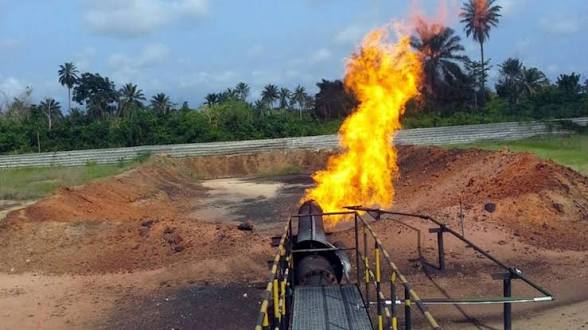
After several decades of government’s and oil companies inaction to end gas flares in the country while hiding behind the payment of meagre penalties for continued flares, environmental activists have again made a case for total ban on burning of gas into the atmosphere, which has exacerbated global warming and contributed in great measures to worsening global climate crisis
By Edu Abade
A foremost group of environmental defenders and climate change crusaders, the Renevlyn Development Initiative (RDI) has urged the Federal Government of Nigeria to ban gas flaring outright, arguing that the oil companies operating in the Niger Delta have remained very comfortable with the payment of ‘meagre penalties’ for flaring rather than stop the practice entirely.
RDI’s position comes on the heels of recent data from the Nigerian Oil Spill Monitor spanning between March 2012 and 2025, which showed that oil companies operating in Nigeria paid an estimated $646 million in gas flaring penalties in 2025, the highest payments in the last five years.
 According to the data, the all-time high penalties payable was $934 million when oil companies in the country flared gas valued at $1.6 billion in 2018. After that there was a dip from 2020 till 2022. The surge in the flares began again in 2023.
The data shows that flared gas was 349.3 million Standard Cubic Feet (SCF) in 2020. It reduced to 264.6 million scf in 2021 and 230.1 million scf in 2022, before rising again to 278.3 million scf in 2023 and even higher at 301.3 million scf in 2024.
Reacting to the development for which environmental groups have continued to agitate for decades, Executive Director of RDI, Philip Jakpor said, “The increase in payment of the penalties should not be viewed in terms of revenue as the Nigerian government wants us to see it.
“It should not be a cause for celebration. What it shows is that the oil companies are very comfortable paying what the government portrays as humungous sums rather than saving our environment and people from the toxic emissions.”
Jakpor, who shared his insight in an emailed document to Tentacle, maintained that for the polluting oil companies the penalties at $2.00 for 1,000 scf still remains a pat on the back, even as he added that after decades of gas flare out deadline breaches since 1984 which should have attracted very weighty sanctions the government has capitulated to a position of financialization of pollution.
Lamenting the devastating impacts gas flares have had on oil producing communities of the Niger Delta, the RDI helmsman argued that successive governments have failed to ask the crucial question, which revolves around the cost to the health of the people and their environment and Nigeria’s contribution to climate change through unending emissions from the gas flare stacks.
“Communities living side by side these polluting facilities carry the biggest burdens in form of constant heat, acid rain, poor farm yields, and the health impacts of inhaling methane and other toxic chemicals from the flare sites. That should be the biggest worry of our government instead of so-called revenue,” he stated.
He said RDI’s position remains that in the present circumstances when rising payment of flares are celebrated, the government’s commitment to net zero emissions by 2060 is questionable, insisting that the only solution is to stop gas flaring in entirety.
“A genuine and just energy transition must be built on cutting emission at source rather than encouraging the fossil fuels industry to continue business as usual. An end to gas flaring is what we want to celebrate, not increased revenue from penalties,” he argued.