Given the rising number of strange diseases and deaths across the globe occasioned by unhealthy diets, public health advocates canvass planetary health diet to salvage humanity from the pangs of ailments and avoidable deaths, urging countries, especially in Africa, to adopt the Mexican, Milan and German models of planetary health diets for maximum health benefits and longevity
By Edu Abade
Public health advocates have established scientifically verifiable links between healthy living and longevity with our food choices, maintaining what human beings consume from childhood to adulthood determines how our immune systems fight diseases, physiological decay and death.
They asserted that while some person pick up unhealthy food choices and live to suffer the health consequences for the rest of their lives, others who carefully and deliberately observe what they consume, which why some suffer stroke, obesity and cardiovascular diseases, among other kinds of ailments early in life, while others live healthy throughout their lifetime.
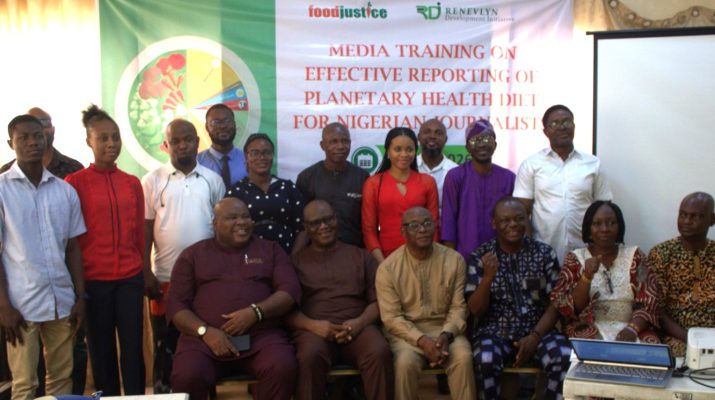
This was the submission of experts who spoke at a hybrid training programme on Effective Reporting of Plenary Health Diet for Nigerian Journalists and civil society groups in Lagos on Thursday, January 15, 2026.
In his introductory remarks, Executive Director of Renevlyn Development Initiative (RDI), Philip Jakpor, said the training organized in collaboration with Foodjustice was conceived with the focus on the media because of its strategic role not only as watchdogs of society, but also a platform for enlightening and galvanizing the public and policy makers to action.
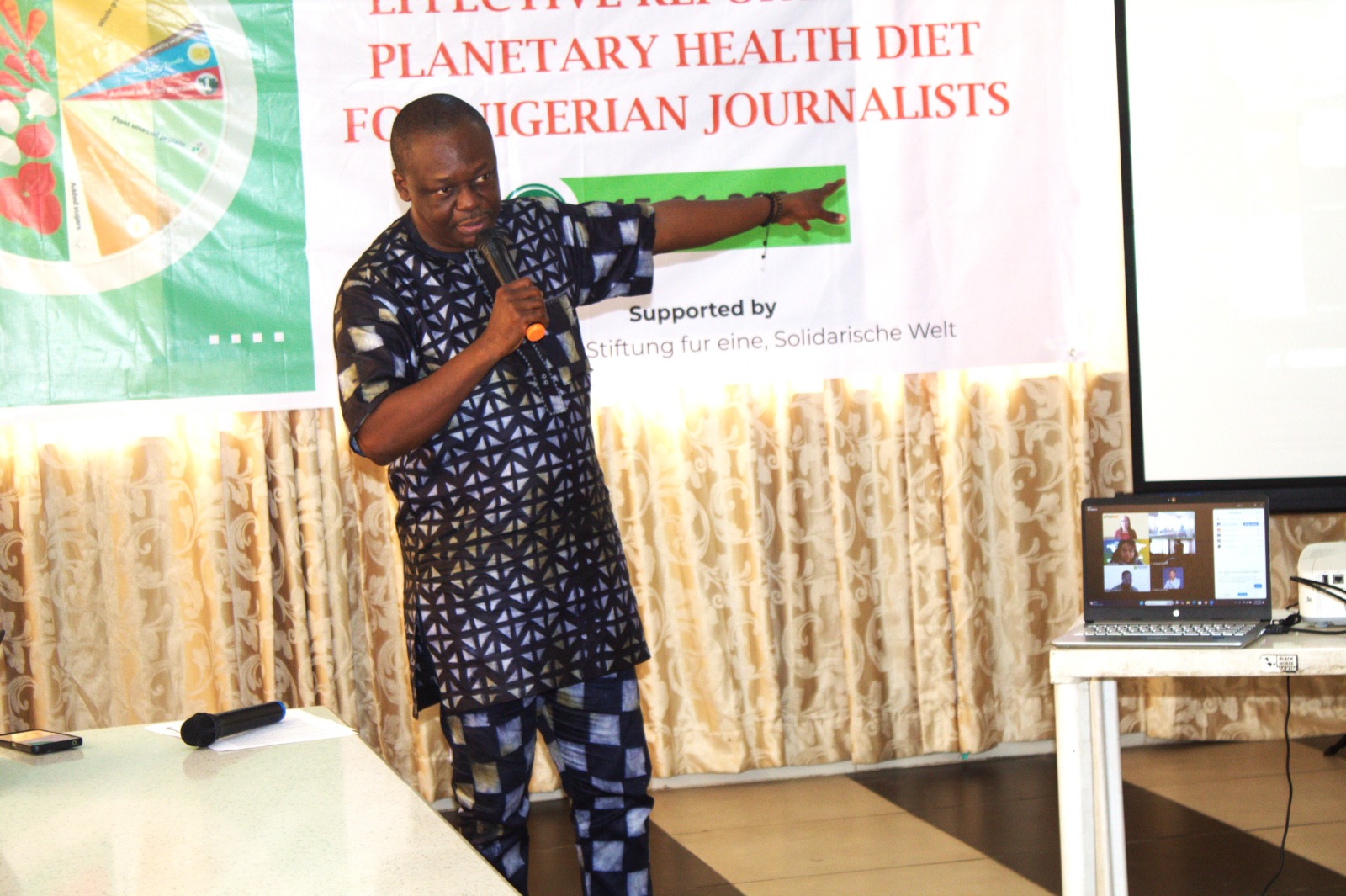
“Planetary health diet is a scientifically-backed dietary pattern designed to be healthy for individuals and sustainable for the planet, with emphasis on plant-based foods and reduction of consumption of red meat and processed foods. It reflects the intersections between what we grow, the ecosystem under which they grow and the positive outcomes when we consume them.
“We must note that Africa is blessed with vast arable land yet as the discourse and clamour for adoption of planetary health dietary patterns continues to grow globally, Africa is largely missing in the scheme of things. Amidst plenty, the continent grapples with the devastating impacts of malnutrition and the health consequences associated with consumption of junk foods and unwholesome diets. As you all may already know, Non-Communicable Diseases (NCDs) are a significant cause of deaths in Africa,” he said.
He explained that in Nigeria, NCDs account for about 30 percent of annual deaths and studies have shown that they are responsible for more illness and deaths than infectious diseases. In 2020, NCDs were responsible for 617,300 deaths in Nigeria, with 22 percent of these being premature deaths of persons between ages 30-70.
“Nigeria continued on this trajectory in 2021 with NCDs still accounting for 29-30 percent of deaths, with cardiovascular diseases (CVDs) being a significant component, resulting to 190,897 deaths. The statistics showed 565 per 100,000 males and 546 per 100,000 females for CVD, cancer, diabetes, and respiratory diseases combined.
“Sadly, most of the deaths were in young people. These are illnesses that were unheard of on the continent before now, but they now account for the huge death burden across the continent due to urbanization, lifestyle changes and socio-economic issues.
“But we must not only reel out disturbing statistics. The task of addressing these challenges must start with proper understanding of the issues, backed with the readiness to embrace proven solutions that are science-based.
“As such the resource persons including a Nigerian pediatrician, an environmental health expert, as well as experts from Mexico and the city of Milan, who will share the practical realities and how they have been able to mainstream planetary health diet into their agriculture, education and school feeding systems, while Percival Agordoh of the University of Health and Allied Sciences, Ghana will share the EAT-Lancet 2.0 report.
In her presentation on Environmental Impact and Cost of Healthy and Sustainable Diets in Mexico, Andrea Arango of the Institute de Salud Publica, Mexico, said unsustainable food systems in Mexico contribute to environmental degradation as well as the further spread of non-communicable diseases like Diabetes II.
She explained that the objective of a study carried out by the institute was t assess the environmental impact, cost and nutritional adequacy of healthy, sustainable diets compared to the current Mexican diet, adding that the survey was modeled using the DietCost tool and data from the Mexican National Health and Nutrition Survey for 2012 and 2016.
In her conclusion and recommendations, she explained that the benefits of sustainable diets include lower costs, reduced environmental impact, and adequate nutrition (with exceptions), adding that policy actions must promote healthy and sustainable diets through regulations such as subsidies to plant-based foods and taxes on meat, adding that for regional adaptation, the Mexican dietary guidelines (MHSDG 2023) should be further localized.
In his presentation on Introduction to the EAT-Lancet Commission 2.0, Agordoh said the EAT-Lancet Commission 2.0 builds upon the original report that introduced the Planetary Health Diet, addressing the interconnected challenges of human health and planetary sustainability.
“This new report was prompted by significant global disruptions post-2019, including volatile food supplies, economic shifts, and increased inequities, which highlighted the unmet need for a Great Food Transformation. The core aim of EAT-Lancet 2.0 is to secure a just transition to healthy, environmentally sustainable, and equitable food systems for all.
“It highlights the robust methods, new aspects and recommendations underpinning the EAT-Lancet 2.0 report. It draws on rich national data for food supply, environmental impacts, and disease burdens, skillfully blending health and emissions insights with advanced global models that project demand, production, nutrition, risks and planetary effects.
“Key innovations include an evolution of the Planetary Health Diet into four distinct and adaptable dietary patterns (flexitarian, pescatarian, vegetarian and vegan), which cater to diverse demographics and preferences while maintaining nutritional adequacy and sustainability.
“A significant new aspect is the explicit integration of social justice and equity, focusing on fair access, distribution and outcomes within the food system. The report also features expanded environmental impact assessments, covering greenhouse gas emissions, land and water use, as well as pollution more comprehensively,” he stated.
Agordoh further explained that the report’s core recommendations called for significant dietary changes, including over a 50 percent reduction in unhealthy foods and over a 100 percent increase in healthy foods, with an emphasis on mainly plant-based diets. It also highlighted the importance of sustainable food production systems through improved efficiency, climate mitigation, biodiversity enhancement, and policies that prevent land expansion.
“Additionally, EAT- Lancet 2.0 suggests cutting food loss and waste by half across the entire food chain and strengthening food system governance by promoting coordinated land and ocean management, international mechanisms and shifting subsidies away from harmful practices. These recommendations collectively require a multi-level, multi-actor transformation, integrating food, health and environmental policies to meet the UN Sustainable Development Goals and the Paris Agreement” he added.
Also in her presentation on Mainstreaming the Planetary Health Diet into Public Health Policies in Lagos, Environmental Health Scientist and Planetary Health Educator, Dr. Chioma Joy Okonkwo, said the session focuses on how the Planetary Health Diet can be integrated into Lagos State’s existing public health and nutrition policies.
According to her the focus was not on creating new policies, but on understanding how global nutrition evidence becomes embedded in local policy systems and how journalists can recognise and report this process effectively.
On why this matters for Lagos, she pointed out that Lagos is a rapidly growing megacity experiencing increasing diet-related non-communicable diseases, food access challenges, and environmental pressures linked to food systems. Public health research shows that dietary patterns at population level are strongly shaped by food environments and policy settings. In this context, policy integration is a critical lever for improving nutrition outcomes at scale.
“Mainstreaming refers to embedding a priority into existing systems so it shapes routine decisions over time. In public health policy, this involves aligning laws, programmes, regulations, and financing mechanisms so nutrition considerations are consistently reflected across sectors such as health, education, food systems, and urban planning. When mainstreamed, policies create observable patterns that can be tracked and reported on,” she added.
Speaking on Planetary Health Diet and Children, Dr. Makoyawo Olayinka, whose presentation was anchored by Mrs. Vicky Urenma Onyekwuru, warned that unhealthy diets are already affecting Nigerian children’s growth, learning and long-term health.
“A diet rich in fruits, vegetables, legumes and whole grains supports immunity, brain development and healthy growth,” she said, adding that the absence of such diets could lead to childhood obesity, learning disabilities, vitamin deficiencies, Type-2 diabetes and increased cancer risk later in life. School feeding programmes and family-level interventions are critical to reversing the trend.”
In her intervention on Sustainable, Just and Healthy School Feeding With Food4Education, Ottavia Pieretto of the Milan Urban Food Policy Pact (MUFPP) in Germany, highlighted the global impact of sustainable school feeding programmes.
She said the over 466 million children worldwide now receive school meals, with every dollar invested generating up to $35 in economic benefits.
Cities like Milan, Addis Ababa, Nairobi and São Paulo, she noted, have used school meals to improve nutrition, boost attendance and support local farmers, lessons Nigeria could adapt.
Further citing the Milan’s approach, she pointed out that the school canteen service is managed by Milano Ristorazione, a public company controlled by the Municipality of Milan in which 15 million meals were distributed per year (83,000 meals/day) across two main kitchens, 22 neighborhood kitchens and 79 kindergarten kitchens.
On its sustainability, Ottavia revealed that public procurement is used to promote sustainable and inclusive food systems, as well as reduced GHG emission in Milan’s School Menus, just as Milan’s school canteens have reduced food-related GHG emissions from 83,422 tons CO2e (2015) to 53,545 tons CO2e in 2024.
In his presentation on Writing Impactful News Stories On Planetary Health Diet: Key Considerations, a veteran journalist, Mr. Tope Oluwaleye, urged participants to avoid bias, adapt global evidence to local food cultures and address criticisms transparently.
He enjoined the participating journalists to use success stories, data-driven storytelling and investigative reporting to push accountability, adding, “Food is political and how we report it determines who benefits and who suffers.”
The organizers said the insights from the training would feed into advocacy, policy engagement and media reporting across Nigeria and the African continent.