
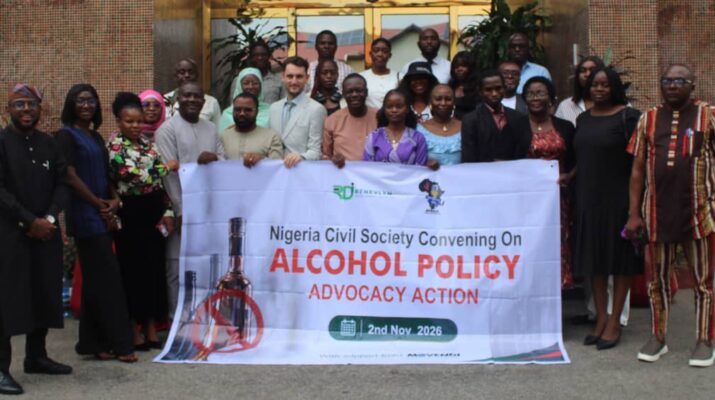
CSO’s Demand Alcohol Control Bill
A coalition of civil society groups urges the National Assembly to pass a National Alcohol Control Bill to save lives of citizens, especially the youths, who have become victims of addiction to alcoholic beverages and other harmful substances
By Edu Abade
Many Nigerian communities have expressed concerns over alcohol harms resulting in mounting calls for the National Assembly to take action to protect lives by enacting appropriate laws to control the reckless use and abuse of alcoholic beverages.
This was the motivation for the convocation of the Nigeria Civil Society Convening on Alcohol Policy Advocacy Action by the Renevlyn Development Initiative (RDI], the Motivator’s Crib Africa (MCA) and other civil society organizations in the Federal Capital Territory [FCT] Abuja.
In a communique issued at the end of its meeting on November 2, 2026, conveners of the summit stated that the one-day gathering served as a critical forum to equip Nigerian civil society with the evidence, policy solutions, and advocacy tools to help advance the Alcohol Control and Regulation Bill and protect people and communities from alcohol harm.
It also presented an opportunity to mobilize the civil society community to strengthen advocacy for speedy passage of the National Alcohol Control Bill, 2026, a comprehensive framework to regulate alcohol marketing, reduce alcohol-related harms and protect youth.
During the meeting, participants examined population-level alcohol use and abuse as well as the practices of multinational alcohol corporations in Nigeria and its negative impact on health and the socioeconomic wellbeing of the people, as well as policy responses to address the burdens of alcohol.
In the course of the discussions, participants observed that alcohol continues to take its toll on Nigerians, and remains a leading cause of preventable deaths, accounting for 42,120 Liver cirrhosis deaths, 15,365 road accidents and 4,687 cancer-linked to alcohol deaths according to the World Health Organization (WHO) in its Global Status Report on Alcohol and Health.
The groups lamented that alcohol burden in Nigeria continues to drain human capital, reduce workforce productivity, escalate public health costs, and increase violence, while the alcohol industry remains a major obstacle to preventing alcohol harm in Nigeria through political interference, resistance to regulation, their so-called Corporate Social Responsibility (CSR) activities and aggressive marketing tactics targeting young people through online digital platforms.
“While the Federal Ministry of Health and agencies like NAFDAC have put in place regulations to address alcohol harm, there is still no overarching legislation to ensure their sustainability. In spite of the NAFDAC ban on alcohol in sachets and small PET bottles there’s still a proliferation of the products in local communities where unscrupulous producers still make them and ensure they are easily accessible to youth and children.
“There is poor multi-sectorial coordination among agencies of government in the enforcement of existing regulations on alcohol use. Young people are the biggest target of the alcohol industry through digital marketing, lifestyle branding, and content that glamorize and normalize alcohol use. According to a recent NAFDAC survey, about 50 percent of Nigerian children as young as nine years old are exposed to or engaged in alcohol consumption, frequently driven by cheap and easily concealed sachets and small-bottle packaging, the communique stated.
It added that the Nigerian culture where 74 percent live free from alcohol consumption is under assault by the alcohol industry through its sustained design and promotion of products that target social milestones, identity groups, and digital landscapes and that civil society was yet to put up a common front to challenge the alcohol industry’s deceptive marketing tactics and attempts at thwarting the decision-making processes of the government.
The groups, therefore, recommended that the National Assembly must prioritize the passage of the National Alcohol Control Bill within the lifetime of the 10th National Assembly to save millions of Nigerians that are victims of alcohol harm and potential victims, especially young people. The current electioneering season must not be allowed to delay the passage of the bill.
The National Assembly supports efforts of the Federal Ministry of Health which has introduced the Nigeria Alcohol Policy and its Multi-sectorial Implementation Plan (2026–2030) as a policy framework to address the alcohol harms, to make it a binding statutory law with penalties and other provisions.
Insisting that there must be increased public awareness on the dangers associated with alcohol consumption, they insisted that the legislature must protect alcohol policy development and implementation from undue commercial influence, while public health decisions should be guarded and guided by independent scientific evidence and the interests of public health rather than commercial interests.
“There must be increased multi-sectorial collaborations among agencies of government for enforcement of alcohol regulations including drink-driving regulations, adequate sobriety testing and monitoring activities at motor parks to protect road users from alcohol enabled road crashes, injuries and fatalities.
“The government must demonstrate greater public health protection by providing greater support for nationwide enforcement of the ban on sachet and miniature alcohol by allocating and disbursing needed resources. Government must engage civil society at all the stages of alcohol policy formulation including Public Hearings and implementation of the policies.
“We believe that the speedy passage of the National Alcohol Control Bill will be of immense benefits to the health, and the socioeconomic wellbeing of Nigerians. A comprehensive alcohol bill will protect our women, our children, and everyone Nigerian. We are therefore using this medium to demand that our lawmakers take a stand for public health by passing the National Alcohol Control Bill into law now,” the communique added.
The civil society groups that endorsed the communique are the Renevlyn Development Initiative (RDI), Motivators Crib Africa (MCA), Initiative for Community Development and Advancement of Social Orientation (ICODASO), Center for Study of the Economies of Africa (CSEA), Cedars Refuge Foundation, Ominya Initiative for Peace and Community Development (OIPCD), Koyenum Immalah Foundation, Development Initiative for Society Health (DISH], Renewed Initiative for African Development, ShiShen Wellness & Consultancy Limited, Association of Advocates Against Alcohol Harm in Nigeria (ASAAHN) and C & A Consult, Abuja.
Others are, Thrive Communications, Pro CEDECOM- Nigeria, Civil Society on Mental Health and Drug Demand Reduction, EdifyHER Institute, Enene Akoyom Foundation, Ihuoma Institute for Human Rights Advocacy, Touch a Child Life Today Initiative, Dr. Mohammed Audu Foundation and Rehabilitation Center, Crusade for Greater Nigeria on Poverty Eradication and Social Matters, El-Rakhum Foundation and Women in Extractives.