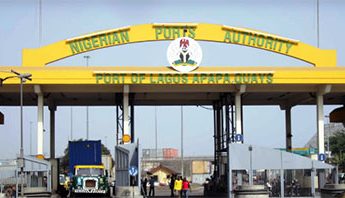
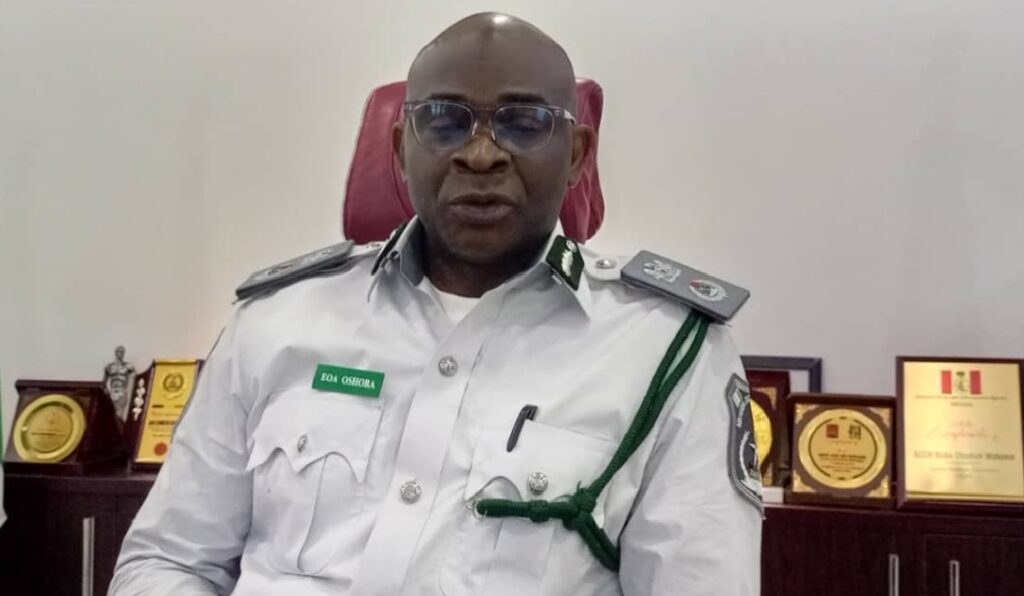
When Comptroller Emmanuel Oshoba assumed leadership of Apapa Port Command in September 2025, expectations were high. Apapa, Nigeria’s busiest port has long been the heartbeat of the nation’s trade, but also a flashpoint for smuggling, revenue leakages, with simmering flashes of community tensions.
Barely 24 hours into his tenure, the Command shattered records by collecting ₦20.1 billion in a single day, the highest daily revenue ever
recorded by any Customs Command in Nigeria. “It was not just about the numbers,” Oshoba told stakeholders at his maiden press briefing. “It was about sending a clear signal that Apapa under my watch will be a commandof discipline, transparency, and uncompromising enforcement.” That statement set the tone for what has become a transformative era at Apapa Port Command.
Raising the Bar on Revenue Collection
Oshoba’s first act was to fully deploy the Unified Customs Management System (UCMS), popularly known as B’Odogwu. The platform streamlined cargo clearance, eliminated loopholes, and ensured real-time monitoring of transactions, within which framework the following followed in consecutive succession.
Record-breaking collections: Daily and monthly revenues consistently surpassed historical averages. Fiscal discipline: Importers and clearing agents reported fewer delays and clearer compliance guidelines.
Investor confidence: “Apapa has become more predictable,” said a freight forwarder, noting that transparency has reduced the risk of arbitrary charges.
Enforcement: A Zero-Tolerance Doctrine
But Oshoba’s leadership has not been defined by revenue alone. He has consistently emphasized that Apapa Port must serve as both a hub of
legitimate trade and a bulwark against economic sabotage. This philosophy has guided his operational doctrine, integrating trade facilitation, revenue generation, and national security into a unified framework.
The focus unswervingly led the premier port command under his watch into what has become the regime of strengthened enforcement and drug seizures. By late 2025 and into early 2026, Apapa Command under Oshoba became synonymouswith decisive enforcement. In partnership with the National Drug Law Enforcement Agency (NDLEA), the command intercepted 347.5kg of Canadian Loud cannabis concealed in an imported Toyota Sienna vehicle.
The seizure, cleverly hidden in 13 bags within one of four vehicles, was the fourth major joint interception in less than two months. Oshoba declared that no cargo, whether import or export would pass unchecked, underscoring his zero-tolerance stance against smuggling.
OnJanuary 2, Apapa Customs operatives in partnership with NDLEA officers intercepted 30 slabs of cocaine weighing 30.1 kilograms aboard
MVAruna, a Marshall Islands-flagged vessel, at the Greenview Terminal in Apapa Port, Lagos.
According to a statement by the Command Public Relations Officer, Chief Superintendent of Customs, Suliaman Isah, the illicit cargo was expertly concealed within the vessel, underscoring the sophisticated methods traffickers employ to exploit Nigeria’s busiest seaport. The interception, occurring on the first working day of the year, sets a strong tone for the agencies’ zero-tolerance stance against illicit trade.
While praising the officers for their vigilance and professionalism, Oshoba said, “This achievement reflects the strong inter-agency synergy between federal government entities and our commitment to intelligence-led enforcement.” Adding: “While criminal elements seek to outsmart us, our officers remain one step ahead”, he said.
Oshoba described the bust as a bold statement for 2026, reaffirming the command’s determination to safeguard national security. Earlier in January, a 25.5kg of cocaine hidden in five bags aboard another vessel was intercepted. On December 11, 2025, authorities uncovered 1,187kg of “Canadian Loud” cannabis, packaged in 2,374 parcels across 55 bags, concealed in imported vehicles inside a 40-foot container.
Reiterating its dual mandate, Oshoba notes that while it is facilitating legitimate trade; it is also incumbent on the customs command to continue to protect the national security. Thus far, the heightened operations underscores Nigeria’s determination to dismantle drug trafficking networks and ensure that the nation’s ports remain secure gateways for lawful commerce.
This offensive against narcotics trafficking elevated Apapa’s profile as a frontline in Nigeria’s war on drugs. The timing was symbolic as Oshoba had just received a World Customs Organisation (WCO) Certificate of Merit, an international recognition of excellence in customs operations.
CommunityEngagement: Building Trust Beyond the Gates
Oshoba also understood that enforcement cannot thrive without community trust. In September 2025, he paid a courtesy visit to the Ojora of Ijora and Iganmu Kingdom, emphasizing peaceful coexistence and stronger inter-agency collaboration.
“Port security is a shared responsibility,” he told community leaders.
“Customs cannot succeed without the cooperation of host communities.”
This outreach reduced friction between Customs and local stakeholders, creating a climate of mutual respect. Maritime Police Command and other agencies also reported improved synergy, leading to intelligence-driven operations rather than reactive enforcement.
The Five Pillars of Oshoba’s Leadership
Analysts describe Oshoba’s stewardship as a five-pillar model of integrated leadership:
- Fiscal discipline– record-breaking revenue collections.
- Operational resilience– seamless adaptation to digital platforms.
- Aggressive enforcement– multiple drug seizures in collaboration with NDLEA.
- Community engagement– building trust with host communities and security agencies.
- Global recognition– WCO Certificate of Merit for outstanding service.
Business and Trade Implications
The ripple effects of Oshoba’s leadership extend beyond Customs:
- Supply chain efficiency: Digital systems reduce clearance delays, boosting competitiveness for importers and exporters.
- Investor confidence: Transparent operations and reduced smuggling risks enhance Nigeria’s attractiveness for legitimate trade.
- National security: By curbing narcotics trafficking and economic sabotage, Apapa strengthens Nigeria’s global trade reputation.
A maritime analyst summed it up: “Apapa under Oshoba is not just a port; it is a statement of intent, that Nigeria can enforce compliance while facilitating trade.”
Conclusion: A Command Redefined
The unfolding story of Apapa under Comptroller Emmanuel Oshoba is one of transformation and balance. Thus, compliance meets innovation, enforcement aligns with facilitation, and customs operations are redefined for a modern Nigeria. As the Nigeria Customs Service pursues its 2026 agenda, Apapa Port Commandunder Oshoba stands as a model of integrated leadership, a place where record revenue performance, strengthened enforcement, and community synergy converge to position Apapa not just as Nigeria’s busiest port, but as a strategic pillar of fiscal stability and national security.