
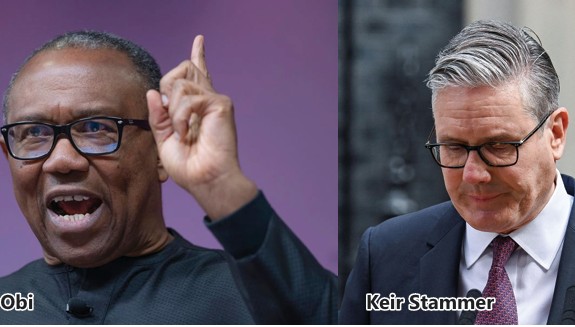
Eventually, President Bola Tinubu the hitherto hunter becomes the hunted as the presidency appears overtly tormented by the call of the presidential candidate of the Nigerian Democratic Congress (NDC), Peter Obi, on the incumbent President to resign due to his government’s inability to confront the daily insecurity and hardship ravaging citizens
By David Oladimeji
When in 2014 President Bola Ahmed Tinubu was desperately campaigning for the late President Muhammadu Buhari during the presidential electioneering of 2015, to position the latter in the minds of the electorate as a better choice than incumbent President Goodluck Jonathan, he would have no regard for the saying, “What goes around comes around”. The now incumbent President Tinubu had thrown caution to the wind, and playing to the gallery, he had called on Jonathan to resign as a sitting President over insecurity issues.
Precisely on Wednesday, November 5, 2014, during one of the All Progressives Congress (APC) rallies in Ilorin, the capital city of Kwara State, to sell Buhari to the electorate of the state, Tinubu had claimed that the Jonathan government lacked the capacity to tackle the rising insecurity of the era, and called on the incumbent Jonathan to resign.
Those were the days the nation was mourning the abduction of the Chibok school girls in Borno State. Jonathan at the time could not challenge Tinubu who posed as the leader of the APC. Recall that Under Jonathan presidency, there occured only one kidnap of school children. But the Buhari presidency which many regarded as clueless, helplessly witnessed 15 incidences of abduction of school children in eight years, while according to available statistics, Tinubu’s government has witnessed 13 school children’s abductions in just three years of its existence.
Following the attacks by terrorists on Kawel Village in the Mushere District of Bokkos Local Government Area (LGA) of Plateau State on Sunday, June 21, 2026 where the lives of over 30 innocent citizens were cut short, as well as the resignation of the former British Prime Minister, Keir Starmer, Peter Obi, the presidential candidate of the Nigerian Democratic Congress (NDC) for the 2027 presidential election, called on Tinubu to resign as a result of the incompetence of his government to secure the lives and properties of the citizens and their welfare which constitute the primary purpose of government existence.
Making the call on Monday, June 22, 2026 in a tweet on his X handle titled, “Owning Up To Leadership Failures and Political Responsibility”, Obi had advised Tinubu thus, “This morning, I listened to the British Prime Minister’s speech announcing his planned resignation in July.
“As a keen observer of global politics, my primary interest lies in examining what successful nations do right and the structural factors that cause others to lag or struggle with governance and development.
“The Prime Minister’s planned resignation comes amid mounting public frustration over a stagnant economy, a worsening cost-of-living crisis, and a perceived failure to honour key campaign pledges.
“Looking inward in our dear country, we can recall our own situation. Before 2015, our President on several occasions championed the call for the then President Goodluck Jonathan to resign over economic hardship and insecurity affecting Nigerians.
‘’During the Chibok school kidnapping incident, he demanded the immediate resignation of President Jonathan, arguing that the government had failed in its most fundamental duty of protecting lives.
“During the 2023 election campaign, President Bola Ahmed Tinubu made several promises, including improved electricity supply. He also challenged the electorate not to vote for him for a second term if he failed to deliver on those commitments, particularly in providing stable power, fighting corruption and improving the welfare of Nigerians.
“At present, however, these conditions have worsened. Electricity supply remains unreliable, insecurity has intensified in many areas, including kidnappings, and economic hardship has deepened rather than eased.’’
In a swift reaction, the Presidency in a statement issued by presidential spokesman, Mr. Bayo Onanuga, said the call by the Labour Party presidential candidate in 2023 was not one to hold the leader accountable, but a mere political grandstanding and an unworthy distraction just hours after President Tinubu’s party recorded resounding victories in the Ekiti State governorship election conducted on Saturday, June 20, 2026.
The statement read: “His view is also simplistic, as is often the case anytime he opens his mouth. Obi forgets our country does not run a parliamentary system of government like the UK. We run a presidential system, with the president elected to a fixed 4-year term.”
The latest political confrontation between Nigeria’s Presidency and the opposition is about far more than a call for resignation. It is a battle over legitimacy, accountability, public perception, and the direction of Nigeria’s democracy.
President Tinubu’s administration has barely settled into the difficult task of governing amid economic reforms, soaring inflation, and persistent insecurity. Yet, the opposition believes the country’s worsening hardship justifies a conversation many governments dread—the question of whether the leader should remain in office.
Obi’s call for Tinubu’s resignation has ignited one of the fiercest political debates in recent months. His argument is simple but provocative: if leadership fails to improve the lives of citizens, accountability should extend beyond campaign promises.
The Presidency wasted little time in firing back. Presidential spokesman Onanuga dismissed Obi’s remarks as childish, politically motivated, and disconnected from Nigeria’s constitutional reality. To the government, resignation is not an option but an attempt to delegitimize an elected administration.
The exchange immediately transformed into a contest of narratives rather than facts. Instead of discussing inflation, unemployment, food insecurity, and rising insecurity, political attention shifted to whether Obi had crossed a democratic line.
Supporters of the President insisted that Nigeria’s current economic pain is the unavoidable consequence of decades of policy failures inherited by the Tinubu administration. They argued that bold reforms naturally produce temporary hardship before yielding long-term gains.
Opposition voices have rejected that explanation. They insisted that governments should be judged not by intentions but by outcomes, arguing that ordinary Nigerians are measuring success by empty wallets, rising transport costs, and declining purchasing power.
Ironically, both sides invoke democracy while accusing each other of undermining it. The Presidency insisted that elections—not political pressure—determine who governs. The opposition counters that democracy also includes the right to question, criticize, and demand accountability from elected leaders.
History offers uncomfortable reminders for both camps. Nigerian politicians have, over the years, repeatedly demanded the resignation of opponents whenever governance faltered. What is condemned today was often celebrated yesterday when political roles were reversed.
That historical inconsistency exposes one of Nigeria’s enduring political contradictions. Principles frequently change depending on whether one occupies government offices or opposition benches.
The resignation debate has therefore become symbolic. It reflects the broader struggle over who controls Nigeria’s political conversation rather than whether the President is actually likely to leave office.
Constitutionally, the matter is straightforward. Nigeria’s President can only leave office through resignation, impeachment, incapacitation, or electoral defeat. Calls for resignation remain expressions of political opinion rather than constitutional instruments.
Yet, political opinions matter. They shape public confidence, influence investor sentiment, and often determine whether governments spend more time defending themselves than governing effectively.
For ordinary Nigerians, however, the political exchanges offer little immediate comfort. Citizens battling rising living costs are less interested in rhetorical battles than in practical solutions capable of easing daily hardship.
Critics argue that both the Presidency and the opposition risk appearing disconnected from public priorities when political arguments overshadow conversations about food prices, electricity supply, healthcare, education, and security.
At the same time, a vibrant democracy requires a vocal opposition willing to challenge those in power. Without criticism, governments may become complacent. Without responsible governance, opposition criticism gains credibility.
Pundits argued that, the Presidency equally carries a heavy burden. They said that dismissing critics may satisfy political loyalists, but sustained public confidence ultimately depends on visible improvements in governance rather than verbal rebuttals.
As Nigeria inches closer to another electoral cycle, every statement from government and opposition will increasingly be viewed through the lens of 2027. Today’s policy disagreements are gradually becoming tomorrow’s campaign themes.
Whether Peter Obi’s resignation call resonates with Nigerians or fades into political memory will depend largely on the government’s ability to deliver measurable improvements in living conditions over the coming months.
Ultimately, the Presidency-opposition war is not really about resignation. It is about competing visions of leadership, contrasting definitions of accountability, and the enduring struggle to convince Nigerians about who truly holds the answers to the nation’s challenges. In the end, the verdict will not be delivered at press conferences or on social media—it will be rendered by citizens whose everyday realities remain the most powerful measure of any government’s success.


