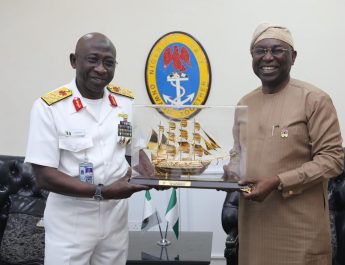
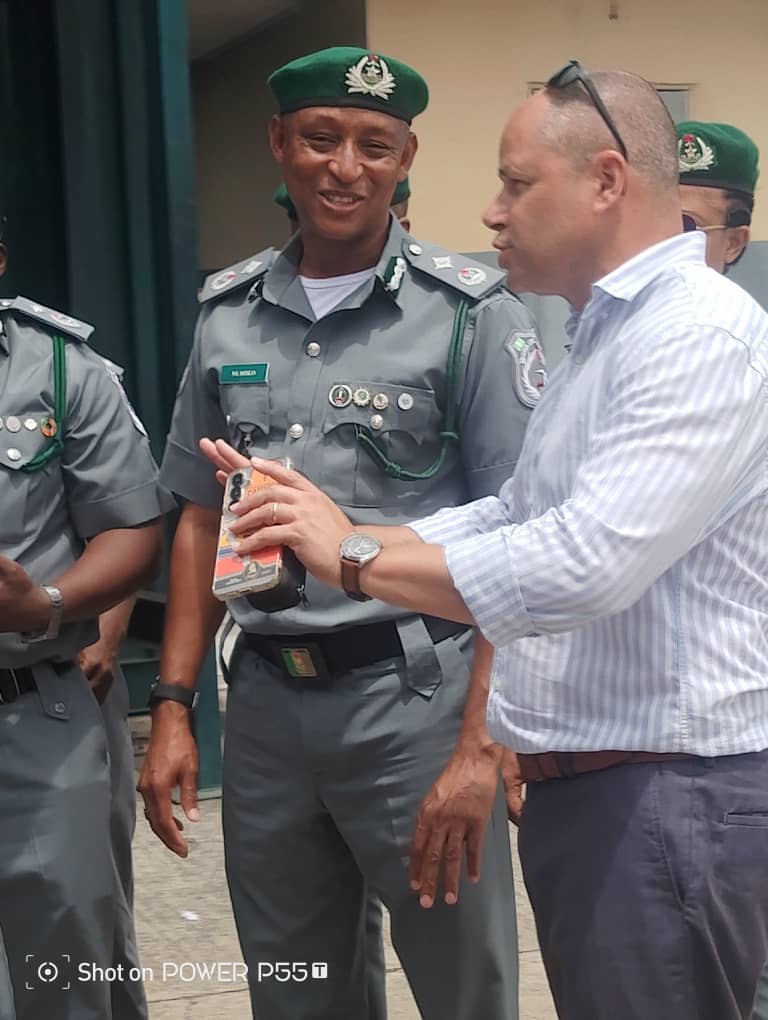
The new Customs Area Controller (CAC) of the Ports and Terminals Multi-Services Limited (PTML) Area Command, Lagos, Deputy Comptroller (DC) Nura Ibrahim Miko, seals off every perceived area of inefficiency and revenue leakage at the sea port in a bid to maximize government revenue and eradicate smuggling activities
By Innocent Chukwu
Efficient leadership is making the waves at the Ports and Terminals Multi-Services Limited (PTML) Area Command of the Nigeria Customs Service (NCS), Tincan Island Port, Lagos, courtesy of the youthful and indefatigable acting Area Controller (CAC) of the Command, Deputy Comptroller Nura Miko. Miko’s mission at the Roll on-Roll off (RoRo) vehicle terminal, according to both Customs officers and various other publics and critical supporting allies of Customs, has been clearly defined: squeeze out the revenue, and arrest any syndicates capable of jeopardizing national security through all forms of illicit trade. This mission, Tentacle gathered, is being pursued vigorously leading to the achievement of a very high percentage of compliance on the part of the trading community.
Already, stakeholders have begun to state that the performance of Miko in his few weeks of leading the Command, in the aspect of tightening any loose ends that would affect revenue generation negatively or the security of the country, is an indication of what the rebranded NCS would become in the nearest future when the youthful new-generation officers would have inherited its leadership structures completely. It is also expected that in the coming months, the PTML Command under Miko may be able to double the revenue generation he met when he took over the mantle of leadership.
The PTML terminal has long stood as Nigeria’s premier Roll-on Roll-off (RoRo) terminal, a critical gateway for imported vehicles, trucks, and heavy machinery. In June 2026, the spotlight on PTML is sharper than ever, as Deputy Comptroller Nura Ibrahim Miko continues to drive reforms that balance efficiency, integrity, and revenue growth. His leadership is redefining how Customs interacts with stakeholders and how Nigeria positions itself in global maritime trade.
The RoRo Model in Nigeria’s Port Ecosystem
The RoRo model is unique in Nigeria’s maritime landscape. Unlike containerized cargo, vehicles and machinery require specialized handling, space management, and clearance procedures. PTML has become the benchmark for this system, offering a two-hour clearance window for compliant imports: a remarkable achievement in a sector often plagued by delays. Sustaining this efficiency, however, demands constant innovation, and Miko’s administration has embraced the challenge head-on.
At PTML, efficiency is not just about speed; it is about credibility. Importers and freight forwarders often push for faster clearance, but Customs must ensure compliance with regulations. Miko’s calm, patient approach has helped bridge this gap. His open-door policy has created a platform where stakeholders feel heard, and solutions are co-created rather than imposed. This inclusive governance is building trust and reducing friction in trade facilitation.
Leadership and Stakeholder Engagement
Deputy Comptroller Miko’s leadership style is marked by transparency and inclusivity. Industry watchers note that his ability to balance firmness with dialogue has been central to PTML’s progress. By encouraging collaboration rather than confrontation, he has fostered a culture where Customs officers, terminal operators, and freight forwarders work toward shared goals.
Terminal operators, represented by PTML’s General Manager Tunde Keshinro, have pledged support, citing Miko’s history of constructive engagement. This synergy between Customs and operators is critical. Stronger cooperation will not only address operational bottlenecks but also reinforce Nigeria’s competitiveness as a maritime destination.
Revenue Generation and Modernization
Revenue generation remains a central mandate for Customs, and PTML contributes significantly to the Service’s revenue architecture. Under Miko’s leadership, expectations are rising. His roadmap aligns with the modernization agenda of the Nigeria Customs Service: leveraging ICT, strengthening scanning operations, and ensuring compliance without stifling trade.
His decision to personally accompany the DCG ICT on inspection tours of scanning units underscores his commitment to modernization as a driver of efficiency and integrity. By integrating technology into clearance processes, PTML is reducing human error, curbing corruption, and enhancing transparency.
Challenges and Solutions
The challenges at PTML are real. Congestion, space management, and balancing speed with scrutiny are recurring issues. Vehicles arriving in bulk often strain available space, leading to delays in offloading and clearance. Yet, Miko’s tenure is already showing signs of progress. His administration has prioritized smarter space allocation, better traffic flow within the terminal, and stricter adherence to compliance protocols.
Stakeholders acknowledge that while speed is desirable, scrutiny is non-negotiable. Customs must ensure that imported vehicles meet regulatory standards, including environmental and safety requirements. Miko’s reforms are designed to strike this delicate balance, ensuring that efficiency does not come at the expense of compliance.
Broader Implications for PTML as a Model of Innovation
The outlook for PTML is promising. With global trade pressures mounting, Nigeria’s maritime sector must compete on efficiency and integrity. Miko’s leadership is positioning PTML as a model of innovation: shorter clearance times, improved space management, stronger stakeholder relations, and higher revenue.
For stakeholders and the trading community, the message is clear: brace up for a tenure defined by efficiency, integrity, and growth. PTML’s RoRo advantage is not just about vehicles; it is about setting a standard for Customs modernization in Nigeria.
Broader Implications for Nigeria’s Maritime Trade
PTML’s success story carries broader implications for Nigeria’s maritime trade. As Africa’s largest economy, Nigeria must demonstrate that its ports can handle global trade demands with efficiency and credibility. The reforms at PTML are a signal to international partners that Nigeria is serious about modernization and competitiveness.
Moreover, the RoRo model offers lessons for other terminals. By adopting similar strategies — transparency, stakeholder engagement, and ICT-driven operations — Nigeria’s port ecosystem can collectively raise its standards. This will not only boost revenue but also enhance Nigeria’s reputation as a reliable trade hub.
Conclusion
By the end of June 2026, PTML stands as a symbol of how strategic leadership can transform trade dynamics. Deputy Comptroller Nura Ibrahim Miko’s reforms are reshaping the narrative around Customs operations, proving that efficiency and integrity can coexist. The RoRo advantage is not just about vehicles; it is about redefining Nigeria’s place in global maritime trade.
With continued collaboration, modernization, and commitment to compliance, PTML is poised to remain the benchmark for vehicle imports in Nigeria; and a beacon of how Customs leadership can shape the future of trade.