The Presidency comes under intense criticism over illicit allocations in the 2026 Appropriation Act which violate Constitutional budgetary provisions and duplicate budgetary spending
By Our Correspondent
The recent revelation of the contentious allocation of $1.3 billion to the Presidential Foreign Intervention Promotion Council (PFIPC) through the backdoor has compelled financial experts to deeply scrutinize the 2026 Appropriation Act to see if there are other illicit allocations and duplication of spending. As a consequence, more revelations have emerged that other unconstitutional allocations were made in the budget. For example, a public accountability organization known as Tracka has discovered another N22.15 billion and N8.05 billion illicit allocations meant for religious entities, and traditional rulers and their palaces.
Tracka said the Federal Government earmarked the N22.15 billion in the budget for the construction, renovation and furnishing of 106 royal palaces across the country.
Reviewing the budget document last week, Tracka disclosed that 11 palace projects valued at N5.85 billion have no identified physical locations, making public tracking and oversight extremely difficult.
Tracka further alleged that none of the 45 Ministries, Departments and Agencies (MDAs) assigned to execute the projects has the statutory mandate to construct royal palaces and edifices for the country’s royal fathers.
Rather, Tracka stated that the projects were domiciled in agencies ranging from research institutes and agricultural colleges to specialised health institutions, rather than agencies directly responsible for building projects.
Tracka’s review further showed that the Federal Cooperative College, Ibadan, was allocated N2.661 billion for the renovation of community halls and palaces in selected communities in Lagos under the Federal Ministry of Agriculture and Food Security, alongside projects worth N350 million in Ekiti South and N210 million in Ondo South.
The Sheda Science and Technology Complex (SHESTCO), Abuja, was allocated N1.54 billion under the Federal Ministry of Science, Technology and Innovation for the modernisation and furnishing of selected national heritage palaces.
In the same vein, Tracka revealed that the Nigerian Building and Road Research Institute (NBRRI), Lagos, received projects valued at N3.92 billion, including N1 billion for pavilions and solar power at the Oluyin Palace in Iyin Ekiti, N525 million for a palace hall in Ojo, Lagos, and several other palace-related projects in Kogi, Ekiti and Nasarawa states.
Other allocations identified by Tracka include N750 million to the Agricultural Research Council of Nigeria for the completion and furnishing of four palaces in Kogi State, N700 million to the National Institute for Hospitality and Tourism (NIHOTOURS) for palace and office projects in Plateau State, and N560 million to the National Horticultural Research Institute for projects involving Emirs’ palaces in Niger State.
The review also listed allocations to agencies, including the Nigeria Stored Products Research Institute, Federal Cooperative College, Oji River, National Cereals Research Institute, Industrial Arbitration Panel, and Border Communities Development Agency, among others.
Tracka said the allocations had triggered concerns among public policy experts, coming at a time the 2026 budget carries a fiscal deficit of N31.45 trillion amid persistent economic hardship.
Many critics have argued that under the Constitution, traditional institutions and community infrastructure fall within the responsibilities of state and local governments rather than the Federal Government.
On a post on X, Tracka said, “At a time of rising debt and limited fiscal space, should the Federal Government fund projects that are largely local in nature, while states and local governments constitutionally exist to address many community-level needs?
“This is not about the importance of our traditional institutions. It is about ensuring that public budgets reflect constitutional responsibilities, institutional mandates, and Nigeria’s development priorities. The Federal Budget should not become a vehicle for financing projects outside the constitutional and statutory responsibilities of the institutions implementing them”.
Tracka’s review also identified ₦8.05 billion earmarked for the construction, renovation, and equipping of churches and mosques nationwide.The breakdown reveals ₦1.91 billion allocated for seven church-related projects and ₦6.14 billion set aside for 52 mosque-related projects. Funding items include solar power systems, boreholes, carpets, church musical equipment, and imam residences, many of which are hidden inside government agencies unrelated to religious affairs.
Public affairs analysts also questioned the practice of locating palace projects within the budgets of research institutes, agricultural agencies and scientific establishments, arguing that it raises concerns over constituency projects, budget padding and accountability in public spending.
In a related development, the Deputy Speaker of the House of Representatives, Benjamin Kalu has defended what experts discovered as illicit church allocation in 2026 budget. Kalu said the N1 billion allocation for the procurement of musical instruments for churches in Bende Federal Constituency of Abia State was targeted at youth reorientation.
The Deputy Speaker’s defence followed public criticism after reports revealed that the N1 billion was earmarked in the budget for the project. In a statement issued by the Deputy Speaker’s Chief Press Secretary, Levinus Nwabughiogu, last week, the office described the reports as a misrepresentation of the purpose of the allocation, insisting that the intervention forms part of a broader youth reorientation and social support programme to be implemented through faith-based organisations.
The controversy surrounding the N1 billion controversial allocation came as a result of the wider scrutiny of the 2026 budget by Tracka which revealed the N8.05 billion for the construction, renovation and equipping of places of worship nationwide.
According to the budget breakdown released by the organisation, N1.91 billion was allocated to projects involving seven churches, while N6.14 billion was set aside for 52 mosque projects.
The budget also contained several religious projects embedded in ministries and agencies with no direct responsibility for religious affairs.
One of the projects, coded ERGP20273981, provides N1 billion through the Industrial Arbitration Panel under the Federal Ministry of Labour and Employment for the provision and distribution of musical and cultural equipment to churches in Bende Local Government Area of Abia State.
However, the Deputy Speaker’s office said the actual value of the intervention was N780 million after Value Added Tax (VAT) and other statutory deductions.
According to Kalu’s statement, “The proposed allocation is actually N780 million after VAT and other tax deductions.
“It is earmarked as a Youth Re-orientation and Social Support Programme delivered evangelistically through faith-based organisations in Bende Federal Constituency of Abia State.”
The N8.05 billion religious allocation has pitted Christians against their Muslim counterparts over the disparity in the sharing formula.
For example, the Northern Christian Association (NCA) has challenged the Federal Government to explain what its described as the glaring disparity in the allocation of about N8.05 billion for church and mosque projects in the 2026 Appropriation Bill, saying the imbalance raised serious concerns about equity, fairness and equal treatment of all Nigerians irrespective of their religious affiliation.
The association said while it was not opposed to government support for religious projects, such interventions must be guided by the constitutional principles of justice, transparency and equal treatment, rather than actions capable of creating the impression of discrimination or preferential treatment. Many other Christians have attributed the discriminatory sharing formula of the N8.05 billion to the Muslim-Muslim presidential government of President Tinubu.
But in a statement personally signed by Chairman of NCA, Rev Joseph John Hayab, on Monday July 20, the association expressed concern over reports indicating that approximately N1.91 billion was earmarked for seven church-related projects, while about N6.14 billion was allocated to 52 mosque related projects in the 2026 budget.
According to the NCA, the disparity has reinforced concerns among many Christians over what it described as the persistent pattern of unequal treatment, selective implementation of government policies and double standards in public affairs.
The association said Christians in Nigeria have continued to exercise restraint and tolerate many developments in the interest of national peace and unity, but regretted that governments at different levels have repeatedly interpreted such patience as weakness.
The body maintained that Nigerians have continued to witness actions exposing inconsistencies in governance, warning that partiality, lack of equity and unequal treatment of citizens remain major factors responsible for division, distrust, segregation and the erosion of national unity.
It also called on the Federal Government to openly explain the basis for the disparity in the allocations, insisting that every Nigerian deserves equal treatment under the Constitution regardless of religious affiliation. “How long will Nigerians continue to read stories that expose the hypocrisy of our leaders?” Hayab asked.
He also said, “The partiality, lack of equity and unequal treatment of citizens by government and political leaders are among the major factors responsible for division, distrust, segregation and the absence of genuine unity and love among Nigerians. Our Constitution recognises every Nigerian as equal before the law, while the teachings of all religions discourage unfair treatment of children, women, family members and fellow human beings.
“Government should, therefore, not be seen to promote policies that suggest preferential treatment for one religious group over another.
“NCA is challenging the Federal Government to explain these abnormalities. Government should not establish a system that creates division among citizens or gives the impression that one religious community is more important than another. Instead, it should initiate programmes and policies that unite Nigerians and strengthen our collective national identity,” the statement said.
Condemning the illicit allocations, the 2027 Presidential candidate of the African Democratic Congress (ADC), Atiku Abubakar, has told President Bola Tinubu that his administration has no constitutional business funding the construction and renovation of palaces for traditional rulers, describing the ₦22.15 billion allocated for 106 such projects in the 2026 Appropriation Act as a constitutional aberration and an instrument for illegality and official corruption.
In a statement on Thursday July 23, by his Senior Special Assistant on Public Communication, Phrank Shaibu, the former vice president said the Constitution of the Federal Republic of Nigeria is unambiguous on the distribution of governmental responsibilities and does not confer on the Federal Government the responsibility for constructing or renovating palaces belonging to traditional institutions.
Atiku said, “President Tinubu swore an oath to preserve, protect and defend the Constitution, not to amend it through the Appropriation Act. Traditional institutions are matters within the constitutional competence of state and local governments. A federal budget cannot lawfully be used to assume responsibilities that the Constitution has assigned elsewhere.
“Under which provision of the Constitution is the Federal Government appropriating ₦22.15 billion from the Federation Account for the construction and renovation of 106 palaces? Which Constitution is President Tinubu operating?
“The 1999 Constitution did not establish, fund or assign any executive responsibility over traditional institutions to the Federal Government. Indeed, its only reference to traditional institutions is in the Third Schedule, Part II, where it merely permits states to establish a Council of Chiefs to advise their governors on chieftaincy and customary law matters. Beyond this limited advisory role, the Constitution leaves the creation, administration and funding of traditional institutions to state governments and the laws enacted by their respective Houses of Assembly. President Tinubu cannot, by the instrument of an Appropriation Act, assume powers that the Constitution deliberately withheld from the Federal Government.
“Our royal fathers deserve dignity and respect. They must not be used as unwilling instruments to legitimise opaque and constitutionally questionable budgetary allocations. If this administration truly respects the traditional institution, it should stop hiding behind it.
“The national treasury is not a Bourdillon-based private vault, and the Appropriation Act is not a license to suspend the Constitution. No government can claim to uphold the rule of law while appropriating public funds for projects it cannot constitutionally undertake and whose beneficiaries it refuses to identify,” he declared.
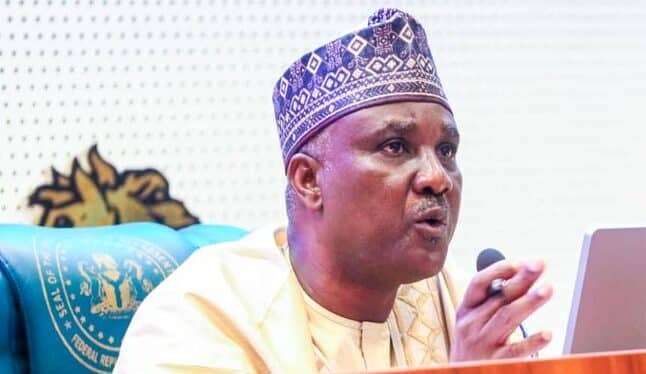
Meanwhile, Senator Tahir Monguno has questioned the Federal Government’s poor budget implementation despite improved revenue performance, arguing that failure to execute an Appropriation Act amounts to a breach of the law and is “an impeachable offence.”
Speaking during a Senate engagement the Minister of Finance and coordinating minister of the economy and top economic officials, Monguno said reports presented by revenue-generating agencies showed that most had exceeded their revenue targets, making the slow pace of budget implementation difficult to understand.
“I am not an economist, but in my 100 level I offered Economics 101 as elective course at the university. Budget implementation is fundamentally a function of revenue,” he said.
“From the figures presented to us and the briefings we have received from revenue-generating agencies, almost all of them have exceeded their revenue targets. If revenue performance has improved so significantly, it appears inherently contradictory that government is still struggling to implement the budget. Where is the revenue going?”
The senator noted that the 2025 budget was not fully implemented, with about 70 per cent of its provisions rolled over into 2026.
He said the government had assured lawmakers that the outstanding 30 per cent would be implemented before March, but that deadline was missed, prompting the National Assembly to extend the lifespan of the 2025 Appropriation Act until September to allow completion of outstanding capital projects.
“Meanwhile, implementation of the 2026 budget has hardly begun,” he said.
“If revenues are exceeding projections, why is budget implementation lagging behind? The dividends of democracy are delivered through the implementation of the budget, particularly capital projects. If the budget is not being implemented, then the fundamental purpose of government is undermined.
“For example, security of lives and property is the primary responsibility of government. Yet, all the security agencies that have appeared before this committee informed us that they have received zero capital releases.
“Failure to implement an Appropriation Act amounts to a breach of the law, and such a breach is an impeachable offence”.
Poopooing on the frivolous budgetary allocations in the 2026 Appropriation Act, some budget governance experts alleged that the illicit figures were intended to be deployed for the manipulation of the 2027 election in favour of the ruling All Progressives Congress (APC). Vahyala Kwaga and Hamzat Lawal both experts in national budgeting, faulted the National Assembly over the insertion of funding for mosques, churches, and palaces in the 2026 budget. Both experts linked the allocations to political spending ahead of the 2027 general election.
Speaking during a live interview on Channels Television on Friday, July 24, 2026, Kwaga, who is Country Director of the BudgIt Foundation, said the revelations were not new but rejected a long-standing failure by the legislature to properly scrutinise the budget. Kwaga said, “These simply point to a complete failure of our legislature to properly fit the budget. A budget is a proposal. A budget is oftentimes made in circumstances of scarce resources. So, where you see things like this, it’s clear that the legislature doesn’t believe Nigeria has scarce resources”.
Kwaga, whose organization tracked such insertions for over a decade, cited findings showing that 11 palace projects worth N5.85 billion had no identified locations making public oversight almost impossible. He added that none of the 45 implementing Ministries, Departments and Agencies (MDAs) captured in the findings had the statutory mandate to execute the projects, naming the Nigerian Building and Road Research Institute, Federal Cooperative College, Ibadan, and Sheda Science and Technology Complex among agencies listed to build palaces worth N22.15 billion.
He called for clarity on whether the legislature has the constitutional power to insert projects into the budget, noting that a related court challenge by Femi Falana, SAN, did not `produce a definitive pronouncement. “The legislature needs to understand that its job is to check the executive, not to do the very thing the executive is meant to do”.
In his own reaction, founder of Connected Development CODE, Lawal said the controversy stemmed from the National Assembly’s failure to hold public hearings or consult communities before passing the budget.
Referring to Bende in Abia State, he said the community lacked adequate primary healthcare centres and schools, making the diversion of funds to religious institutions difficult to justify. “As much as issues around religion is sensitive, and the issues around traditional rulers… if we’re now budgeting and allocating resources for churches, mosques, what happened to traditional institutions when it has to do with traditionalists?” he asked.
Lawal argued that the allocations were tied to political spending ahead of next year’s elections. According to him, “We’re going into an election cycle. The campaign would soon start. And next year is our elections. This is money for elections. Let’s tell ourselves the truth,” he said, adding that similar patterns had been observed in appropriations tagged as empowerment programmes used to settle political loyalists. He called for the Socioeconomic Rights and Accountability Project (SERAP) to approach the Supreme Court for clarity on the National Assembly’s role in the budget process saying the legislature could not simultaneously provide oversight while inserting contested line items into the budget it is meant to scrutinize.