Environmental activists and climate justice crusaders raise the alarm that extractive activities of fossil fuel companies and Agro-industrial plantation companies are major contributors to the desertification ravaging in the Lake Chad Basin and 11 frontline states of Northern Nigeria, destroying livelihoods in the impacted states, and seeks immediate remediation actions
By Edu Abade
Unless government at the federal and states levels take urgent and concrete actions, the desertification ravaging the Lake Chad Basin and 11 states of the country might wipe away all means of livelihoods, including water bodies, farmlands, cattle rearing or other livestock farming and fishing activities in the impacted areas.
Speaking during a training for journalists, civil society groups and community representatives on the sidelines of this year’s World Environment Day (WED), Executive Director of the Citizens Free Service Forum (CFSF), Comrade Sani Baba lamented that every part of Nigeria was beset with one climate impact or the other.
“We are faced with desertification and drought, rising sea levels, coastal erosion, gulley erosion and loss of forest cover and biodiversity, we are under assault. The situation in about 14 states of the North where the Sahara continues to march downwards remains even more dire.
“Desert encroachment affects nearly 45 of Nigeria’s landmass in the northern part of the country. Some of the affected states are Adamawa, Bauchi, Borno, Gombe, Yobe, Jigawa, Katsina, Kebbi, Sokoto and Zamfara with studies showing that the region loses about 350,000 hectares of land annually,” he stated.
Sani lamented that climate change has resulted to the Lake Chad declining from 25,000 square kilometers in the 1960s to less than 1,500 square kilometers adding that the decline did not only affect space; it has affected livelihoods of over 40 million people who were fisherfolks and farmers. The region is now experiencing dwindling or no rainfall.
Speaking further, he explained that the desert encroachment in the region is further exacerbated by human activities such as overgrazing and intensive farming, adding, “Cumulatively, millions of people in Northern Nigeria are affected by desertification and they suffer crop failures, water scarcity and land owner-herder conflicts. There have been government interventions that have led to little or no positive impact and unfortunately, these issues are under-reported in the media to elicit policy level interventions.”
Also speaking, Chairman, Socialists Workers League, Ayemhenre Kelvin explained that desertification is a process when land gradually becomes dry and unproductive, pointing out that desertification is not only an environmental issue but also a labour issue, economic issue and social justice issue
According to him, the natural factors of desertification include climate variability, drought and rising temperatures, while the human factors are deforestation, overgrazing, unsustainable farming and industrial activities (including extractive sectors), just as its political-economic drivers include poor environmental governance, neglect of rural development, capitalist extraction versus sustainability
On the impacts of desertification on small holder farming, he said it leads to agrarian crisis and rising cost of living, saying “As agricultural output falls, the supply of food reduces, which drives up prices. Workers are forced to spend more on basic needs, especially food, while wages remain largely stagnant. The widening gap between income and living costs places increasing financial pressure on working people.
“Desertification leads to loss of livelihoods. It is steadily destroying the economic base of rural communities. As land becomes less productive, farmers are unable to sustain their activities, leading to loss of income and employment. Similarly, fishing and related sectors decline due to shrinking water sources and ecosystem damage, leaving many workers without stable means of livelihood
“It also creates poor working conditions in that it contributes to rising temperatures and harsher environments, which directly affect workers, particularly those in outdoor occupations such as construction, transport and other forms of manual labour. Prolonged exposure to extreme heat increases fatigue, reduces productivity, and exposes workers to serious health risks, including dehydration and heat-related illnesses.”
He further explained that desertification leads to forced migration and job pressure to the extent that the loss of rural livelihoods pushes many workers to migrate to urban areas in search of opportunities.
“However, cities are unable to absorb the growing labour force, leading to intense competition for limited jobs. As a result, more workers are pushed into informal, unstable and low-paying employment,” he added.
On her part, Executive Director Centre for Transparency Advocacy and Coordinator Women in Extractives, Faith Nwadishi, argued that Northern Nigeria is vulnerable because many communities depend directly on rain-fed farming, livestock, fuelwood and local water sources.
She pointed out that seasonal rainfall, drought stress, vegetation loss and poor land management can weaken already fragile land and that the concern is practical: degraded land reduces the ability of households to farm, graze animals, access water and earn income
“The furthest northern border states bearing the brunt of environmental degradation. Key states at risk include Sokoto, Kebbi, Katsina, Zamfara, Kano, Jigawa, Bauchi, Gombe, Yobe, Borno and Adamawa. There is an environmental shift as between 50 percent and 75 percent of the land in these specific states shows advanced signs of desertification with over 40 million people relying directly on the rapidly deteriorating ecosystem,” she stated.
On the effects of desertification on water, farming and livestock, she explained that farms produce less when soil fertility declines or topsoil is lost, pastoralists travel farther to find pasture and water for animals, competition can increase around wells, ponds, grazing routes and fertile land, women and children spend more time searching for water or fuelwood, while households sell their assets, reduce meals or withdraw children from school when income falls.
Desertification leads to economic and agricultural collapse as evident in crop failure and massive yield drops in regional staples like millet, sorghum, cowpeas and groundnuts. Stripped pasturelands lead to widespread cattle malnutrition, starvation, and economic loss, Skyrocketing food prices across Nigeria as northern agricultural output sharply declines, while rural families lose their primary income assets, accelerating extreme poverty cycles.
It affects food security, income and household wellbeing. Reduced harvests can increase food shortages and household spending on food. Loss of pasture can reduce livestock productivity and market value. Small traders, transporters and food processors also suffer when farm output falls. Poor households are hit hardest because they have fewer savings and fewer alternatives. Desertification can turn an environmental problem into a poverty and social protection challenge.
Its impact on gender and vulnerable groups remain massive in that women face heavier care work when water, food and fuelwood become scarce, girls lose study time when household chores increase or families face hardship, youths migrate earlier when farming and local employment become less reliable, while pastoralists, smallholder farmers, persons with disabilities and displaced families face distinct risks.
Desertification also leads to migration, conflict, health and education to the extent that when land and water become less reliable, some people move temporarily or permanently, competition over land, water and grazing routes can increase local tension if poorly managed, dust, heat, poor water access and food stress can affect health and nutrition just as children’s education can suffer when families migrate, incomes fall or chores increase.
There is equally the issue of climate migration and resource competition leading to forced displacement as millions of northern farmers and pastoralists are forced to abandon unlivable land, southward movement as witnessed in massive migration waves push rural populations into the Middle Belt and Southern regions, resource clashes evident in shrinking land sparks deadly conflicts between migrating herders and local farmers over water and pasture, as well as urban strain in which displaced rural youth flood into regional cities, straining municipal infrastructure and job markets.
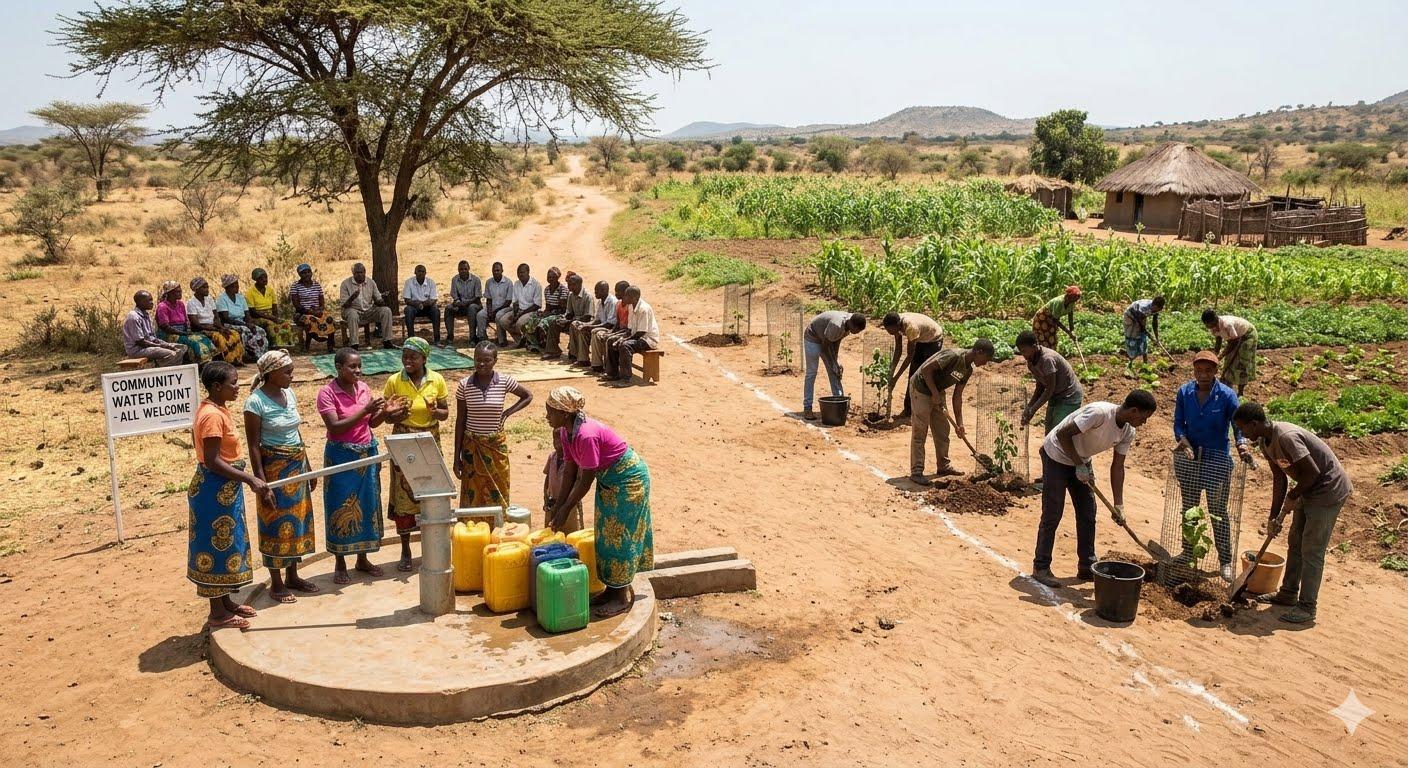
In her recommendations, she canvassed restoration of degraded land through planting of trees, grasses, shelterbelts and assisted natural regeneration, protection of water sources and invest in climate resilient water systems, support for climate smart farming, soil conservation and sustainable grazing management and provision of alternative energy and livelihoods to reduce pressure on trees and land.
Others are making public programmes transparent in such a way as to be community owned and inclusive of women and youths, encouraging communities to protect and nurture native tree stumps to regrow naturally, peacebuilding, early warning and fair resource governance, inclusion of women and affected communities in land, water and restoration decisions, as well as utilization of Utilize simple, traditional techniques that do not require expensive machinery.
On what is already being done, she said, “Nigeria is not starting from zero. Existing responses include the Great Green Wall, the National Agency for the Great Green Wall, shelterbelts and sand-dune stabilisation, Agro-Climatic Resilience in Semi-Arid Landscapes (ACReSAL’s) watershed and landscape restoration work, afforestation, community woodlots, climate resilient agriculture and livelihood support. The challenge is not only implementation, but scale, maintenance, transparency, community ownership and measurable impact.
“Desertification is a livelihood, food, water, peace and governance issue. Northern Nigerian communities need restoration, adaptation and fair resource management. Women, girls, youth, farmers, pastoralists and vulnerable groups must be part of solutions. Government action should be evidence based, transparent and sustained beyond ceremonies.
“Protecting land is protecting lives, food, peace and the future. Desertification is a livelihood story: jobs, food, income and survival choices. Desertification is a governance story: land use, budgets, services and accountability. It is a human a human-interest story because families are adapting under pressure and it a peace and development story in that it should involve cooperation, resilience and risk reduction,” she concluded.
Executive Director of Renevlyn Development Initiative (RDI), Philip Jakpor, whose presentation focused on The Place of The Media In Reporting Desertification, charged journalists to expose industry language of false solutions such as geoengineering –Ocean fertilization, Ocean Pump, Biomass, Biodiesel, Biofuel, Clean Development Mechanism (CDM), Carbon Markets, Carbon Credits, Emission Trading, REDD and Net Zero.
He insisted that fossil fuel companies including Shell, Chevron, Eni, Exxon Mobil, BP and TotalEnergies, among others in collaboration with the International Emission Trading Association (IETA) and agro industrial plantation companies such as Wilmar International Limited, IOI Group and Agropalma, among others should be held accountable for their infractions as they were behind the desertification, environmental challenges and the global climate change crisis.