
Knocks Trail Tinubu’s Re-election Manifesto
From recycled campaign pledges to worsening economic hardship, electricity crisis and insecurity, opposition parties challenge President Bola Tinubu to present his performance scorecard before asking Nigerians for another four years
By David Oladimeji
The unveiling of President Bola Tinubu’s 2027–2031 re-election manifesto has opened another front in Nigeria’s increasingly heated political contest, with opposition parties questioning the credibility of the administration’s promises and demanding explanations for commitments made during the 2023 presidential campaign. What the All Progressives Congress (APC) presents as a fresh roadmap from economic reforms to national prosperity has been dismissed by critics as a repackaging of old promises that have yet to translate into meaningful improvements in the lives of ordinary Nigerians.
President Tinubu has, once again, laced his re-election campaign with rhetorical promises. This time around, Tinubu has promised to improve electricity supply, create additional employment opportunities and reduce the cost of living if given another four-year mandate in the 2027 presidential election.
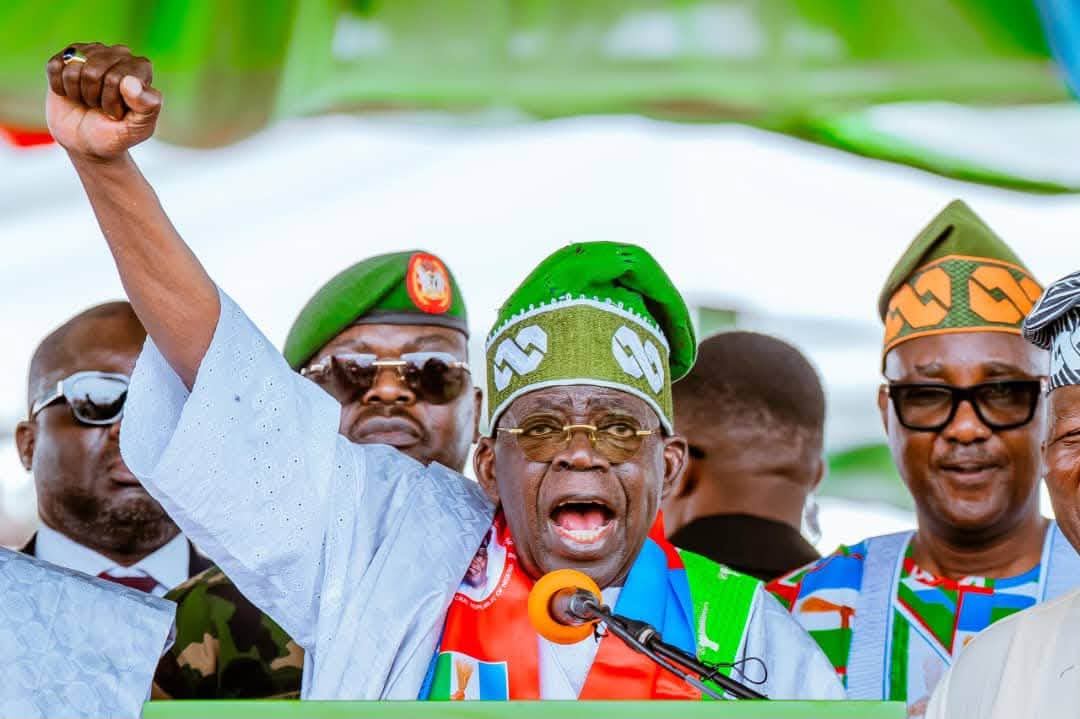
The President made the commitment last week while speaking at the APC presidential campaign rally held in Dutse, the Jigawa State capital.
Tinubu assured Nigerians that his administration would introduce and implement policies designed to strengthen the economy, improve living conditions and enhance the welfare of citizens.
He explained that his government would focus on developing the country’s industrial sector, supporting nano, micro, small and medium-sized enterprises (NMSMEs), and create more job opportunities for Nigerians.
The President also identified affordable living conditions and dependable electricity as key areas his administration would address if re-elected.
According to him, his government would take steps to address the challenges affecting electricity supply, insisting that Nigerians deserved a more reliable power system.
“We will lower the cost of living. We will provide reliable power, not the whole privatisation that is not working. We will provide you with reliable power in this Nigeria,” Tinubu said.
On economic policies, the President promised to maintain the removal of petrol subsidy, suggesting that his administration would continue with the economic reform measures introduced since assuming office in May 2023.
He also pledged to sustain government intervention programmes aimed at providing financial assistance and improving access to essential services for Nigerians.
Tinubu specifically mentioned the Nigerian Education Loan Fund (NELFUND), which provides financial support to eligible students pursuing higher education in the country.
The controversy surrounding the manifesto, titled “From Reforms to Prosperity Agenda 2027–2031”, is particularly significant because Tinubu is no longer an opposition politician campaigning on what he intends to do. He is an incumbent President seeking another mandate after more than three years in office. Consequently, critics argue that his next electoral proposition should begin with an honest assessment of his administration’s performance rather than another elaborate catalogue of promises.
The African Democratic Congress (ADC) has emerged among the most vocal critics of the document, describing it as a recycling of unfulfilled campaign commitments from 2023. In a statement signed by its National Publicity Secretary, Bolaji Abdullahi, the opposition party questioned why a government that has been in power since 2015, with Tinubu as President since May 2023, should be presenting Nigerians with promises it ought to have substantially delivered within its first term.
The ADC argued that the manifesto reads like the programme of a political party seeking power for the first time rather than that of an administration seeking re-election. It maintained that Nigerians should not be required to renew a President’s mandate before receiving the benefits of commitments made during his initial campaign. The party consequently demanded a comprehensive account of what Tinubu promised, what he delivered, what remained unfulfilled and the reasons behind the failures.
One of the issues highlighted by the ADC concerns the President’s promise to expand health insurance coverage to 40 per cent of Nigerians within two years. According to the opposition party, coverage remains significantly below that target, while the new manifesto has shifted the ambition towards 2031. It also questioned the administration’s one-million ICT jobs commitment, alleging that government figures indicate only about 15,000 jobs and opportunity pathways against the original target. These claims have intensified the debate over whether the new document represents policy continuity or postponed deadlines.
Electricity supply has also become a major flashpoint. The ADC recalled that Tinubu had publicly challenged Nigerians not to re-elect him if he failed to improve electricity supply. The party questioned the administration’s ability to promise more than 10,000 megawatts in its new agenda when the manifesto itself acknowledges average generation figures below the 4,500-megawatt level previously described by the APC as inadequate. For businesses, manufacturers and households spending heavily on alternative power, the electricity debate remains one of the most tangible tests of the administration’s promises.
The opposition party also raised questions about the administration’s mechanised agriculture programme, particularly the much-publicised importation of 2,000 tractors from Brazil. It demanded to know the extent to which the equipment had been deployed and the measurable impact on agricultural productivity. At a time when food affordability remains a major concern, critics have argued that agricultural announcements must be supported by evidence of increased production, improved distribution and reduced food prices rather than government publicity.
Beyond the ADC’s criticism, the Allied Peoples Movement (APM), whose presidential candidate is Oyo State Governor Seyi Makinde, has also challenged the APC’s manifesto. The Makinde-Daura Presidential Campaign Organisation accused the ruling party of appropriating ideas from Makinde’s political vision, alleging similarities between its proposals and the APM’s Reset Nigeria agenda. Its Director of Strategic Communications, Richard Ihediwa, described the alleged appropriation as an admission of the relevance of Makinde’s ideas. The APC has not, in the reports examined, been shown to have accepted the allegation. The controversy has nevertheless widened the debate over the originality and substance of the competing political programmes.
The APM’s criticism goes beyond the question of policy ownership. The campaign organisation argued that the APC’s projections were overly ambitious and questioned whether the administration possessed the capacity to implement the promises contained in the document. Its position reflects a broader opposition concern that Nigerian politics has become increasingly dominated by attractive policy declarations without sufficient attention to implementation, funding, institutional capacity and measurable outcomes.
Another criticism has come from the ADC Presidential Campaign Council, which separately condemned the President’s re-election campaign messages as divisive and lacking a credible performance scorecard. The council, through its Director of Media and Publicity, Kola Ologbondiyan, questioned the administration’s massive borrowings, the gains from petrol subsidy removal, persistent insecurity, hunger and the rising cost of living. It also criticised what it described as personal attacks against political opponents, arguing that the President should be explaining his record rather than engaging in political exchanges.
The ADC-PCC further challenged Tinubu over his electricity commitments and agricultural promises, while raising concerns about the state of democratic institutions and the independence of public institutions. In another intervention, the campaign council’s Director of Strategic Communication, Phrank Shaibu, accused APC operatives of distributing money and gifts at political gatherings to create an impression of popular support for the President. The council called on the Economic and Financial Crimes Commission (EFCC) and the Independent National Electoral Commission (INEC) to investigate the allegations.
However, the ruling APC has defended its manifesto as a continuation of reforms intended to move Nigeria towards sustainable prosperity. At the unveiling in Abuja, government officials maintained that the difficult economic decisions taken during Tinubu’s first term were necessary to address longstanding structural weaknesses. The administration’s position is that the next phase of governance will focus on translating economic reforms into tangible benefits for households, businesses and communities.
The APC’s new agenda contains ambitious targets, including six per cent annual economic growth, electricity generation exceeding 10,000 megawatts, at least $15 billion in annual non-oil exports, one million export-related jobs by 2030 and the development of 200,000 affordable homes. It also promised improvements in food security, healthcare coverage, education, infrastructure and national security.


