

Two organized labour unions, the Trade Union Congress (TUC) and the Nigeria Labour Congress (NLC), disagree on the N70,000 allowance which the Federal Government promises labour unions as transport relief package
By Patrick Ogboru
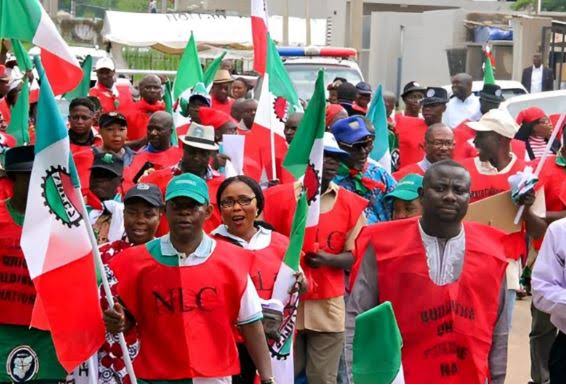
On Tuesday October 27, 2026, the Federal Government and the Nigeria Labour Congress (NLC) reached an agreement on a series of measures to ease the economic difficulties facing workers, including a ₦70,000 transport intervention and the payment of 19 months’ arrears owed health workers.
The agreements were sealed during a reconciliation meeting held at the Federal Ministry of Labour and Employment on the said day following an earlier meeting convened on October 22.
The meetings were necessary to address concerns raised by the NLC over the rising cost of living, the implementation of the National Minimum Wage, reduction in the fuel pump prices, workers’ welfare and outstanding allowances.
The agreement was signed on behalf of the Federal Government by Dr. Muhammad Maigari Dingyadi, Minister of Labour and Employment; Timi Yakubu, Director-General, Budget; and Dr. Garba Abdul S. U., Permanent Secretary (SWO), Office of the Head of the Civil Service of the Federation, while the NLC president, Joe Ajaero, and National Secretary, JNPSNC, Olowoyo Gbenga, stood for labour.
Under the agreement, the Federal Government would provide a transport intervention package of N70,000 across all levels for six months, beginning in November 2026.
The government also approved peculiar allowance with effect from May 1, 2026, while payment of the arrears is expected to begin in November and will be made in three equal monthly instalments.
In addition, the 19 months’ outstanding allowances owed health workers would be paid within three months, beginning in December 2026.
The meeting also agreed that the Minimum Wage Negotiation Committee would be constituted to commence work immediately.
However, the parties remained divided over the effective date for implementing the new minimum wage.
Barely one day after the Labour-Federal Government agreement, the Trade Union Congress of Nigeria (TUC), which represents senior workers union, rejected the proposed N70,000 monthly transport allowance for federal workers.
On its part, the Nigeria Union of Pensioners (NUP), condemned its exclusion from the transport allowance for workers, accusing the Federal Government and the leadership of NLC of abandoning retired workers who were battling the same punishing cost of living.
While rejecting the wage award, the TUC said the Federal Government had the capacity to raise the salary of the lowest-paid worker to N300,000 from the current minimum wage of N70,000, without waiting for a review of the minimum wage.
In a statement jointly signed by Festus Osifo and Nuhu Toro, President-General and Secretary respectively, the TUC said, in view of the prevailing economic hardship facing workers and the wider population, as well as the proposed measures to address it, what was needed was a salary increase and the implementation of the Joint Health Sector Union (JOHESU) Agreement.
In its statement, TUC said, “Our position is unequivocal, workers are not asking for favours, they are demanding social and economic justice that protects their dignity and livelihoods.
“The TUC will continue to defend workers’ rights without retreat, expose non-compliance and pursue every legitimate avenue to compel the government to honour its obligations.
“Workers’ welfare is not a privilege. Agreements must be honoured. Workers’ rights must be respected. Government must comply.
“The TUC rejects inadequate temporary relief and demands wage justice for all categories of workers, social protection, reduction of the cost of living for the vulnerable, and full compliance with agreements.
“The TUC, therefore, awaits the final outcome of the scheduled meeting with the government to decide on its next line of action.”
“The wage award agreed between the Federal Government and organised labour on October 2, 2023, was to be implemented until a new minimum wage was agreed in 2024, but it was never implemented holistically. Some workers are still being owed one or two months, while others never received the award at all.”
The trade union movement wondered why the government was returning to the same wage award that never benefited all workers.
‘’How can workers be expected to trust fresh promises when previous obligations remain outstanding,’’ it queried.
In reaction, the NLC condemned the action of TUC for rejecting the negotiated N70,000 transport allowance for workers, describing the relief as a significant intervention to cushion the effects of rising petrol prices and the escalating cost of living.
The NLC President, Ajaero, also challenged the TUC to negotiate better benefits for its members rather than criticise an agreement it did not participate in negotiating. In its own reaction, the Nigeria Employers’ Consultative Association (NECA), warned that the organised private-sector employers cannot be bound by minimum wage agreements reached between the Federal Government and organised labour without their participation and concurrence, insisting that employers must have an equal voice in the negotiation processes.
Ajaero maintained that the intervention could serve as a benchmark for further negotiations involving workers across different employment categories.
The NLC leader also warned that the six-month allowance must not expire without a new minimum wage arrangement that would reflect the prevailing economic realities.
He argued that future wage negotiations must consider rising transportation costs, food prices, housing and other necessities, adding that “We have to find a way out of it. It is not in favour of government to now stop paying and then there is no new minimum wage and there is nothing new”.